Tag: nuclear age

  • The Man in the TNT Vest

    This article was originally published at the Nuclear Risk website

    Imagine a man wearing a TNT vest were to come into the room and, before you could escape, managed to tell you that he wasn’t a suicide bomber. He didn’t have the button to set off the explosives. Rather, there were two buttons in very safe hands. One was with President Obama and the other was with President Medvedev, so there was nothing to worry about. You’d still get out of that room as fast as you can!

    Just because we can’t see the nuclear weapons controlled by those two buttons, why do we stay in this room? As we would if confronted by the man in the TNT vest, we need to be plotting a rapid escape. Instead, we have sat here complacently for roughly 50 years, trusting that because Earth’s explosive vest hasn’t yet gone off, it never will.

    Before society will look for an escape route, we have to overcome its mistaken belief that threatening to destroy the world is somehow risk free. Changing societal thinking is a huge task, but as with achieving the seemingly impossible goals of ending slavery and getting women the vote, the first step in correcting this misperception is for courageous individuals to speak the truth: The nuclear emperor has no clothes — except for that stupid vest!

    You have an advantage that the abolitionists and the suffragettes did not. You can propagate the needed message to all your friends merely by emailing them a link to this page http://nuclearrisk.org/email21.php, or whatever you think would be most effective. While communicating with friends may seem trivial compared to the immense task we face, as explained in the resource section below, at this early stage of the process it is the essential action. I hope you will consider doing that, so that Earth’s explosive vest can become but a distant nightmare to future generations.


    Illustration is ©2009 NewsArt.com

    Martin E. Hellman is a member of the National Academy of Engineering and Professor Emeritus at Stanford University. His current project applies risk analysis to nuclear deterrence, and is described in detail at NuclearRisk.org.
  • Nuclear Memories

    This article was originally published by the Federation of American Scientists.

    Dick DudaI was 9 years old in 1945 when the first atomic bomb was detonated above a city. I remember the radio news broadcasts about Hiroshima and Nagasaki, and how my parents reacted with amazement. I didn’t know what to think.

    I was 11 years old in 1947 when I watched a double feature in a darkened movie theater— a Roy Rogers western with Andy Devine, followed by what I thought was another adventure film, a docudrama on the Manhattan Project called “The Beginning or the End.” The Saturday afternoon audience, filled mainly by school kids, was unusually subdued. This wasn’t fantasy, this was real. I didn’t say anything, but I was troubled.

    I was 26 years old in 1962 when the U.S. and the Soviet Union walked right to the brink of thermonuclear war. I remember when the Soviet ships turned around and everyone took a collective deep breath. I felt like we really dodged a bullet that time.

    I was 50 years old in 1986 when Ronald Reagan and Mikhail Gorbachev met in Reykjavik, Iceland, and fumbled the greatest opportunity the world has ever had to rid nuclear weapons. Commentators assessed the summit as an ill-planned failure. I felt a deep sense of loss.

    I was 53 years old in 1989 when the Berlin Wall fell. I remember how people thought that the threat of nuclear war was over at last. No doubt about it – I felt euphoric!

    I was 65 years old in 2001 when terrorists flew two airplanes into the Twin Towers. Everyone said that the world had changed. I remember thinking, “What if it had been a nuclear bomb instead of just those planes?”

    I was 71 years old in 2007 when George Shultz, William Perry, Henry Kissinger and Sam Nunn published their celebrated Wall Street Journal Op-Ed, “A World Free of Nuclear Weapons.” I was surprised by how few people I knew were even aware of it. I thought that this could be a game changer, and I finally started to do something.

    During all those many years, I was well aware of all the effort to control the nuclear genie— the warnings by Bertrand Russell and Albert Einstein, the spearheading of the National Committee for a Sane Nuclear Policy (SANE) by Norman Cousins, the “Ban the Bomb” marches, the Nuclear Freeze movement.

    But I didn’t see how I could make a difference. And I was well aware of how quickly the progress toward nuclear disarmament faded with the end of the Cold War. The 1999 failure of the Senate to ratify the Comprehensive Test Ban Treaty exemplified a decade of ever-worsening developments. Now North Korea has the bomb and the Middle East threatens to become awash with nuclear weapons.

    For the past five years, I have worked locally to promote nuclear disarmament. I know that I am only one person. At age 76, I am keenly aware that fewer and fewer people I meet have actual memories of the bombing of Hiroshima and Nagasaki. I don’t know how long it will be before the last nuclear bomb is dismantled. But I will always remember the people who encouraged me to do my part to make a difference – to work to reduce the threat that these weapons still pose to my children, my grandchildren, and future generations everywhere around the world.

  • Book Review: Working for Peace and Justice: Memoirs of an Activist Intellectual

    Working for Peace and Justice: Memoirs of an Activist Intellectual by Lawrence S. Wittner


    Publisher:  University of Tennessee Press, Knoxville, TN


    Publication Date: February 2012, 288 pages


    Paperback Price: $29.95


    Working for Peace and Justice: Memoirs of an Activist Intellectual is a must read for all who are interested and involved in the search for peace, racial equality, and other aspects of social justice.  The book is a very well written autobiography by Lawrence S. Wittner, emeritus professor of history at the State University of New York-Albany.


    Born and raised in Brooklyn, New York,  Wittner graduated from Columbia College (B.A., 1962), the University of Wisconsin (M.A., 1963), and Columbia University (Ph.D. in history, 1967).  His teaching assignments were at Hampton Institute, Vassar College, the University of Toyko, and finally, SUNY/Albany from which he retired as a full professor in 2010.  His scholarship included authorship of eight books and the editing or co-editing of another four, plus the writing of over 250 published articles and book reviews.  His most challenging scholarly effort was the completion of a three book series The Struggle Against the Bomb on the history of the nuclear disarmament movement.  The books were:  One World or None: A History of the World Nuclear Disarmament Movement Through 1953Resisting the Bomb: A History of the World Nuclear Disarmament Movement, 1954-1970;  and Toward Nuclear Abolition: A History of the World Nuclear Disarmament Movement, 1971 to the Present.  An abbreviated version of the entire trilogy is also available as Confronting the Bomb: A Short History of the World Nuclear Disarmament Movement. Additionally, his Rebels Against War: The American Peace Movement, 1933-1983 is a widely acclaimed, comprehensive account of the missing link between the mass peace and justice movements of the 1930s and their rebirth in the 1960s with emphasis on civil rights, non-violent resistance and the prevention of World War III.


    During the course of his research, Wittner delved into the records and periodicals of many peace organizations like the War Resisters League, the Fellowship of Reconciliation, the Women’s International League for Peace and Freedom and SANE (now Peace Action). Among the prominent peace activists whom he interviewed for his publications were A.J. Muste, Norman Thomas, Dave Dellinger, and Mercedes  Randall.  During his research for the Struggle Against the Bomb series, he interviewed such well known peace movement leaders as Randy Forsberg, Sandy Gottlieb, Helen Caldicott, John Isaacs, Randy Kehler, Jeremy Stone, Bernard Lown, Bob Musil and Frank von Hippel.


    In addition to his research and teaching roles, Wittner was a tireless agitator and social activist.  A paragraph in the Preface of the book describes those activities:


    ” Over the course of my life, I … have been tear-gassed, threatened by police with drawn guns, charged by soldiers with fixed bayonets, spied upon by U.S. government intelligence agencies, and purged from my job for political reasons.  Although, in my opinion, I did nothing that merited this kind of treatment, it is certainly true that much of my behavior was quite unconventional.  Indeed throughout most of my life I worked diligently as a peace agitator, civil rights activist, socialist organizer, labor union militant, and subversive songwriter. My experiences ranged from challenging racism in the South, to building alliances with maquiladora workers in Mexico, to leading the annual antinuclear parade through the streets of Hiroshima.  Like Wendell Phillilps, the great abolitionist leader, I have been a consistent thorn in the side of complacency – at least I hope so.”


    Clearly Wittner paid a price for his agitation and activism.  While he had a very enviable and successful academic career, his road to success was not easy.  Most major U.S. universities require three primary duties of their tenured professors and those who are seeking tenure.  Those duties are research, teaching, and community service.  If there ever was a university professor who excelled in all three of those functions, it was Lawrence Wittner.  That fact, notwithstanding, he had a VERY rough road to promotion and success because of ultra conservative presidents, deans, departmental chairs, and dead-wood academic colleagues.  Several of those individuals threw sand into the gears of his work as researcher, teacher, and community service provider.  Inane university politics delayed his achievement of tenure,  and ensured that his pay was not usually commensurate with his voluminous work output.   Lesser individuals would have succumbed to such outlandish obstacles.  This was not the case with Lawrence Wittner.  His life was, and is, a life of caring, persistence and dedication to the cause of peace, social justice and human survival.  It is important that his life’s contributions and achievements be passed on to young and old alike.  Working for Peace and Justice is an excellent book for general audiences, peace activists, ethicists, students of peace studies, students of history, and social activists of every stripe. 

  • War Is Not Inevitable

    David KriegerThere have not always been wars; and there need not always be wars.  Before the onset of civilization, there may have been tribal skirmishes but there was not organized warfare between competing military forces. 


    It was not until agriculture allowed for societal specialization, hierarchy and the generation of a warrior class loyal to a military or political leader or social system that wars began in earnest.  Agriculture required defense of boundaries and crops.  Such defense required the specialization of a warrior class organized into military forces.  Such forces required organization and a willing youthful pool of potential soldiers.  But legitimate purposes of defense can also be turned to offensive uses.  Leaders throughout history have been adept at justifying aggressive war in terms of defense. 


    War is a byproduct of civilization, and it is made more likely by having distinct competing social entities, such as city-states or today’s nation-states.  In the 20th century, wars became global or nearly so.  In World War I, soldiers mostly slaughtered other soldiers.  In World War II, however, with the development of modern air warfare, cities and civilians became targets of warfare.  Some 20 million people were killed in WWI and some 50 million in WWII. 


    The technology of warfare has increased in sophistication and lethality.  WWII ended with the destruction of two unprotected Japanese cities, Hiroshima and Nagasaki, by two US atomic bombs, one dropped on each city.  This opened a new era, the Nuclear Age, in which it became possible to destroy civilization and complex life, including human life, on the planet.  By our own cleverness, we humans have created instruments capable of destroying ourselves.  The creation of nuclear weapons has made the world too dangerous for warfare. 


    Warfare requires a high level of social organization, but peace requires an even higher level of social organization.  The United Nations Charter prohibits the use of force between nations except under very limited conditions of self-defense or when the Security Council authorizes the use of force.  Of course, this prohibition against the use of force has not been very successful, largely because the major powers have relied upon the law of force rather than the force of law. 


    We have created a situation in which either warfare or humanity is obsolete.  We humans can choose.  We can choose to put an end to warfare, or we can continue to run the risk of warfare putting an end to us.  This is the way that Bertrand Russell and Albert Einstein put it in a 1955 statement calling for an end to warfare due to the power of thermonuclear weapons: “Here, then, is the problem which we present to you, stark and dreadful and inescapable: Shall we put an end to the human race; or shall mankind renounce war? People will not face this alternative because it is so difficult to abolish war.”


    But people must face this alternative.  Peace is an imperative of the Nuclear Age.  It is both a right and responsibility.  The sooner we realize this, the sooner we can get on with the necessary task of abolishing nuclear weapons and building a warless world.  In doing so, we will free up vast resources that can be used to achieve the UN Millennium Development Goals to end poverty, improve health, protect the environment and better the lives of people everywhere.


    Vaya aquí para la versión española.

  • El sexagésimo quinto aniversario de la Era Nuclear

    El 16 de julio de 1945 marcó el comienzo de la Era Nuclear. Ese día, Estados Unidos llevó a cabo la primera prueba de un artefacto atómico. La prueba fue nombrada Trinidad y se llevó a cabo en el campo de pruebas de Alamogordo, en el desierto Jornada del Muerto en Nuevo México. La bomba tuvo como nombre clave  “El Artefacto”.


    La prueba utilizó un dispositivo de implosión de plutonio, el mismo tipo de arma que se utilizaría en la ciudad de Nagasaki tan solo tres y media semanas después. Su fuerza explosiva fue de 20 kilotones de TNT.


    Los nombres asociados con la prueba merecen reflexión. “El Artefacto”, que indica algo simple e inocuo, se hizo estallar en un desierto llamado Jornada del Muerto. El plutonio, la fuerza explosiva de la bomba, fue nombrado por Plutón, el dios romano del mundo subterráneo. El isótopo de plutonio que se usó en la bomba, plutonio-239, es uno de los materiales radiactivos más mortales en el planeta. En la Tierra sólo existía en pequeñas cantidades antes de que EE.UU. comenzara a crearlo para su uso en las bombas por la fisión del uranio-238.


    No existe una explicación definitiva de por qué la prueba fue nombrada Trinidad, pero en general parece que se asocia con un concepto religioso de Dios. Los pensamientos de J. Robert Oppenheimer, director científico del proyecto creador de la bomba y quien dio nombre a la prueba, ofrecen algunas pistas.


    “No está claro por qué elegí el nombre, pero sé bien las ideas que rondaban por mi cabeza. Hay un poema de John Donne, escrito poco antes de su muerte, que yo conozco y amo. Esta es una cita de ese poema: «En Occidente y Oriente / en todos los mapas – yo soy uno- uno solo, / Y la muerte toca la resurrección.”   Eso aún no explica lo de la Trinidad, pero en otro poema, más conocido como devocionario, Donne dice, ‘Golpea mi corazón, tres personas en un Dios.”’


    La reacción de Oppenheimer al ser testigo de la explosión atómica nos hace recordar estas líneas de la escritura sagrada hinduista Bhagavad Gita.


    Si el resplandor de mil soles


    Estallaran de una vez en el cielo,


    Eso sería como el esplendor del Poderoso …


    Me he convertido en la Muerte,


    El destructor de mundos.


    ¿Oppenheimer pensó que ese día había muerto, o más bien, todos nosotros.? Desde luego que esa primera explosión nuclear presagiaba la posibilidad de que el mundo sería destrozado (¿por un “Poderoso”?), Muy pronto eso ocurriría en Hiroshima y Nagasaki.


    Muchas cosas han pasado en estos 65 años de la Era Nuclear. En Hiroshima y Nagasaki hemos visto la devastación que las armas nucleares inflingen sobre las ciudades y sus habitantes. Hemos sido testigos de una carrera armamentista verdaderamente absurda entre Estados Unidos y la antigua Unión Soviética, en la que el número de armas nucleares en el mundo aumentó a 70.000. Hemos aprendido que un arma nuclear puede destruir una ciudad, unas pocas armas nucleares pueden destruir un país, y una guerra nuclear podría destruir la civilización y la mayoría de las formas de vida en el planeta.


    Las armas nucleares han puesto en peligro la especie humana, y aún hoy existen más de 20.000 armas nucleares en el mundo. Nueve países ya poseen estas armas. La humanidad sigue jugando con el fuego del omnicidio – la muerte de todos. Todavía estamos esperando por los líderes que nos llevarán más allá de esta amenaza global hacia un futuro común. En lugar de seguir esperando, tenemos que convertirnos en líderes.


    En este 65 º aniversario del embarque en el camino de la muerte, debemos cambiar de rumbo y eludir el precipicio nuclear. Las armas son ilegales, inmorales, antidemocráticas e innecesarias militarmente. La manera más segura de ponerlas bajo control es mediante la negociación de un nuevo tratado, una Convención de Armas Nucleares, para que en forma transparente, progresiva, verificable e irreversible se logre la eliminación de las armas nucleares.


    Estados Unidos condujo al mundo a la era nuclear. El presidente Obama ha señalado que el país también tiene una responsabilidad moral para encontrar una salida. Esto se puede lograr, pero no con ciudadanos ignorantes, apáticos y en estado de negación. Sesenta y cinco años en el Camino de la Muerte es demasiado tiempo. Llegó el momento para que los ciudadanos despierten y se involucren en este tema como si su futuro dependiera de ello, y en realidad así es.


    La ferviente oración de los hibakusha, los supervivientes de Hiroshima y Nagasaki, es “¡Nunca más!” Ellos hablan para que su pasado no se convierta en nuestro futuro. Es algo en lo que cada uno de nosotros debe participar, tanto con voces y acciones para lograr un mundo libre de armas nucleares.

  • The Anniversary of the Nuclear Age

    The Anniversary of the Nuclear Age

    [fusion_builder_container type=”flex” hundred_percent=”no” hundred_percent_height=”no” min_height_medium=”” min_height_small=”” min_height=”” hundred_percent_height_scroll=”no” align_content=”stretch” flex_align_items=”flex-start” flex_justify_content=”flex-start” flex_wrap_medium=”” flex_wrap_small=”” flex_wrap=”wrap” flex_column_spacing=”” hundred_percent_height_center_content=”yes” equal_height_columns=”no” container_tag=”div” menu_anchor=”” hide_on_mobile=”small-visibility,medium-visibility,large-visibility” status=”published” publish_date=”” class=”” id=”” spacing_medium=”” margin_top_medium=”” margin_bottom_medium=”” spacing_small=”” margin_top_small=”” margin_bottom_small=”” margin_top=”” margin_bottom=”” padding_dimensions_medium=”” padding_top_medium=”” padding_right_medium=”” padding_bottom_medium=”” padding_left_medium=”” padding_dimensions_small=”” padding_top_small=”” padding_right_small=”” padding_bottom_small=”” padding_left_small=”” padding_top=”” padding_right=”” padding_bottom=”” padding_left=”” link_hover_color=”” link_color=”” border_sizes=”” border_sizes_top=”” border_sizes_right=”” border_sizes_bottom=”” border_sizes_left=”” border_color=”” border_style=”solid” border_radius_top_left=”” border_radius_top_right=”” border_radius_bottom_right=”” border_radius_bottom_left=”” box_shadow=”no” box_shadow_vertical=”” box_shadow_horizontal=”” box_shadow_blur=”0″ box_shadow_spread=”0″ box_shadow_color=”” box_shadow_style=”” z_index=”” overflow=”” background_color_medium=”” background_color_small=”” background_color=”” gradient_start_color=”” gradient_end_color=”” gradient_start_position=”0″ gradient_end_position=”100″ gradient_type=”linear” radial_direction=”center center” linear_angle=”180″ background_image_medium=”” background_image_small=”” background_image=”” skip_lazy_load=”” background_position_medium=”” background_position_small=”” background_position=”center center” background_repeat_medium=”” background_repeat_small=”” background_repeat=”no-repeat” background_size_medium=”” background_size_small=”” background_size=”” background_custom_size=”” background_custom_size_medium=”” background_custom_size_small=”” fade=”no” background_parallax=”none” enable_mobile=”no” parallax_speed=”0.3″ background_blend_mode_medium=”” background_blend_mode_small=”” background_blend_mode=”none” background_slider_images=”” background_slider_position=”” background_slider_skip_lazy_loading=”no” background_slider_loop=”yes” background_slider_pause_on_hover=”no” background_slider_slideshow_speed=”5000″ background_slider_animation=”fade” background_slider_direction=”up” background_slider_animation_speed=”800″ background_slider_blend_mode=”” video_mp4=”” video_webm=”” video_ogv=”” video_url=”” video_aspect_ratio=”16:9″ video_loop=”yes” video_mute=”yes” video_preview_image=”” pattern_bg=”none” pattern_custom_bg=”” pattern_bg_color=”” pattern_bg_style=”default” pattern_bg_opacity=”100″ pattern_bg_size=”” pattern_bg_blend_mode=”normal” mask_bg=”none” mask_custom_bg=”” mask_bg_color=”” mask_bg_accent_color=”” mask_bg_style=”default” mask_bg_opacity=”100″ mask_bg_transform=”left” mask_bg_blend_mode=”normal” render_logics=”” logics=”” absolute=”off” absolute_devices=”small,medium,large” sticky=”off” sticky_devices=”small-visibility,medium-visibility,large-visibility” sticky_background_color=”” sticky_height=”” sticky_offset=”” sticky_transition_offset=”0″ scroll_offset=”0″ animation_type=”” animation_direction=”left” animation_color=”” animation_speed=”0.3″ animation_delay=”0″ animation_offset=”” filter_hue=”0″ filter_saturation=”100″ filter_brightness=”100″ filter_contrast=”100″ filter_invert=”0″ filter_sepia=”0″ filter_opacity=”100″ filter_blur=”0″ filter_hue_hover=”0″ filter_saturation_hover=”100″ filter_brightness_hover=”100″ filter_contrast_hover=”100″ filter_invert_hover=”0″ filter_sepia_hover=”0″ filter_opacity_hover=”100″ filter_blur_hover=”0″][fusion_builder_row][fusion_builder_column type=”1_1″ layout=”1_1″ align_self=”auto” content_layout=”column” align_content=”flex-start” valign_content=”flex-start” content_wrap=”wrap” spacing=”” center_content=”no” column_tag=”div” link=”” target=”_self” link_description=”” min_height=”” hide_on_mobile=”small-visibility,medium-visibility,large-visibility” sticky_display=”normal,sticky” class=”” id=”” type_medium=”” type_small=”” flex_grow_medium=”” flex_grow_small=”” flex_grow=”” flex_shrink_medium=”” flex_shrink_small=”” flex_shrink=”” order_medium=”0″ order_small=”0″ dimension_spacing_medium=”” dimension_spacing_small=”” dimension_spacing=”” dimension_margin_medium=”” dimension_margin_small=”” margin_top=”” margin_bottom=”” padding_medium=”” padding_small=”” padding_top=”” padding_right=”” padding_bottom=”” padding_left=”” hover_type=”none” border_sizes=”” border_color_hover=”” border_color=”” border_style=”solid” border_radius=”” box_shadow=”no” dimension_box_shadow=”” box_shadow_blur=”0″ box_shadow_spread=”0″ box_shadow_color=”” box_shadow_style=”” z_index_hover=”” z_index=”” overflow=”” background_type=”single” background_color_medium=”” background_color_small=”” background_color_medium_hover=”” background_color_small_hover=”” background_color_hover=”” background_color=”” gradient_start_color=”” gradient_end_color=”” gradient_start_position=”0″ gradient_end_position=”100″ gradient_type=”linear” radial_direction=”center center” linear_angle=”180″ background_image_medium=”” background_image_small=”” background_image=”” background_image_id_medium=”” background_image_id_small=”” background_image_id=”” lazy_load=”none” skip_lazy_load=”” background_position_medium=”” background_position_small=”” background_position=”left top” background_repeat_medium=”” background_repeat_small=”” background_repeat=”no-repeat” background_size_medium=”” background_size_small=”” background_size=”” background_custom_size=”” background_custom_size_medium=”” background_custom_size_small=”” background_blend_mode_medium=”” background_blend_mode_small=”” background_blend_mode=”none” background_slider_images=”” background_slider_position=”” background_slider_skip_lazy_loading=”no” background_slider_loop=”yes” background_slider_pause_on_hover=”no” background_slider_slideshow_speed=”5000″ background_slider_animation=”fade” background_slider_direction=”up” background_slider_animation_speed=”800″ background_slider_blend_mode=”” render_logics=”” sticky=”off” sticky_devices=”small-visibility,medium-visibility,large-visibility” sticky_offset=”” absolute=”off” absolute_props=”” filter_type=”regular” filter_hover_element=”self” filter_hue=”0″ filter_saturation=”100″ filter_brightness=”100″ filter_contrast=”100″ filter_invert=”0″ filter_sepia=”0″ filter_opacity=”100″ filter_blur=”0″ filter_hue_hover=”0″ filter_saturation_hover=”100″ filter_brightness_hover=”100″ filter_contrast_hover=”100″ filter_invert_hover=”0″ filter_sepia_hover=”0″ filter_opacity_hover=”100″ filter_blur_hover=”0″ transform_type=”regular” transform_hover_element=”self” transform_scale_x=”1″ transform_scale_y=”1″ transform_translate_x=”0″ transform_translate_y=”0″ transform_rotate=”0″ transform_skew_x=”0″ transform_skew_y=”0″ transform_scale_x_hover=”1″ transform_scale_y_hover=”1″ transform_translate_x_hover=”0″ transform_translate_y_hover=”0″ transform_rotate_hover=”0″ transform_skew_x_hover=”0″ transform_skew_y_hover=”0″ transform_origin=”” transition_duration=”300″ transition_easing=”ease” transition_custom_easing=”” motion_effects=”” scroll_motion_devices=”small-visibility,medium-visibility,large-visibility” animation_type=”” animation_direction=”left” animation_color=”” animation_speed=”0.3″ animation_delay=”0″ animation_offset=”” last=”true” border_position=”all” first=”true”][fusion_text columns=”” column_min_width=”” column_spacing=”” rule_style=”” rule_size=”” rule_color=”” hue=”” saturation=”” lightness=”” alpha=”” content_alignment_medium=”” content_alignment_small=”” content_alignment=”” hide_on_mobile=”small-visibility,medium-visibility,large-visibility” sticky_display=”normal,sticky” class=”” id=”” margin_top=”” margin_right=”” margin_bottom=”” margin_left=”” fusion_font_family_text_font=”” fusion_font_variant_text_font=”” font_size=”” line_height=”” letter_spacing=”” text_transform=”” text_color=”” animation_type=”” animation_direction=”left” animation_color=”” animation_speed=”0.3″ animation_delay=”0″ animation_offset=”” logics=””]

    July 16, 1945 marked the beginning of the Nuclear Age. On that day, the United States conducted the first explosive test of an atomic device. The test was code-named Trinity and took place at the Alamogordo Test Range in New Mexico’s Jornada del Muerto Desert. The bomb itself was code-named “The Gadget.”

    The Trinity test used a plutonium implosion device, the same type of weapon that would be used on the city of Nagasaki just three and a half weeks later.  It had the explosive force of 20 kilotons of TNT.

    The names associated with the test deserve reflection. “The Gadget,” something so simple and innocuous, was exploded in a desert whose name in Spanish means “Journey of Death.”  Plutonium, the explosive force in the bomb, was named for Pluto, the Roman god of the underworld. The isotope of plutonium that was used in the bomb, plutonium-239, is one of the most deadly radioactive materials on the planet.  It existed only in minute quantities on Earth before the US began creating it for use in its bombs by the fissioning of uranium-238.

    There is no definitive explanation for why the test was named Trinity, but it generally seems most associated with a religious concept of God. The thoughts of J. Robert Oppenheimer, the scientific director of the project to create the bomb and the person who named the test, provide insights into the name:

    “Why I chose the name is not clear, but I know what thoughts were in my mind. There is a poem of John Donne, written just before his death, which I know and love. From it a quotation: ‘As West and East / In all flatt Maps—and I am one—are one, / So death doth touch the Resurrection.’ That still does not make a Trinity, but in another, better known devotional poem Donne opens, ‘Batter my heart, three person’d God.’”

    Oppenheimer’s reaction to witnessing the explosion of the atomic device was to recall these lines from the Bhagavad Gita:

    If the radiance of a thousand suns
    Were to burst at once into the sky,
    That would be like the splendor of the Mighty One…
    I am become Death,
    The shatterer of Worlds.

    Did Oppenheimer think that he had become death that day, or that all of us had?  Certainly that first nuclear explosion portended the possibility that worlds would be shattered (by a “Mighty One”?), as they were soon to be in Hiroshima and Nagasaki.

    This year marks the 65th anniversary of the Trinity test. We are now 65 years into the Nuclear Age.  At Hiroshima and Nagasaki we have seen the devastation that nuclear weapons can inflict on cities and their inhabitants. We have witnessed a truly mad arms race between the United States and the former Soviet Union, in which the number of nuclear weapons in the world rose to 70,000. We have learned that one nuclear weapon can destroy a city, a few nuclear weapons can destroy a country, and a nuclear war could destroy civilization and most of the complex life forms on the planet.

    Nuclear weapons have endangered the human species, and yet today there are still more than 20,000 nuclear weapons in the world. Nine countries now possess these weapons. Humanity is still playing with the fire of omnicide – the death of all. We are still waiting for the leaders who will take us beyond this overarching threat to our common future. Instead of continuing to wait, we must ourselves become these leaders.

    On this 65th anniversary of embarking on the Journey of Death, we must change course and move back from the nuclear precipice. The weapons are illegal, immoral, undemocratic and militarily unnecessary. The surest way to bring them under control is by negotiating a new treaty, a Nuclear Weapons Convention, for the phased, verifiable, irreversible and transparent elimination of nuclear weapons.

    The United States led the world into the Nuclear Age. President Obama has pointed out that the country also has a moral responsibility to lead the way out. This can be done, but not with a citizenry that is ignorant, apathetic and in denial. Sixty-five years on the Journey of Death is long enough. It is past time for citizens to awaken and become engaged in this issue as if their future depended upon it, as it does.

    The fervent prayer of the hibakusha, the survivors of Hiroshima and Nagasaki, is “Never Again!”  They speak out so that their past does not become our future. It is a prayer that each of us must join in answering, both with our voices and actions to achieve a world free of nuclear weapons.

    [/fusion_text][/fusion_builder_column][/fusion_builder_row][/fusion_builder_container]

  • Soaring, Cryptography and Nuclear Weapons

    Section 1: 99.9% Safe Maneuvers

    Let’s face it, nuclear weapons are the elephant in the room that no one likes to talk about. So let’s approach the issue from the less threatening perspective of the awesome picture below.
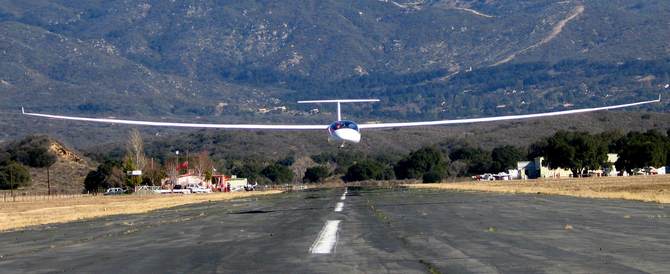
    Figure 1

    Figure 1: A glider executing a high speed low pass.

    The glider looks like it’s suspended above the runway, but in reality it’s screaming toward the photographer at 150 mph in a maneuver known as a high speed low pass. The pilot starts about 2000 feet high and a mile from the runway. He then dives to convert altitude into speed and skims the runway. Next, he does a steep climb to reconvert some of that speed into altitude so he can turn and land.

    Given that the glider has no engine, you might wonder how the pilot can be sure he’ll gain enough altitude in the climb to safely turn and land. The laws of physics tell us exactly how altitude is traded for speed and vice versa. While there is a loss due to the air resistance of the glider, that is a known quantity which the pilot takes it into account by starting from a higher altitude than needed for the landing phase.

    But it’s important to read the fine print in that guarantee provided by the laws of physics. It only applies if the air is stationary. If there’s a slight wind the difference is negligible, but if the air movement is unusually strong all bets are off – which is what happened to a friend of mine who had safely executed the maneuver many times before. But this time he hit an unusually strong, continuous downdraft. The laws of physics still applied, but the model of stationary air was no longer applicable and he had no way of knowing his predicament until he approached the runway with much less speed than needed for a safe landing. He managed to land without damage to himself or his glider, but was so shaken that he no longer does that maneuver.

    While most experienced glider pilots sometimes do low passes (and some race finishes require them), I’ve opted not to because I regard them as a 99.9% safe maneuver – which is not as safe as it sounds. A 99.9% safe maneuver is one you can execute safely 999 times out of a thousand, but one time in a thousand it can kill you.

    Even though they are clearly equivalent, one chance in a thousand of dying sounds a lot riskier than 99.9% safe. The perspective gets worse when it’s recognized that the fatality rate is one in a thousand per execution of the maneuver. If a pilot does a 99.9% safe maneuver 100 times, he stands roughly a 10% chance of being killed. Worse, the fear that he feels the first few times dissipates as he gains confidence in his skill. But that confidence is really complacency, which pilots know is our worst enemy.

    A similar situation exists with nuclear weapons. Many people point to the absence of global war since the dawn of the nuclear era as proof that these weapons ensure peace. The MX missile was even christened the Peacekeeper. Just as the laws of physics are used to ensure that a pilot executing a low pass will gain enough altitude to make a safe landing, a law of nuclear deterrence is invoked to quiet any concern over possibly killing billions of innocent people: Since World War III would mean the end of civilization, no one would dare start it. Each side is deterred from attacking the other by the prospect of certain destruction. That’s why our current strategy is called nuclear deterrence or mutually assured destruction (MAD).

    But again, it’s important to read the fine print. It is true that no one in his right mind would start a nuclear war, but when people are highly stressed they often behave irrationally and even seemingly rational decisions can lead to places that no one wants to visit. Neither Kennedy nor Khrushchev wanted to teeter on the edge of the nuclear abyss during the 1962 Cuban Missile Crisis, but that is exactly what they did. Less well known nuclear near misses occurred during the Berlin crisis of 1961, the Yom Kippur War of 1973 and NATO’s Able Archer exercise of 1983. In each of those episodes, the law of unintended consequences combined with the danger of irrational decision making under stress created an extremely hazardous situation.

    Because the last date for a nuclear near miss listed above was 1983, it might be hoped that the end of the Cold War removed the nuclear sword hanging over humanity’s head. Aside from the fact that other potential crises such as Taiwan were unaffected, a closer look shows that the Cold War, rather than ending, merely went into hibernation. In the West, the reawakening of this specter is usually attributed to resurgent Russian nationalism, but as in most disagreements the other side sees things very differently.

    The Russian perspective sees the United States behaving irresponsibly in recognizing Kosovo, in putting missiles (albeit defensive ones) in Eastern Europe, and in expanding NATO right up to the Russian border. For our current purposes, the last of these concerns is the most relevant because it involves reading the fine print – in this case, Article 5 of the NATO charter which states that an attack on any NATO member shall be regarded as an attack on them all. It is partly for that reason that a number of former Soviet republics and client states have been brought into NATO and that President Bush is pressing for Georgia and the Ukraine to be admitted. Once these nations are in NATO, the thinking goes, Russia would not dare try to subjugate them again since that would invite nuclear devastation by the United States, which would be treaty bound to come to the victim’s aid.

    But, just as the laws of physics depended on a model that was not always applicable during a glider’s low pass, the law of deterrence which seems to guarantee peace and stability is model-dependent. In the simplified model, an attack by Russia would be unprovoked. But what if Russia should feel provoked into an attack and a different perspective caused the West to see the attack as unprovoked?

    Just such a situation sparked the First World War. The assassination of Austria’s Archduke Ferdinand by a Serbian nationalist led Austria to demand that it be allowed to enter Serbian territory to deal with terrorist organizations. This demand was not unreasonable since interrogation of the captured assassins had shown complicity by the Serbian military and it was later determined that the head of Serbian military intelligence was a leader of the secret Black Hand terrorist society. Serbia saw things differently and rejected the demand. War between Austria and Serbia resulted, and alliance obligations similar to NATO’s Article 5 then produced a global conflict.

    When this article was first written in May 2008, little noticed coverage of a dispute between Russia and Georgia [Champion 2008] reported that “Both sides warned they were coming close to war.” As it is being revised, in August 2008, the conflict has escalated to front page news of a low-intensity, undeclared war. If President Bush is successful in his efforts to bring Georgia into NATO, and especially if the conflict should escalate further, we would face the unpleasant choice of reneging on our treaty obligations or threatening actions which risk the destruction of civilization. A similar risk exists between Russia and Estonia, which is already a NATO member.

    Returning temporarily to soaring, although I will not do low passes, I do not judge my fellow glider pilots who choose to do them. Rather, I encourage them to be keenly aware of the risk. The pilot in the photo has over 16,000 flight hours, has been doing low passes at air shows for over 30 years, will not do them in turbulent conditions, ensures that he has radio contact with a trusted spotter on the ground who is watching for traffic, and usually does them downwind so that he only has to do a “tear drop” turn to land. The fact that such an experienced pilot exercises that much caution says something about the risk of the maneuver. The danger isn’t so much in doing low passes as in becoming complacent if we’ve done them 100 times without incident.

    In the same way, I am not arguing against admitting Georgia to NATO or suggesting that Estonia should be kicked out. Rather, I encourage us to be keenly aware of the risk. If we do that, there is a much greater chance that we will find ways to lessen the true sources of the risk, including patching the rapidly fraying fabric of Russian-American relations. The danger isn’t so much in admitting former Soviet republics into NATO as in becoming complacent with our ability to militarily deter Russia from taking actions we do not favor.

    Section 2: Substates

    Part of society’s difficulty in envisioning the threat of nuclear war can be understood by considering Figure 2 below:
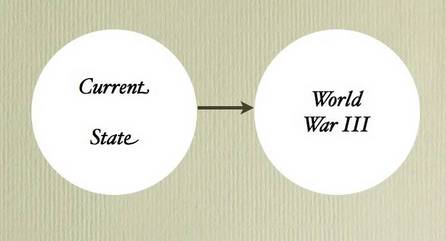
    Figure 2
    Figure 2. An overly simplified model

    The circle on the left represents the current state of the world, while the one on the right represents the world after a full-scale nuclear war. Because World War III is a state of no return, there is no path back to our current state. Even though an arrow is shown to indicate the possibility of a transition from our current state to one of global war, that path seems impossible to most people. How could we possibly transit from the current, relatively peaceful state of the world to World War III? The answer lies in recognizing that what is depicted as a single, current state of the world is much more complex. Because that single state encompasses all conditions short of World War III, as depicted below, it is really composed of a number of substates – world situations short of World War III, with varying degrees of risk:
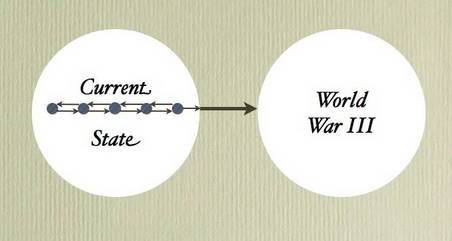
    Figure 3
    Figure 3. A more accurate model

    Society is partly correct in thinking that a transition from our current state to full-scale war is impossible because, most of the time, we occupy one of the substates far removed from World War III and which has little or no chance of transiting to that state of no return. But it is possible to move from our current substate to one slightly closer to the brink, and then to another closer yet. As described below, just such a sequence of steps led to the Cuban Missile Crisis and could lead to a modern day crisis of similar magnitude involving Estonia, Georgia, or other some other hot spot where we are ignoring the warning signs.

    The Cuban Missile Crisis surprised President Kennedy, his advisors, and most Americans because we viewed events from an American perspective and thereby missed warning signs visible from the Russian perspective. Fortunately, that view has been recorded by Fyodr Burlatsky, one of Khrushchev’s speechwriters and close advisors, as well as a man who was in the forefront of the Soviet reform movement. While all perspectives are limited, Burlatsky’s deserves our attention as a valuable window into a world we need to better understand:

    In my view the Berlin crisis [of 1961] was an overture to the Cuban Missile Crisis and in a way prompted Khrushchev to deploy Soviet missiles in Cuba. … In his eyes [America insisting on getting its way on certain issues] was not only an example of Americans’ traditional strongarm policy, but also an underestimation of Soviet might. … Khrushchev was infuriated by the Americans’ … continuing to behave as if the Soviet Union was still trailing far behind. … They failed to realize that the Soviet Union had accumulated huge stocks [of nuclear weapons] for a devastating retaliatory strike and that the whole concept of American superiority had largely lost its meaning. … Khrushchev thought that some powerful demonstration of Soviet might was needed. … Berlin was the first trial of strength, but it failed to produce the desired result, [showing America that the Soviet Union was its equal] . [Burlatsky 1991, page 164]

    [In 1959 Fidel Castro came to power and the U.S.] was hostile towards the Cuban revolutionaries’ victory from the very start. … At that time Castro was neither a Communist nor a Marxist. It was the Americans themselves who pushed him in the direction of the Soviet Union. He needed economic and political support and help with weapons, and he found all three in Moscow. [Burlatsky 1991, page 169]

    In April 1961 the Americans supported a raid by Cuban emigrees … The Bay of Pigs defeat strained anti-Cuban feelings in America to the limit. Calls were made in Congress and in the press for a direct invasion of Cuba. … In August 1962 an agreement was signed [with Moscow] on arms deliveries to Cuba. Cuba was preparing for self-defense in the event of a new invasion. [Burlatsky 1991, page 170]

    The idea of deploying the missiles came from Khrushchev himself. … Khrushchev and [Soviet Defense Minister] R. Malinovsky … were strolling along the Black Sea coast. Malinovsky pointed out to sea and said that on the other shore in Turkey there was an American nuclear missile base [which had been recently deployed]. In a matter of six or seven minutes missiles launched from that base could devastate major centres in the Ukraine and southern Russia. … Khrushchev asked Malinovsky why the Soviet Union should not have the right to do the same as America. Why, for example, should it not deploy missiles in Cuba? [Burlatsky 1991, page 171]

    In spite of the similarity between the Cuban and Turkish missiles, Khrushchev realized that America would find this deployment unacceptable and therefore did so secretly, disguising the missiles and expecting to confront the U.S. with a fait accompli. Once the missiles were operational, America could not attack them or Cuba without inviting a horrific nuclear retaliation. (The Turkish missiles had a similar purpose from an American point of view.) However, Khrushchev did not adequately envision what might happen if, as did occur, he was caught in the act.

    With respect to the Cuban Missile Crisis, the substates of Figure 3 which brought us to the brink of nuclear war can now be identified as:

    • conflict between America and Castro’s Cuba;
    • Russia demanding to be treated as a military equal and being denied this status;
    • the Berlin Crisis;
    • the Bay of Pigs invasion;
    • the American deployment of IRBM’s in Turkey; and
    • Khrushchev’s deployment of IRBM’s in Cuba

    The actors involved in each step did not perceive their behavior as overly risky. But compounded and viewed from their opponent’s perspective, those steps brought the world to the brink of disaster. During the crisis, there were additional, fortunately unvisited substates that would have made World War III even more likely. As just one example, the strong pressure noted by Burlatsky to correct the Bay of Pigs fiasco and remove Castro with a powerful American invasion force intensified after the Cuban missiles were discovered. But those arguing in favor of invasion were ignorant of the fact – not learned in the West until many years later – that the Russians had battlefield nuclear weapons on Cuba and came close to authorizing their commander on the island to use them without further approval from Moscow in the event of an American invasion.

    Section 3: Risk Analysis

    I have been concerned with averting nuclear war for over twenty-five years, but an extraordinary new approach only occurred to me last year: using quantitative risk analysis to estimate the probability of nuclear deterrence failing. This approach is a bit like Superman disguised as mild-mannered Clark Kent but, before I can explain why it is extraordinary, we need to explore what it is and overcome a key mental block that helps explain why no one previously had thought of applying this valuable technique.

    To understand this mental block, imagine someone gives us a trick coin, weighted so heads and tails are not equally likely, and we need to estimate the chance of its showing heads when tossed. What do we learn if we toss the coin fifty times and it comes up tails every time? Statistical analysis says we can be moderately confident (95% to be precise) that the chance of heads is somewhere between zero and 6% per toss, but that leaves way too much uncertainty.

    Thinking of the fifty years that deterrence has worked without a failure as the fifty tosses of the the coin, we are moderately confident that the chance of nuclear war is somewhere between zero and 6% per year. But there is a big difference between one chance in a billion per year and 6% per year, both of which are in that range. At one chance in a billion per year, a few more years of business as usual would be an acceptable risk. But 6% corresponds to roughly one in 16 odds, in which case our current nuclear strategy would be the equivalent of playing nuclear roulette – a global version of Russian roulette – once each year with a 16 chambered revolver.

    Just as the overly simplified two-state model of Figure 2 hides the danger of a nuclear war, the coin analogy hides the possibility of teasing much more information from the historical record – the two-sided coin corresponding to Figure 2’s two states. Breaking down one large state of Figure 2 into Figure 3’s smaller substates illuminated the danger hidden in the two state model. In the same way, risk analysis breaks down a catastrophic failure of nuclear deterrence into a sequence of smaller failures, many of which have occurred and whose probabilities can therefore be estimated.

    Modern risk analysis techniques first came to prominence with concerns about the safety of nuclear reactors, and in particular with the 1975 Rasmussen Report produced for the Nuclear Regulatory Commission. In Risk-Benefit Analysis, Wilson and Crouch note “[The Rasmussen report] used event tree analysis … This new approach originally had detractors, and indeed the failure … to use it may have contributed to the occurrence of the Three Mile Island Accident. If the event tree procedure … had been applied to [the reactor design used at Three Mile Island] … probably the Three Mile Island incident could have been averted.” [Wilson and Crouch 2001, pp. 172-173]

    An event tree starts with an initiating event that stresses the system. For a nuclear reactor, an initiating event could be the failure of a cooling pump. Unlike the catastrophic failure which has never occurred (assuming we are analyzing a design different from Chernobyl’s), such initiating events occur frequently enough that their rate of occurrence can be estimated directly. The event tree then has several branches at which the initiating event can be contained with less than catastrophic consequences, for example by activating a backup cooling system. But if a failure occurs at every one of the branches (e.g., all backup cooling systems fail), then the reactor fails catastrophically. Probabilities are estimated for each branch in the event tree and the probability of a catastrophic failure is obtained as the product of the individual failure probabilities.

    Applying risk analysis to the catastrophic failure of nuclear deterrence, a perceived threat by either side is an example of an initiating event. If either side exercises adequate caution in its responses, such an initiating event can be contained and the crisis dies out. But the event tree consisting of move and counter-move can fail catastrophically and result in World War III if neither side is willing to back down from the nuclear abyss, as almost happened with the 1962 Cuban crisis. Each branch or partial failure corresponds to moving one or more substates toward disaster in Figure 3.

    Because nuclear deterrence has never completely failed, the probability assigned to the last branch in the event tree (the final transition in Figure 3) will involve subjectivity and have more uncertainty. Confidence in the final result can be increased by incorporating a number of expert opinions and using a range instead of a single number for that probability, as well as providing justifications for the different opinions.

    The Cuban Missile Crisis provides a good example of how to estimate that final probability. President Kennedy estimated the odds of the crisis going nuclear as “somewhere between one-in-three and even.” His Secretary of Defense, Robert McNamara, wrote that he didn’t expect to live out the week, supporting an estimate similar to Kennedy’s. At the other extreme McGeorge Bundy, who was one of Kennedy’s advisors during the crisis, estimated those odds at 1%.

    In a recently published preliminary risk analysis of nuclear deterrence [Hellman 2008] I used a range of 10% to 50%. I discounted Bundy’s 1% estimate because invading Cuba was a frequently considered option, yet no Americans were aware of the Russian battlefield nuclear weapons which would have been used with high probability in that event. As an example of faulty reasoning due to this lack of information, Douglas Dillon, another member of Kennedy’s advisory group, wrote, “military operations looked like they were becoming increasingly necessary. … The pressure was getting too great. … Personally, I disliked the idea of an invasion [of Cuba] … Nevertheless, the stakes were so high that we thought we might just have to go ahead. Not all of us had detailed information about what would have followed, but we didn’t think there was any real risk of a nuclear exchange.” [Blight & Welch 1989, page 72]

    The sequence of steps previously listed as leading up to the Cuban Missile Crisis is an example of an event tree that nearly led to a catastrophic failure, and reexamining those steps in the light of similar current events will show that, contrary to public opinion which sees the threat of nuclear war as a ghost of the past, the danger is lurking in the shadows, waiting until once again it can surprise us by suddenly leaping into clear view as it did in 1962:

    Step #1: conflict between America and Castro’s Cuba:

    The current conflicts between Russia and a number of former Soviet client states are similar. For example, as noted earlier, President Bush is pushing for Georgia to become a NATO member even though Russia and Georgia just fought an undeclared war over still unresolved issues

    Step #2: Russia demanding to be treated as a military equal and being denied this status:

    The same is true today. Even though Russia has 15,000 nuclear weapons, America sees itself as the sole remaining superpower, leading even Mikhail Gorbachev to say recently, “there is just one thing that Russia will not accept … the position of a kid brother, the position of a person who does what someone tells it to do.” [Tatsis 2008] Repeated American statements that we defeated Russia in the Cold War add fuel to that fire since the Russians feel they were equal participants in ending that conflict.

    Steps #3 and #4: The Berlin Crisis and the Bay of Pigs invasion:

    Several potential crises are brewing (e.g., Chechnya, Georgia, Estonia, and Venezuela) which have similar potential.

    Step #5: The American deployment of IRBM’s in Turkey:

    A missile defense system we are planning for Eastern Europe bears an ominous similarity to those Turkish missiles. While these new missiles are seen as defensive and a non-issue in America, the Russians see them as offensive and part of an American military encirclement. In October 2007, Putin warned, “Similar actions by the Soviet Union, when it put rockets in Cuba, precipitated the Cuban Missile Crisis.” [Putin 2007] Two months later Gorbachev questioned America’s stated goal of countering a possible Iranian missile threat, “What kind of Iran threat do you see? This is a system that is being created against Russia.” [Gorbachev 2007]

    Step #6: Khrushchev’s deployment of the Cuban missiles:

    While there is not yet a modern day analog of this step, serious warning tremors have occurred. In July 2008 Izvestia, a Russian newspaper often used for strategic governmental leaks, reported that if we proceed with our Eastern European missile defense deployment then nuclear-armed Russian bombers could be based on Cuba [Finn 2008]. During Senate confirmation hearings as Air Force Chief of Staff, General Norton Schwartz countered that “we should stand strong and indicate that is something that crosses a threshold, crosses a red line.” [Morgan 2008] While the Russian Foreign Ministry later dismissed Izvestia’s reports as false [Rodriguez 2008], there is a dangerous resemblance to events which led to the Cuban Missile Crisis.

    The fact that we are not yet staring at the nuclear abyss is little cause for comfort. In terms of the sequence of events that turn a 99.9% safe maneuver into a fatal accident, we are already at a dangerous point in the process and, as in soaring, need to recognize complacency as our true enemy.

    Section 4: How Risky Are Nuclear Weapons?

    Even minor changes in our nuclear weapons posture have been rejected as too risky even though the baseline risk of our current strategy had never been estimated. Soon after recognizing this gaping hole in our knowledge, I did a preliminary risk analysis [Hellman 2008] which indicates that relying on nuclear weapons for our security is thousands of times more dangerous than having a nuclear power plant built next to your home.

    Equivalently, imagine two nuclear power plants being built on each side of your home. That’s all we can fit next to you, so now imagine a ring of four plants built around the first two, then another larger ring around that, and another and another until there are thousands of nuclear reactors surrounding you. That is the level of risk that my preliminary analysis indicates each of us faces from a failure of nuclear deterrence.

    While the analysis that led to that conclusion involves more math than is appropriate here, an intuitive approach conveys the main idea. In science and engineering, when trying to estimate quantities which are not well known, we often use “order of magnitude” estimates. We only estimate the quantity to the nearest power of ten, for example 100 or 1,000, without worrying about more precise values such as 200, which would be rounded to 100.

    In this intuitive approach I first ask people whether they think the world could survive 1,000 years that were similar to 20 repetitions of the last 50 years. Do they think we could survive 20 Cuban Missile Crises plus all the other nuclear near misses we have experienced? When asked that question, most people do not believe we could survive 1,000 such years. I then ask if they think we can survive another 10 years of business as usual, and most say we probably can. There’s no guarantee, but we’ve made it through 50 years, so the odds are good that we can make it through 10 more. In the order of magnitude approach, we have now bounded the time horizon for a failure of nuclear deterrence as being greater than 10 years and less than 1,000. That leaves 100 years as the only power of ten in between. Most people thus estimate that we can survive on the order of 100 years, which implies a failure rate of roughly 1% per year.

    On an annual basis, that makes relying on nuclear weapons a 99% safe maneuver. As with 99.9% safe maneuvers in soaring, that is not as safe as it sounds and is no cause for complacency. If we continue to rely on a strategy with a one percent failure rate per year, that adds up to about 10% in a decade and almost certain destruction within my grandchildren’s lifetimes. Because the estimate was only accurate to an order of magnitude, the actual risk could be as much as three times greater or smaller. But even ⅓% per year adds up to roughly a 25% fatality rate for a child born today, and 3% per year would, with high probability, consign that child to an early, nuclear death.

    Given the catastrophic consequences of a failure of nuclear deterrence, the usual standards for industrial safety would require the time horizon for a failure to be well over a million years before the risk might be acceptable. Even a 100,000 year time horizon would entail as much risk as a skydiving jump every year, but with the whole world in the parachute harness. And a 100 year time horizon is equivalent to making three parachute jumps a day, every day, with the whole world at risk.

    While my preliminary analysis and the above described intuitive approach provide significant evidence that business as usual entails far too much risk, in-depth risk analyses are needed to correct or confirm those indications. A statement endorsed by the following notable individuals:

    • Prof. Kenneth Arrow, Stanford University, 1972 Nobel Laureate in Economics
    • Mr. D. James Bidzos, Chairman of the Board and Interim CEO, VeriSign Inc.
    • Dr. Richard Garwin, IBM Fellow Emeritus, former member President’s Science Advisory Committee and Defense Science Board
    • Adm. Bobby R. Inman, USN (Ret.), University of Texas at Austin, former Director National Security Agency and Deputy Director CIA
    • Prof. William Kays, former Dean of Engineering, Stanford University
    • Prof. Donald Kennedy, President Emeritus of Stanford University, former head of FDA
    • Prof. Martin Perl, Stanford University, 1995 Nobel Laureate in Physics

    therefore “urgently petitions the international scientific community to undertake in-depth risk analyses of nuclear deterrence and, if the results so indicate, to raise an alarm alerting society to the unacceptable risk it faces as well as initiating a second phase effort to identify potential solutions.” [Hellman 2008]

    This second phase effort will be aided by the initial studies because, in addition to estimating the risk of a failure of nuclear deterrence, they will identify the most likely trigger mechanisms, thereby allowing attention to be directed where it is most needed. For example, if as seems likely, a nuclear terrorist incident is found to be a likely trigger mechanism for a full-scale nuclear war, then much needed attention would be directed to averting that smaller, but still catastrophic event.

    While definitive statements about the risk we face must await the results of the proposed in-depth studies, for ease of exposition the remainder of this article assumes the conclusion reached by my preliminary study – that the risk is far too great and urgently needs to be reduced.

    Section 5: The Positive Possibility

    In the mid 1970’s Whit Diffie, Ralph Merkle and I invented public key cryptography, a technology that now secures the Internet and has won the three of us many honors. Yet, when we first conceived the idea many experts told us that we could not succeed. Their skepticism was understandable because a public key flew in the face of the accumulated wisdom of hundreds of years of cryptographic knowledge: How could the key be public if its secrecy was all that kept an opponent from reading my mail? What was missed is that “the key” might become “two keys,” a public key for enciphering and a secret key for deciphering. Everyone could encipher messages using my public key, but only I could understand them by deciphering with my secret key.

    Just as many cryptographic experts thought we couldn’t split the key and used arguments based on years of accumulated wisdom that were not applicable to the new possibility, most people have difficulty envisioning a world in which the nuclear threat is a relic of the past. While there is no guarantee that a similar breakthrough exists for ending the threat posed by nuclear weapons, this section provides evidence that our chances for survival are greater than we think.

    First Figure 3 must be modified by adding a third state in which the risk of nuclear catastrophe has been reduced thousands of times from its present level, so that it is at an acceptable level.
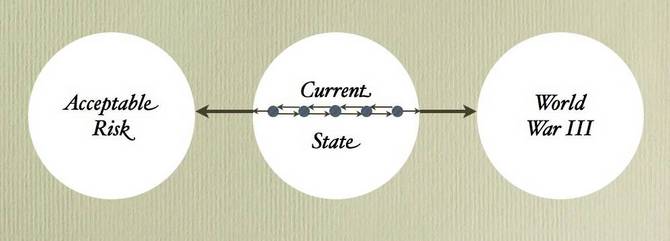
    Figure 4
    Figure 4. Adding hope to the model

    For the risk to truly be acceptable, this new state also must be a state of no return – its risk would not be acceptable if the world could transition back to our current state with its unacceptable risk. In this new figure, our current substate is near the middle of the current state of the world. We are not close to World War III, but neither are we close to an acceptable level of risk.

    Much as people had difficulty envisioning public key cryptography before we developed a workable system, they also have difficulty envisioning a world that is far better than what they have experienced in the past. The evolution of the movement to abolish slavery in the United States provides a good illustration of that difficulty. In 1787 slavery was written into our Constitution. In 1835 a Boston mob attacked the abolitionist William Lloyd Garrison and dragged him half naked through the streets. In Illinois in 1837 a mob killed another abolitionist, Elijah Lovejoy. The next year, a Philadelphia mob burned the building where an antislavery convention was held [Goldsmith 1998, pages 11, 29]. In that environment or substate, few people could envision the end of slavery within thirty years, much less that citizens of Massachusetts, Illinois and Pennsylvania would give their lives to help bring about that noble goal.
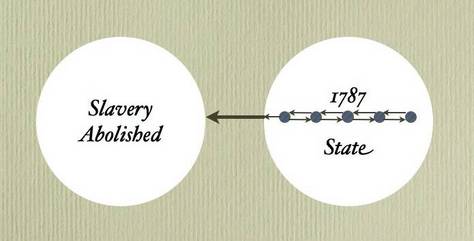
    Figure 5
    Figure 5. Substates leading to a positive end state

    While it was almost impossible to envision in 1787 – or even in the 1830’s – we now know that, as depicted in Figure 5 above, there was a sequence of substates that led to a new state in which slavery not only was abolished, but had no possibility of returning. The anti-abolitionist riots of the 1830’s – probably seen by most at that time as evidence of the insurmountable barriers to ending slavery – were actually a sign that a new substate had been reached and change was beginning to occur. There were no such riots in 1787 because the abolitionist movement was almost non-existent. By the 1830’s abolition was beginning to be seen as a serious threat to the supporters of slavery, resulting in the riots.

    History shows that people have tremendous difficulty envisioning both negative and positive possibilities that are vastly different from their current experience. Therefore, even if I had a crystal ball and could predict the sequence of substates (steps) that will take us to the state of acceptable risk depicted in Figure 4, very few would believe me. As an example of the difficulty imagine the reaction if someone, prior to Gorbachev’s coming to power, had predicted that a leader of the Soviet Union would lift censorship, encourage free debate, and not use military force to prevent republics from seceding from the union. At best, such a seer would have been seen as extremely naive.

    I had a milder version of that problem in September 1984 when I started a project designed to foster a meaningful dialog between the American and Soviet scientific communities in an attempt to defuse the threat of nuclear war, which was then in sharp focus. I was aware of the limitations that Soviet censorship imposed, but believed there still was some opportunity for information flow, primarily unidirectional. It had been eight years since my last trip to the Soviet Union and this visit was an eye-opening experience. While I did not know it at the time, I was meeting with people who were in the forefront of the nascent reform movement which would bring Gorbachev to power six months later, with some of them directly advising him.

    Censorship was still the law of the land, so the scientists with whom I met could not agree with those of my views that contradicted the party line. But neither did they argue. I sensed something very different was brewing, but on returning to the U.S. I was often seen as extremely naive for believing that meaningful conversations were possible with persons of any standing within the Soviet system.

    The steps leading to a truly safe world in Figure 4 would sound similarly naive to most people today. It is therefore counterproductive to lay out too explicit a road map to that goal. But how can one garner support without an explicit plan for reaching the goal? Until I realized the applicability of risk analysis, I didn’t see how that could be accomplished, but risk analysis provides an implicit, rather than an explicit map. No single step can reduce the risk a thousand-fold, so if the risk analysis approach can be embedded in society’s consciousness, then one step after another will have to be taken until a state with acceptable risk is reached. Later steps, which today would be rejected as impossible (which they probably currently are) need not be spelled out, but are latent, waiting to be discovered as part of that process.

    The first critical step therefore is for society to recognize the risk inherent in nuclear deterrence. If you agree, please share this article – or whatever approach you favor – with others. Email is particularly effective since friends who agree can then relay your message to others. This article, a sample email, and other tools can be found on the resource page at NuclearRisk.org. “Just talking” might not seem to accomplish much, but as graphically depicted in Figure 4 and as noted by the ancient Chinese sage Lao Tzu, “The journey of a thousand miles starts with a single step.” If you have not already done so, I hope you will take the first step.

    References

    This article was originally published at NuclearRisk.org

    Martin Hellman is a co-inventor of public key cryptography, the technology that secures communication of credit card and other sensitive information over the Internet. He has worked for over twenty-five years to reduce the threat posed by nuclear weapons and his current project is described at NuclearRisk.org. He is a glider pilot with over 2,600 hours in the air.

  • The Deja Vu of the Cold War

    Historically as a fact and as a chapter in Encyclopedias, the so-called Cold War drew to a close in the last years of the 80’s and the early 90’s.

    To celebrate that epic event, bells were rung, walls were destroyed, books and poems were written, movies were made to announce the beginning of a “new peace era”. Basically, two decades have passed and in the last years, mostly during the present Bush administration, the key elements for the bellicose situation have been revived.

    We are entering into a new nuclear arms race. The sword has been pulled out of the old armoire. The rhetoric of the perennial accusations resounds one more time. “You are the one”, “No, you are the one”. The conditions to deteriorate even more the precarious peace are popping up all over.

    In the most recent events, Mr. Vladimir Putin, the now Prime Minister of Russia accused the US government of orchestrating the rebellion in Georgia for political gains during the US Presidential campaign. For many, these remarks are simply untrue, for others, it is possible. Once again the world starts to be divided into two fronts.

    What is it in human nature that lures us so often and so rapidly to jump from one conflict to the next? Is peace simply a pause between two wars? Is there a real possibility to live in concord?

    What are we teaching our children, when they read the History of Humankind, and they only see wars as the most important events? The military is the most heroic status in society. It is “so cool” to see the parade of war paraphernalia; soldiers, missiles, airplanes, nuclear bombs.

    If you oppose that way of thinking you will be labeled a pacifist. And in the political lexicon that means you are an appeaser. In the era of Rambo and Terminator that is not fashionable.

    As long as we continue piling the nuclear arsenals the world will be playing Russian roulette. Minor quarrels could become major conflicts and will threaten the use of the ultimate weapons of mass destruction.

    We need to convince our governments, those with Nuclear weapons to get rid of the Armageddon weaponry forever. But first, we need to convince ourselves that the elimination of nuclear weapons is not just a dream.

    More than ever we must unite forces, to put to work the best minds looking for real and permanent solutions, not only bandages for deep open wounds.

    The Appeal to the next US President is a powerful tool. Let’s work together and collect all the signatures we can. Let’s flood Washington with names from all over the world.

    Ruben Arvizu is Director for Latin America for the Nuclear Age Peace Foundation (www.wagingpeace.org). He is coordinating the Appeal to the Next US President campaign in Latin America.

  • Saving Humanity from the Fiery Threat of Nuclear Annihilation, Through the Power of Women

    In my youth, I wrote stories about the possible destruction of the beautiful planet on which I lived, deceiving readers into thinking that I was an embittered old man. I leaped into the future as far as I could see, and I saw creatures coming from other worlds with the weapons to destroy the world around me. I was haunted by the screams of my father, who had to kill other men in hand-to-hand combat in the global war that ranged from 1914 to 1918.

    In 1943, I was drafted into the American army to stop Hitler and his murderous followers from conquering Europe. I was trained to shoot and stab other men, just as my father had been trained in his generation. I was selected as a war correspondent to write about the atrocities suffered by other men in bloody battles where they had lost their arms and legs, and sometimes their brains and testicles. I lived through glorious days after I came home unwounded, but I had to face the grim realities created by scientists who had acted on the wild possibilities I had envisioned in my science fiction stories.

    In 1932, I had published a story titled “Red April 1965” about a nuclear war between the United States and the Soviet Union—and I was confronted early in April of 1965 by a madman who rushed into my office screaming about the imminent occurrence of such a war on the very date when I had predicted it. The war did not happen then, but I still had a deep fear that atomic bombs would destroy our civilization.

    In 1948, I wrote speeches for President Harry Truman, who had used nuclear weapons on Japan to save the lives of thousands of civilians and end the Second World War as quickly as possible. After his action, the world embarked on a nuclear arms race, which has continued for many years. Life on earth is under the fiery threat of annihilation.

    In 1982, David Krieger asked me to join him in founding the Nuclear Age Peace Foundation, a nonprofit educational organization, which has become a voice of conscience for the community, the nation, and the world. Its message is that nuclear weapons threaten the future of all life on our planet, and that it is the responsibility of all of us, working together, to end this threat forever. Nuclear weapons were created by humans, and they must be abolished by us. Peace in a world free of nuclear weapons is everyone’s birthright. It is the greatest challenge of our time to restore that birthright to our children and all future generations.

    In 1983, I was invited to go to Moscow by the Council of Citizens, a nonpartisan organization based in New York. In Russia, I was given an opportunity to speak to 77 Soviet leaders in the Kremlin. I urged them to take the initiative in getting rid of nuclear weapons. I said that I hoped my own government—the U.S. government—would do that, but I was afraid that American leaders would not do it.

    The Soviets listened to me, and my speech was quoted in Pravda. I was interviewed by Radio Moscow, but the Soviets told me that if they discarded their nuclear weapons, they would be regarded as “weak” in many parts of the world. I felt that my mission to Moscow did not have the positive results I had hoped for.

    Now, I believe that a worldwide initiative by women has the best possibilities of ending the nuclear threat. Courageous women are making a difference in all nations; in fact, many countries have elected women to the highest offices in their governments.

    The Nuclear Age Peace Foundation has many notable women on its board of directors, its council of advisors, its associates, and staff. Its development and progress is largely due to the generosity and activities of these women.

    The Foundation’s financial survival was largely dependent on the gifts of Ethel Wells, a Santa Barbara resident. In the 1980s, the Foundation coordinated an International Week for Science and Peace. Mrs. Wells reasoned that scientists were at the heart of creating constructive or destructive technologies, so she contributed $50,000 for a prize for the best proposal for a scientific step forward. The winning proposal came from the Hungarian Engineers for Peace and called for the formation of an International Network of Engineers for Peace. A short time later, the engineers joined with a group of like-minded scientists and established the International Network of Engineers and Scientists for Global Responsibility. That organization continues to thrive with a large list of supporters.

    In 1995, friends of Barbara Mandigo Kelly, my wife, established an annual series of awards through the Nuclear Age Peace Foundation to encourage poets to explore and illuminate positive visions of peace and the human spirit. These awards are offered to people in three categories—adults, young persons 13 to 18 years old, and youth 12 and under. Thousands of poems have been received from people of all ages, from all over the world. The prize-winning poems have been published in book form, in anthologies and on the Foundation’s website.

    For many years, the Foundation offered prizes, financed by Gladys Swackhamer, awarded for essays by high school students all over the world, who shared their thoughts on nuclear policy and peace issues. Many of these essays have been published in magazines in many places, and the authors include many young women from a wide variety of backgrounds.

    The necessity for cooperative action was highlighted recently in an article published in the Wall Street Journal signed by four men who have served in high positions—George Shultz, William Perry, Henry Kissinger, and Senator Sam Nunn. They expressed the belief that “We have arrived a dangerous tipping point in the nuclear era, and we advocate a strategy for improving American security and global security….We are in a race between cooperation and catastrophe.” [Emphasis added.]

    I think the time has come for the formation of a Women’s Task Force for Nuclear Peace, composed of leaders of women’s organizations with millions of members around the world. The Nuclear Age Peace Foundation is prepared to work in cooperation with these organizations to awaken humanity to the urgent need of preserving life on earth.


    Frank K. Kelly is a co-founder and senior vice president of the Nuclear Age Peace Foundation (www.wagingpeace.org).

  • The Nuclear Age Peace Foundation Needs You

    The Nuclear Age Peace Foundation Needs You

    The Nuclear Age Peace Foundation (NAPF) is a civil society organization, made up of and supported by individuals who care about its goals. Like thousands of other civil society organizations throughout the world, the Foundation tries to accomplish goals that will make the world a better place.

    The principal goal of NAPF is to abolish nuclear weapons. This is a goal that it cannot accomplish directly. It is a goal, for example, that differs from the direct assistance of providing food or medical supplies to disaster victims or people living in extreme poverty. To achieve its goal of abolishing nuclear weapons, NAPF must exert influence on public policy, leading to creating a world free of nuclear weapons. The Foundation works by educating and advocating. For its work, the Nuclear Age Peace Foundation has been recognized by the United Nations as a Peace Messenger organization.

    Since the goal of creating a world free of nuclear weapons requires a broad international effort and the Foundation has limited resources, it must be strategic in fulfilling its mission. Thus, NAPF has concluded that it is best to direct its efforts for change by working with international networks of like-minded civil society organizations and by focusing specifically on changing US nuclear policy.

    In its networking, NAPF helped found the Abolition 2000 Global Network for the Elimination of Nuclear Weapons, a network now linking over 2,000 organizations and municipalities worldwide. It was also a founding member of the Middle Powers Initiative, a coalition of international organizations that works with middle power governments to apply pressure to the nuclear weapons states for nuclear disarmament. NAPF helped found the International Network of Engineers and Scientists for Global Responsibility. The Foundation also maintains an office in Washington, DC where it networks with US arms control and disarmament organizations on nuclear policy issues coming before the Congress. The Foundation continues to be active in all of these networks, providing leadership where it can.

    The Foundation is a US-based organization, and it has concluded that US leadership is necessary in order to make significant progress in eliminating nuclear weapons. Thus, NAPF puts special emphasis on educating the US public on issues of nuclear weapons dangers and the need to abolish these weapons. It also seeks to influence US policy makers to assert greater leadership in this policy area.

    More than 60 years into the Nuclear Age, there is today not one US Senator that champions the abolition of nuclear weapons as one of his or her principal legislative goals. Nor has such leadership been exerted by any US President, although many have noted the importance of this issue.

    The Foundation has concentrated on building its base by educating the public on the need to abolish nuclear weapons and by advocating positions that the public can press for with their elected representatives. The Foundation believes that public pressure is needed to move policy makers to take stronger positions on the elimination of nuclear weapons.

    There are many obstacles to achieving change in the area of US nuclear policy. First, the mainstream media are not highly receptive to the Foundation’s message. Second, psychological factors of fear, denial and apathy make this a difficult issue for attracting widespread public involvement. Third, the public most likely also feels that their voices do not count on this issue and that policy makers do not pay attention to them. Fourth, there are corporate interests with profit motivations exerting a strong counterinfluence on the US government.

    Despite these obstacles, public opinion polls show that over 70 percent of Americans favor nuclear disarmament. It is significant that there is a major disconnect between the majority of people in the US and their government on the issue of eliminating nuclear arsenals. The US government, for reasons having more to do with power and profit than security, finds it preferable to continue to rely upon nuclear weapons, even in light of the dangers of these weapons falling into the hands of terrorists who could not be deterred from using them.

    A number of former high-level US policy makers – including Henry Kissinger, George Shultz, William Perry and Sam Nunn – have concluded that the world is at a nuclear “tipping point,” and that it is strongly in the US interest to provide leadership for a world free of nuclear weapons. This is the position that the Nuclear Age Peace Foundation reached 25 years ago.

    The Foundation has been a voice of conscience and sanity on the nuclear threat confronting humanity for 25 years. It has also been a voice largely in the wilderness. NAPF has been right, but it has been ignored. It is time for new leadership in America. The Foundation’s vision of a world free of nuclear weapons and US leadership to obtain this goal should be at the forefront of a new direction for the country.

    Without US leadership, the goal of a nuclear weapons-free world is not a possibility. With US leadership, the US can take important steps to assure its own future security, as well as that of humanity, and can free up resources for constructive pursuits.

    The Nuclear Age Peace Foundation’s work is more critical than ever. But to succeed as a civil society organization, the Foundation needs greater personal and financial support from civil society. Those who give low priority to abolishing nuclear weapons are rolling the dice on the future of their children, grandchildren and all generations to follow. Abolishing nuclear weapons is the Foundation’s mission; it is also a responsibility of all of us alive on the planet today.

    David Krieger is President of the Nuclear Age Peace Foundation.