Tag: nuclear abolition

  • Abolishing Nuclear Arms: It Can Be Done

    This article was originally published on CNN Opinion

    When President Obama called for a world free of nuclear weapons in Prague, Czech Republic, this spring, many dismissed this part of his speech as idealistic rhetoric.

    But the abolition of nuclear weapons is not an unrealistic fantasy. It is a practical necessity if the American people are to have a secure future. President Obama should use his Nobel speech this week to reaffirm his commitment to this essential and obtainable goal.

    It is essential because a world armed with nuclear weapons is simply too dangerous for us to countenance. Since the end of the Cold War we have tended to act as though the threat of nuclear war had gone away. It hasn’t. It is only our awareness of this danger that has faded. In fact, there are some 25,000 nuclear weapons in the world today; 95 percent of them are in the arsenals of the United States and Russia.

    Just this past weekend, the START treaty limiting the number of U.S. and Russian warheads expired. Negotiators in Geneva, Switzerland, have not yet been able to work out the details of a follow-up treaty.

    We must hope they will be able to agree to deep reductions. A recent study by Physicians for Social Responsibility showed that if only 300 of the weapons in the Russian arsenal attacked targets in American cities, 90 million people would die in the first half hour. A comparable U.S. attack on Russia would produce similar devastation.

    Further, these attacks would destroy the entire economic, communications and transportation infrastructure on which the rest of the population depends for survival. In the ensuing months the vast majority of people who survived the initial attacks in both countries would die of disease, exposure and starvation.

    The destruction of the United States and Russia would be only part of the story. An attack of this magnitude would lift millions of tons of soot and dust into the upper levels of the atmosphere, blocking out sunlight and dropping temperatures across the globe.

    In fact, if the entire Russian and U.S. strategic arsenals were involved in the fighting, average surface temperature worldwide would fall 10 degrees Centigrade to levels not seen on Earth since the depth of the last ice age 18,000 years ago.

    For three years there would not be a single day in the Northern Hemisphere free of frost. Agriculture would stop, ecosystems would collapse and many species, perhaps even our own, would become extinct. This is not just some theoretical scenario; it is a real and present danger.

    On January 25, 1995, we came within minutes of nuclear war when Russian military radar mistook a Norwegian-U.S. scientific rocket for a possible attack on Moscow. President Yeltsin, a man reportedly suffering from alcoholism and other major medical problems, was notified and given five minutes to decide how to respond.

    Then as now, both the United States and Russia maintained a policy of “launch on warning,” authorizing the launch of nuclear missiles when an enemy attack is believed to be under way. We don’t know exactly what happened in the Kremlin that morning, but someone decided not to launch Russian missiles and we did not have a nuclear war.

    January 25, 1995, was five years after the end of the Cold War. There were no unusual crises anywhere in the world that day. It was a relatively good day in a time much less dangerous than our own. And we almost blew up the world. That was 15 years ago and the United States and Russia still maintain more than 2,000 warheads on high alert ready to be launched in 15 minutes and to destroy each other’s cities 30 minutes later.

    Nuclear weapons are the only military threat from which U.S. armed forces cannot protect us. It is urgently in our national security interest to eliminate these instruments of mass annihilation from the arsenals of potential adversaries. If we have to get rid of our own nuclear weapons to achieve this, it is a deal well worth making.

    Make no mistake, the elimination of nuclear weapons is an attainable goal. These bombs are not some force of nature. They are the work of our hand. We built them and we can take them apart.

    Some governments falsely see these weapons as safeguards of their security. It will not be easy to convince them that true safety requires that we abolish them. Nor will it be easy to design the verification regime needed to assure that the weapons are dismantled and that no new weapons are built. Yet national security experts in the United States and around the world say that it can be done and it must be done.

    If politics is the art of the possible, then statesmanship is the art of the necessary. And if ever there was a time that cried out for statesmanship it is now.

    There are many important issues that demand our attention — health care reform, energy policy, creating more jobs — but none is as urgent as eliminating the threat of nuclear war.

  • Breaking Down Walls for a World With Peace and Justice

    The Nobel Peace Laureates, representatives of non-governmental organizations and youth representatives, gathered in Berlin on 10-11, November, 2009, having considered the historical implications of the fall of the Berlin Wall and global developments during the 20 years since then, call on the international community to break down the national, international, personal, and institutional walls,

    Walls that stand in the way of a nuclear weapons free world by:

    • achieving a paradigm shift from counter-productive and excessive militarization to collective security based on cooperative initiatives to address global threats;
    • fully implementing the non-proliferation and disarmament obligations under the Nuclear Nonproliferation Treaty, and all other international agreements on nuclear weapons by all members of the international community;
    • negotiating a new convention for the universal and verifiable elimination of nuclear weapons;
    • supporting the successful conclusion of the initiative of President Obama and President Medvedev of adopting a new agreement on  nuclear disarmament and its successful implementation;
    • supporting the UN Secretary-General’s five-point plan on nuclear disarmament;
    • respecting the rules of international humanitarian law and adopting the conventions banning indiscriminate weapons such as landmines and cluster bombs; and
    • addressing the root causes of regional and global conflicts to assure that the security of all states can be safeguarded without nuclear weapons.

    Walls between rich and poor by:

    • mobilizing all necessary national and international resources to achieve the full implementation of the Millennium Development Goals, and by
    • using the current financial crisis to construct a new global economic system that will be fair for all mankind and that lays the foundation for a strong, sustainable and balanced growth through the creation of decent work.

    Walls between cultural, religious, and ethnic communities by:

    • calling on the UN General Assembly to convene an international conference on minority rights, with a view to strengthening protections of the rights of religious, cultural and linguistic minorities.

    Physical walls or barriers that separate or isolate people in various parts of the world and limit freedom of movement and the possibilities of communication by:

    • breaking down walls and barriers such as those that divide Palestinians and Israelis, North and South Koreans, and the people of Kashmir; as well as by
    • addressing the reality and perception of the fears of aggression and terrorism upon which such walls and barriers have been constructed.

    Walls that stand in the way of the crucial need to combat climate change by:

    • ensuring the success of the upcoming Copenhagen conference in securing firm international commitment to effective global action as expressed in the (attached) special statement of the Summit; and
    • assuring sustainable development that will enable mankind to live in harmony with the fragile global environment and with each other.

    Walls that stand in the way of inter-generation justice by:

    • including youth and youth-led organizations effectively in the decisions concerning their future; and by
    • ensuring active dialogue and communication between generations.

    The Summit also calls on the international community to build bridges based on our shared values, vision and humanity. It also calls on all people to show love, compassion and toleration in their relations with one another. In this spirit we recommit ourselves to the Charter for a World Without Violence which articulates our vision for a world with peace and justice.

  • 2009 Evening for Peace President’s Message

    2009 Evening for Peace President’s Message

    Twenty years ago, almost to the day, the Berlin Wall fell. Before this happened, virtually no one thought it would be possible or that the Cold War would come to an end. And yet these seemingly impossible dreams occurred, and they did so not by magic but because there were largely unobserved efforts at work to bring about change. Marking this anniversary should remind us that change does happen and should give us added strength and incentive to carry on our work of seeking a world free of nuclear weapons.

    At the Foundation we educate and advocate for peace. We seek to overcome obstacles of ignorance, apathy and hostility. We seek a world free of domination and double standards. First and foremost, we seek a world free of the omnicidal threat posed by nuclear weapons.

    Our annual Evening for Peace is meant to accomplish three goals: to shine a light on peace leadership and world citizenship; to honor our deeply deserving awardees; and to inspire new peace leaders. We thank you all for being an important part of this Evening for Peace.

    I want to give you a brief report on the State of the Foundation as we approach our 28th year.

    Our membership has expanded to over 31,000 individuals and organizations.

    Our Action Alert Network now has over 26,000 participants, who send messages on key issues to members of Congress and the Administration.

    Our Sunflower e-Newsletter reaches people all over the world, keeping them abreast of important developments related to nuclear weapons and nuclear disarmament.

    The Foundation’s latest DVD has been viewed more than 3,500 times online, and is now being shown in classrooms and on Public Access television stations across the country.

    Earlier this year, we transmitted to the White House more than 200,000 signatures on our Appeal for US Leadership for a Nuclear Weapons Free World.

    The Foundation’s websites, WagingPeace.org and NuclearFiles.org, have more than 750,000 unique visitors each year.

    The Foundation has had more than 300 articles in the press so far this year.

    The Foundation’s Swackhamer video contest this year drew more than 120 entries on the need for nuclear disarmament. These have been viewed online by more than 10,000 people.

    Our Kelly Peace Poetry Awards had more than 2,000 poems this year. The winning poems for this year and previous years may be viewed at the Foundation’s WagingPeace.org website.

    In the past two years we’ve edited and published two important anthologies on the need to abolish nuclear weapons: At the Nuclear Precipice: Catastrophe or Transformation? and The Challenge of Abolishing Nuclear Weapons.

    We also produce various other publications throughout the year, including our Annual Report, our annual Kelly Lecture, and briefing booklets and articles.

    This year we formed a new chapter of the Foundation in Silicon Valley, and we are excited about the enthusiasm they are bringing to their work.

    Fellows of the Foundation, Daniel Ellsberg and Martin Hellman, are engaged in important research and writing projects.

    We have a new Peace Leadership Program. Its director is Paul Chappell, a West Point graduate who is dedicated to building peace. Paul is doing an outstanding job in reaching out to people all over the country and encouraging them to engage in waging peace.

    The rest of our staff is quite extraordinary as well. I’d like to take this opportunity to acknowledge their dedicated work day in and day out.

    Vicki Stevenson is our ever cheerful receptionist and my assistant. She makes everyone feel at home at the Foundation and is also a superb editor.

    Sharon Rossol is our talented and tireless office manager, who assures that our office runs smoothly.

    Rick Wayman is our Director of Programs. He oversees our programs, supervises our interns, works on chapter development, updates our websites, and much, much more.

    Steven Crandell is our Director of Development and Public Affairs. He is the person responsible for raising funds for the Foundation, and for our outreach to the media.

    In addition to having a superb staff, the Foundation also has many enthusiastic interns, volunteers and supporters, and a dedicated Board of Directors. I bow to you all, and thank you deeply. Without you the Foundation could not have existed and grown as it has over the past 27 years.

    In 2009, the Foundation has had a dramatically different environment in which to do our work. While we remain judiciously nonpartisan, we now have a US president who shares our vision. That is a major step forward. In Prague this year he said, “I state clearly and with conviction America’s commitment to seek the peace and security of a world without nuclear weapons.” He also said that he wasn’t naïve and that this goal might not be reached in his lifetime. Nonetheless, our goals, if not our timeframe, are aligned. We will continue to urge the president to push forward toward a world free of nuclear weapons with a sense of urgency. This goal can be achieved over the next decade.

    So that is where we stand. I’d like make just a few remarks about our theme this evening of Women for Peace.

    First, it seems more natural for women, as child bearers, to protect and nurture life than to destroy it. We need their leadership in the areas of peace and nonviolence, and men need to do better at learning such perspectives.

    Second, what woman would not prefer for her children and all children to have the opportunity to be fed, sheltered, educated and provided with health care, rather than sacrificed on the altar of war? The world is still spending nearly $1.5 trillion annually on military might, funds that could be far better used in meeting basic human needs.

    Third, women have long been leaders in asserting themselves for a better and more peaceful world. In 1889, Bertha von Suttner wrote a book, Lay Down Your Arms. It was Suttner who convinced Alfred Nobel to establish the Nobel Peace Prizes, and who became the first female recipient of the prize in 1905. It was Eleanor Roosevelt who led the United Nations in creating the Universal Declaration of Human Rights, a document that is foundational for a peaceful future.

    Fourth, a number of our sister organizations working for a peaceful world are women’s groups that have made a substantial contribution to building peace. A great example is Another Mother for Peace, which had the ironic and iconic tagline, “War is not healthy for children and other living things.”

    Finally, in the past, the Nuclear Age Peace Foundation has honored some truly outstanding women, including Nobel Peace Laureates Mairead Corrigan Maguire and Jody Williams. We have also honored Mary Travers, Hafsat Abiola, Queen Noor of Jordan, Bianca Jagger, Anne Erlich, Helen Caldicott, and Elisabeth Mann Borgese.

    We draw encouragement from the roles played by women in seeking to build a more decent world. Our 2009 honorees, Judith Mayotte and Riane Eisler, have made quiet but large and important contributions to building a better world. To all the young people who are with us for our Evening for Peace, please learn and take inspiration from these two extraordinary women, and know that your lives can make a true difference in our world.

    David Krieger is President of the Nuclear Age Peace Foundation (www.wagingpeace.org) and a Councilor on the World Future Council.

  • ‘A World Without Nuclear Weapons’ Might Still be Possible

    This article was originally published on the Huffington Post

    Washington’s current debate over escalation in Afghanistan, the continuing war in Iraq, and the administration’s refusal, so far, to exert any serious pressure on Israel, do not bode well for Obama’s foreign policy. But in another key conflict area — Iran — President Obama appears to be implementing, at least for the moment, his campaign commitment to engage rather than threaten, to use diplomacy rather than force.

    The fact that the latest round of U.S.-Iran talks is moving forward despite a deadly attack on Iran’s Revolutionary Guard leadership by an organization long linked to the United States, means there is still hope. The October 18 suicide bombing claimed by the Jundullah organization took place near Iran’s border with Afghanistan and Pakistan, leaving at least 15 top Guard commanders and many more people dead. While there is no evidence U.S. officials actually supported the attack, it could easily have derailed the talks, ending the sliver of hope that the U.S. would turn towards diplomacy rather than force to resolve its differences with Iran. But Iran allowed the hope to continue, the hope for serious diplomacy that could, just maybe, lead a few steps closer to the “world without nuclear weapons” that President Obama has called for.

    But achieving what Obama calls a “world without nuclear weapons” means more than just talking, as earlier U.S. administrations always did, of preventing other countries from obtaining nukes. It means recognizing — and implementing — Washington’s own obligations under the Non-Proliferation Treaty (NPT), obligations to move towards complete nuclear disarmament. That was the NPT’s deal — countries without nuclear weapons, like Iran, agreed not to seek or make such weapons, in return for two things. First, they were promised access to nuclear power and nuclear technology for peaceful uses. Second, though too often conveniently forgotten, was the commitment by the Nuke Five – the U.S., Britain, China, France and Russia — to get rid of their nuclear weapons. That’s Article VI of the NPT.

    And reaffirming that commitment should be the starting point of any U.S. negotiations over anyone else’s nuclear weapons.

    Diplomatic engagement with Iran requires real engagement, recognizing both sides’ rights as well as obligations. If negotiations with Iran mean Washington just goes through the motions, just to be able to say “we tried” before an inevitable escalation to harsher sanctions or even military strikes later on, diplomacy doesn’t stand a chance.

    So what should real nuclear engagement with Iran look for? One great medium-term goal would be the creation of a Nuclear Weapons-Free Zone across the entire over-armed and volatile Middle East. A number of countries in the region have argued for such a zone for years, including U.S. allies such as Egypt. Iran would almost certainly be very interested. But there’s a catch: there’s a powerful nuclear weapons arsenal already in the Middle East, whose very existence is instigating a regional nuclear arms race, while undermining all disarmament and non-proliferation efforts. That arsenal belongs to a member of the small group of outlaw countries that have refused even to sign the Non-Proliferation Treaty. Its arsenal is widely known, but not officially acknowledged, and the UN’s nuclear watchdog agency has never been allowed to inspect the hundreds of high-density nuclear bombs in its arsenal.

    That country is Israel. And Obama, so far, has accepted Israel’s policy of “strategic ambiguity,” in which Tel Aviv refuses to acknowledge its nuclear arsenal. Israel rejects a nuclear weapons-free zone, because it would mean having to open its nukes to immediate international inspection and then quickly getting rid of them. Other countries that built and tested nuclear weapons, such as India and Pakistan in 1998, faced serious U.S. sanctions. But the U.S. refuses to hold Israel accountable for its dangerous nuclear weapons.

    Similar nuke-free zones in other parts of the world — in Latin America, the South Pacific, Southeast Asia, and (now pending) in Africa and Central Asia — play important roles in shaping public and diplomatic discourse over ending wars, avoiding future wars, protecting impoverished and endangered peoples. Regional nuclear-free zones set the stage for global campaigns to strengthen the NPT and enforce the obligations of the five nuclear weapons states — all of whom are currently violating their Article VI disarmament obligations.

    A nuclear weapons-free zone in the Middle East would mean Israel would have to get rid of its nukes. Iran, Egypt, Saudi Arabia and everyone else in the region would continue their current obligation not to create nuclear weapons. And the U.S. would be prohibited from sending nuclear weapons on ships, subs or planes into the no-nuke zone.

    The great secret — Obama’s top officials may not even have been briefed about it — is that support for such a nuclear weapons-free zone in the Middle East is already U.S. policy. In 1991, the U.S. drafted the United Nations resolution that ending Operation Desert Storm, the first U.S. war against Iraq. Article 14 of that resolution calls for “establishing in the Middle East a zone free of weapons of mass destruction and all missiles to deliver them.” The whole region — no exceptions. And Council resolutions are binding, so now it’s the law — for the U.S. and the whole world – enshrined in Security Council resolution 687.

    A nuclear weapons-free zone would allow everyone in the Middle East to sleep a little better. And it would make future negotiations — over issues including Iran’s nuclear power facilities and the Palestinian-Israeli conflict — much more likely to succeed.

    If Obama is serious about “a world without nuclear weapons,” he should be leading global efforts towards real nuclear disarmament — and he could begin by talking with Iran about supporting a nuclear weapons-free zone. Ironically, he wouldn’t even need to change U.S. policy. He just needs to acknowledge and make good on what official policy — and the law — already require.

    Phyllis Bennis is a fellow of the Institute for Policy Studies in Washington, DC.
  • The Atomic Bombing, The Tokyo War Crimes Tribunal and the Shimoda Case: Lessons for Anti-Nuclear Legal Movements

    The War Crimes Trials and the Issue of Indiscriminate Bombing

    On May 14, 1946, ten days after the opening of the International Military Tribunal for the Far East (popularly known as the Tokyo War Crimes Tribunal), Captain George Furness, a member of the defense counsel, cast serious doubt on the fairness of the Tribunal conducted by the victorious nations in World War II:

    ‘We say that regardless of the known integrity of the individual Members of this Tribunal they cannot, under the circumstances of their appointment, be impartial; that under such circumstances this trial, both in the present day and history, will never be free from substantial doubt as to its legality, fairness, and impartiality.’1

    For this reason Captain Furness urged that the trial be conducted “by representatives of neutral nations free from the heat and hatred of war.”2

    After Furness’ presentation, Major Ben Bruce Blakeney, another American member of the defense counsel, turned to the issue of “Crimes Against Peace,” and argued that such crimes “do not constitute charges of any offense known to or defined by any law.”3 He reasoned that war, and even waging a war of aggression, is not a crime, and cannot be defined as just or unjust. It is neither legal nor illegal. Moreover, he pointed out that, if considered a crime, waging war is an ex post facto crime, so that a ‘Crime Against Peace should be dismissed by the Tribunal as beyond its jurisdiction to entertain.’4
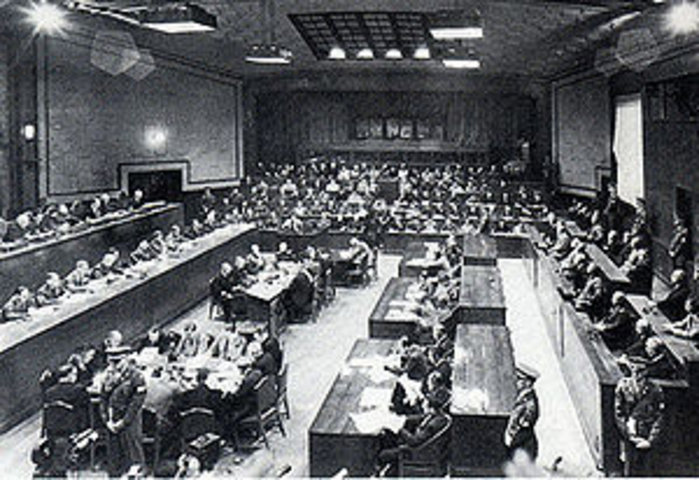
    Court

    The International Military Tribunal for the Far East in session

    Blakeney then argued that war is the act of a nation, not of individuals, so that killing in war cannot be charged as murder. In order to emphasize his point, he took the bold step of addressing the extremely sensitive issue of the atomic bombing of Hiroshima:

    ‘If the killing of Admiral Kidd by the bombing of Pearl Harbor is murder, we know the name of the very man who[se] hands loosed the atomic bomb on Hiroshima, we know the chief of staff who planned the act, we know the chief of the responsible state. Is murder on their consciences? We may well doubt it. We may well doubt it, and not because the event of armed conflict has declared their cause just and their enemies unjust, but because the act is not murder. Show us the charge, produce the proof of the killing contrary to the laws and customs of war, name the man whose hand dealt the blow, produce the responsible superior who planned, ordered, permitted or acquiesced in this act, and you have brought a criminal to the bar of justice.’5

    Thus he implied that if the killing of combatants of the U.S. forces by Japanese forces during the Pearl Harbor attack was regarded as “murder,” by the same token the U.S. President, Harry S. Truman, and the U.S. Army Chief of Staff, George C. Marshall, i.e., two of the American leaders ultimately responsible for the atomic bombing of Hiroshima, could be accused of “murder” as well. In order to invalidate the new legal definition of “Crimes Against Peace,” he directly challenged the dominant popular American idea at the time that the atomic bombing of Hiroshima and Nagasaki was a rightful act of revenge for the surprise attack on Pearl Harbor. In fact Blakeney was convinced that the atomic bombing of Japanese citizens was clearly a violation of the Hague Convention IV, the Laws and Customs of War on Land. He clearly pointed this out in court on March 3, 1947. However, the evidence the defense counsel asked the court to examine in assessing the atomic bombing was rejected by a majority decision by the judges, and deliberation on this issue was never conducted.6

    At the Tokyo War Crimes Tribunal, the issue of the indiscriminate bombing of many Chinese cities by Japanese Imperial Forces during the Asia Pacific War was never raised, despite repeated wartime condemnation by the US government of Japan’s aerial attacks on Chinese civilians. It is obvious that the reason for not bringing this matter before the court lay in America’s own conduct against Japanese civilians, which took the form of the most extensive aerial campaign against civilians, destroying sixty four Japanese cities with incendiary bombs and two with atomic bombs. The fact that the Nazis’ indiscriminate bombing of various cities in Europe and England was never a topic of criminal investigation at Nuremberg was probably due to the same reason.

    In the end, Judge Pal from India, was the only person, among eleven judges who presided over the Tokyo War Crimes Tribunal, who made a critical comment on the atomic bombing, albeit briefly. In his dissenting judgment, he wrote:

    ‘It would be sufficient for my present purpose to say that if any indiscriminate destruction of civilian life and property is still illegitimate in warfare, then, in the Pacific war, this decision to use the atom bomb is the only near approach to the directives of German Emperor during the first world war and of the Nazi leaders during the second world war. Nothing like this could be traced to the credit of the present accused.’7

    Interestingly, there was one exception at a B class trial conducted in Yokohama, in which the indiscriminate bombing of Japanese cities by American forces became the focus of a heated discussion in court. This was at the trial of General Okada Tasuku, who issued orders to execute several crew members of B-29 bombers, who had been captured by the Japanese after being shot down near Nagoya city, without conducting proper court-martial trials. Dr. Joseph Featherstone, an American lawyer acting as chief defense counsel for General Okada, argued that, because the American B-29 crews were engaged in unlawful indiscriminate bombings which killed and wounded many Japanese civilians, they were criminals rather than POWs. Featherstone claimed that the execution of those Americans was therefore legitimate. Although the court found General Okada guilty and sentenced him to death, it seems that Featherstone’s argument and the evidence he presented to the court had considerable influence on the relatively lenient judgments handed down to Okada’s subordinates who had carried out Okada’s orders. A number of American judges and prosecutors sent petitions to General MacArthur, requesting that he commute the death sentence to life imprisonment, however their appeals failed to change MacArthur’s decision.8

    Okamoto’s Struggle for Justice for the Victims of the Atomic Bombings

    One of the Japanese members of the defense counsel of the Tokyo War Crimes Tribunal was a lawyer named Okamoto Shoichi, who also acted as a member of the defense counsel for General Okada and assisted Featherstone. Okamoto’s experience with these American lawyers seems to have had considerable influence on his thinking concerning justice for the Japanese victims of aerial indiscriminate bombings, including the atomic bombings of Hiroshima and Nagasaki. Okamoto pursued a legal struggle to bring justice to the A-bomb survivors long after the conclusion of the Tokyo War Crimes Tribunal. In February 1953, Okamoto sent a copy of a booklet he had made to 64 lawyers in Hiroshima and Nagasaki. In “Genbaku Minso Wakumon (Questions and Answers on the Civil Lawsuit over the Atomic Bombings),” he requested the assistance and cooperation of his colleagues in Hiroshima and Nagasaki in order to file an action against the U.S. government over the atomic bombings of these two cities. The introduction explained how he came to entertain this idea.

    ‘I was a member of the defense council of the International Military Tribunal for the Far East for over two and half years from June 1946. What was always in my mind during this period was how unfair it was that, due to the simple fact that they won the war, the victor nations had never been questioned about their responsibility for some of their actions which violated international law. I was, however, quietly hoping that the leaders of the victor nations would at least express remorse for the atomic bombing of Hiroshima and Nagasaki after the peace treaty had been concluded.

    A year has already passed, yet there is no sign of such action. It is utterly deplorable to see the U.S. and the U.K., nations in which Christianity is the dominant religion and humanism the base of democracy, behave in this manner.

    While I was working as a member of the defense council of the IMTFE, I was already thinking of bringing a civil suit to pursue the responsibility for at least the atomic bombing of Hiroshima and Nagasaki after the peace treaty had come into effect. Thus I told my friends that I would like to file a suit in the court of jurisdiction against the leaders and nations who participated in this illegal action.

    As the peace treaty became effective last year, I have renewed my decision and conducted some research on this issue. Consequently I now believe that it is possible to carry out this lawsuit in the U.S. and U.K., in particular in the U.S.’9

    In this booklet, Okamoto explained the essential legal issues pertaining to the atomic bombing, providing his own answers to the important questions surrounding this contentious issue. It is clear from his arguments that he wished to apply the Nuremberg principle to the atomic bombing of Hiroshima and Nagasaki. His arguments can be summarized in the following four points.

    1) The use of atomic bombs should be banned in accordance with the Regulations respecting the Law and Customs of War on Land annexed to the Hague Convention IV.
    2) The atomic bomb is one of the most inhumane and brutal weapons ever created, capable of exterminating the entire human race. Therefore, the immunity of liable individuals in the name of “act of state” must not be applied in this case. The Nuremberg Trial and Tokyo Trial set precedents for this.
    3) The liability for individual or corporate victims can be placed with two groups: one is that of the American individuals who participated in the decision making for the atomic bombings, the other is the U.S. government.
    4) This case should be brought to an American court, as one of the main purposes of this trial is to judge the crime committed by the victor nation, and to this end it requires close assistance and cooperation from American lawyers with a strong sense of universal justice.10

    It is clear that Okamoto was hoping to gain support from American lawyers, believing that many American law professionals would share the views of Furness, Blakeney, and Featherstone, who had made concerted efforts to defend accused Japanese wartime leaders by utilizing their knowledge of international criminal law. However, he realized that his trust in American lawyers was misplaced when Roger Baldwin, a well-known American pacifist and chairman of the International League for the Rights of Man, now known as the International League for Human Rights, responded to Okamoto’s request in March 1954. Baldwin was known in Japan as a human rights activist, having come to the country in 1947 on the invitation of General Douglas MacArthur, Supreme Commander of the Allied Powers, to foster the growth of civil liberties in that country. In Japan, he founded the Japan Civil Liberties Union, and later the Japanese government awarded him the Order of the Rising Sun for this contribution. Baldwin informed Okamoto that he was in complete opposition to Okamoto’s plan, as he believed the case had no legal base whatsoever and that it would be harmful for the U.S. – Japan bilateral relationship. Two months later, A. Wiling and F. Auckland, two members of the Los Angeles branch of the American Civil Liberties Union, for which Baldwin was the national leader until 1950, contacted Okamoto and offered their assistance as attorneys for this controversial case. For this service, however, they requested US$25,000 (equivalent to 9 million yen) as a minimum fee. At that time this was an unimaginably large sum of money for the A-bomb survivors, most of whom were suffering from various kinds of illness and struggling to survive without adequate medical and social welfare support from their own government. In fact, Okamoto was conducting his work at no charge and personally covered all operating costs, including the production cost of the aforementioned booklet.11
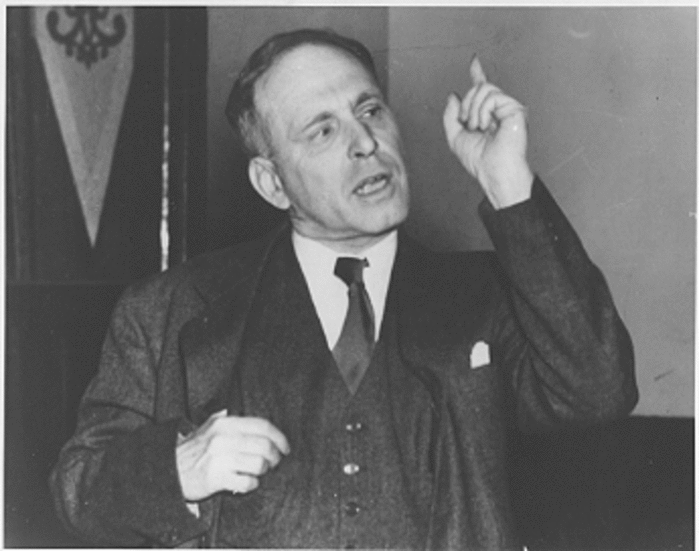
    Baldwin

    Roger Baldwin

    Not only American human rights activists and lawyers but also Japanese lawyers and local politicians in Hiroshima and Nagasaki were reluctant to support Okamoto’s bold proposal. For example, the then mayor of Hiroshima and A-bomb survivor, Hamai Shinzo, declined Okamoto’s request to join this scheme, claiming that it could become a mud-slinging political contest with the U.S., although he said that he would not oppose private citizens joining the plan to pursue the judgment of the atomic bombing in strict accordance with international law. Most lawyers in the two cities, including those who were A-bomb survivors, were also unenthusiastic about taking legal action against the biggest economic and military world power. They regarded such action as unrealistic and success impossible, although some doubtless shared Okamoto’s view that indiscriminate attack on civilians with atomic bombs clearly constituted a war crime. It was the official opinion of both the Lawyers Association of Hiroshima and that of Nagasaki that an international tribunal established upon the international treaty should be created to deal with international crimes such as the atomic bombing of Hiroshima and Nagasaki, but they recognized that it would be extremely difficult to instigate legal action against the U.S. government to claim damages, given the language of the peace treaty concluded in 1951. Article 19 (a) of the Peace Treaty between the Allied Powers and Japan stated that ‘Japan waives all claims of Japan and its nationals against the Allied Powers and their nationals arising out of the war or out of actions taken because of the existence of a state of war, and waives all claims arising from the presence, operations or actions of forces or authorities of any of the Allied Powers in Japanese territory prior to the coming into force of the present Treaty.’12

    The socio-political atmosphere in Japan during the occupation may also have deterred popular willingness to pursue justice for the victims of the atomic bombings. The U.S. occupation policy in Japan to suppress all information on the atomic bombings remained in effect until April 1952, when the Allied occupation ended.13 Because of the lack of accessible information due to this policy, the Japanese people at that time knew little of the nature of the atomic bombings and their aftereffects. It was not until 1954 that strong anti-nuclear sentiment suddenly erupted and spread all over Japan as a result of an incident in which radioactive dust from the American hydrogen bomb test called the Bravo shot fell, not only on many Marshall Islanders, but famously on a Japanese tuna fishing boat called the Lucky Dragon No.5, irradiating all twenty-three fishermen. Captain Kuboyama Aikichi died on September 23 in 1954. Nationwide anti-nuclear sentiment led to the creation of Gensuikyo (Japan Council Against A- and H-Bombs) in 1955, which launched a powerful movement opposing U.S. use of nuclear weapons in the Korean War. Yet even this active anti-nuclear trend did not directly transfer to nor invigorate support for Okamoto’s plan to seek legal justice for surviving A-bomb victims. It is difficult to understand the general passivity towards the “legal movement” in contrast to the vigorous popular anti-nuclear “political movement” of this period. It may have been due in part to the Japanese popular notion that, as a nation defeated in war, it was necessary to accept the consequences of defeat. In addition, many who were deeply involved in the anti-nuclear movement of this period were acutely aware of Japan’s responsibility for atrocities committed against Asian nations, hence may have been reluctant to support a movement to claim damages from the atomic bombing, even damages for victims.

    Faced with the lack of support both from American and Japanese lawyers as well as from the public, Okamoto gave up the plan to bring the case to the U.S. court. He decided instead to appeal to a Japanese court. Fortunately a small group of A-bomb survivors in Hiroshima called “Genbaku Higaisha no Kai (The Association of A-bomb Survivors)” expressed full support and willingness to cooperate with Okamoto. Although this small group of A-bomb survivors later became the core of the large nation-wide A-bomb victims’ lobbying organization, “Nippon Gensuibaku Higaisha Dantai Kyogikai (Japan Confederation of A- and H-Bomb Sufferers Organization), at that time it was still a minor, non-political organization set up predominantly for mutual help among survivors, who had little public assistance or aid to cope with their harsh living conditions and protracted illness. Through the Association of the A-bomb Survivors in Hiroshima and those in Nagasaki who had contact with this organization, eventually five A-bomb survivors from Hiroshima and Nagasaki were selected in 1955 to become plaintiffs, ten years after the atomic bombings.14 Amongst them, the hardship experienced by Shimoda Ryuichi, a then 57-year-old man from Hiroshima, seemed to symbolically represent the lives of all the A-bomb survivors. The operator of a small, family-based factory, he lost four daughters and one son, aged between 4 and 16, as a result of the atomic bombing. He, his wife (40 years old at the time of the A-bomb attack) and their youngest child (a two-year-old boy), survived. In 1955 he had keloid burns all over his body caused by the bombing and suffered from liver and kidney disorder. Due to these health problems, he was unable to work, and both his wife and child suffered from persistent fatigue, headache and listlessness, i.e., the so-called “A-bomb disease,” a typical symptom of irradiated survivors. They were living in poverty, relying upon a small amount of money sent to them by his sister once a month.15

    A 33-year-old lawyer born in Mihara City of Hiroshima Prefecture, Matsui Yasuhiro, joined Okamoto’s struggle to bring justice to the A-bomb survivors. Matsui had entered Kansai University Law School in Osaka in 1941, but was sent to China as a young army trainee paymaster in December 1943 before completing his study. He lost many relatives in the atomic bombing. His brother and an uncle were A-bomb survivors. After the war he entered and graduated from the Law School of Waseda University, beginning work as a lawyer in Tokyo in 1949. Okamoto, who was based in Osaka, often came up to Tokyo to discuss with Matsui important issues surrounding their case and to examine the opinions of various international law scholars. Together they prepared a complaint, and in April 1955, appealed to the District Court of Tokyo.16

    There have been only a few scholarly analyses of this so-called Shimoda case both in Japan and the United States. Amongst them are the work of Professor Richard Falk, ‘The Shimoda Case: A Legal Appraisal of the Atomic Attacks on Hiroshima and Nagasaki,’ published in the American Journal of International Law in 1965, and a Japanese article written by Professor Fujita Hisakazu, entitled ‘Genbaku Hanketsu no Kokusaihoteki Saikento (A Re-examination of the Judgment of the A-bomb Trial),’ published in the Law School Journal of Kansai University in 1975. As both articles were written specifically for readers in legal profession, their analyses involve highly jurisprudential discussions. Hence, for general readers, many parts of their discussions are not easy to follow and fully comprehend. The aim of this paper is therefore to explain the important points of contention in this case as plainly as possible with the intention of learning lessons from the judgment and utilizing them for civil movements towards the abolishment of nuclear weapons.17

    Damages Caused by the Atomic Bombings

    Before assessing the arguments put forward by the plaintiffs as well as the defense of this controversial case, let us first objectively analyze the actual damages caused by the atomic bombings.18

    At 8:15 am on the 6th of August, 1945, the world’s first atomic bomb was dropped on Hiroshima, and at 11:02 am on the 9th of August a second atomic bomb was dropped on Nagasaki. The bomb used on Hiroshima was a uranium type atomic bomb referred to as ‘Little Boy.’ It exploded 580 meters above the ground with a force equivalent to 12.5 kilotons of TNT. The bomb used on Nagasaki was a plutonium type atomic bomb known as ‘Fat Man’. It exploded 503 meters above the ground with a force equivalent to 22 kilotons of TNT. Of the total amount of energy that rained down to the ground, 35% was heat rays, 50% was the blast and the remaining 15% was radiation. The effects of these three elements of the bomb can be summarized respectively as follows:

    (1) Heat rays: Estimates suggest that after the atomic bomb was detonated, powerful heat rays were released for a period of approximately 0.2 to 0.3 seconds, heating the ground to temperatures ranging from 3,000 to 4,000ºC. These heat rays burnt people near the hypocenter to ashes and melted bricks and rocks. It is said that people suffered burns up to 3.5 kilometers from the hypocenter in Hiroshima and up to 4 kilometers in Nagasaki. In addition, the heat rays burnt buildings, triggered large-scale fires and ignited an enormous firestorm.

    (2) The Blast: The blast from the atomic bomb completely destroyed all surrounding structures in an area of 4.7 square miles by US estimate. In the areas surrounding the hypocenter, people were slammed into walls and crushed to death by collapsing houses. Injuries were sustained from flying glass and other debris even in areas a long distance from the hypocenter.

    (3) Radiation: The most characteristic devastating feature of the atomic bomb was radiation. Of the total energy released by the explosion, 5% was comprised of initial radiation and 10% of residual radiation. The initial radiation was caused by the nuclear fission of uranium or plutonium. Gamma and neutron rays emitted at this time penetrated people on the ground. Neutron rays caused soil and above ground structures to become radioactive. Fission products were picked up and carried in the atmosphere by upward wind currents turning into ‘Black Soot’ and when in the atmosphere tiny particles became moist and fell to the ground in the form of ‘Black Rain.’ These radioactive particles caused both internal and external damage. Many of those killed in the months following the bomb displayed acute symptoms such as hair loss, diarrhea, purpuric skin lesions, bleeding gums and fever. Cancer, leukemia and various other after-effects also became apparent.

    The compound effects of the heat rays, blast and radiation had a far greater effect than any of these would have had individually. Heat rays caused the outbreak of fires. Blast destroyed buildings causing secondary fires and the ensuing firestorm created upward wind currents that spread radioactive matter on the ground and through the atmosphere. Exposure to radiation seriously damaged the health and eventually took the lives of many people.

    The atomic bomb wiped out the lives of many people in an instant. The victims of the bombs were not only Japanese nationals, but also many Koreans and Chinese who were working in Japan as well as some prisoners of war from the Allied forces captured by the Japanese military. Tens of thousands of others died soon after the bombs were dropped through lack of medical supplies. By the end of 1945, an estimated 140,000 people had died in Hiroshima and 70,000 in Nagasaki. Since 1945, countless more have died as a result of various after-effects. Many of those who experienced this ‘hell on earth’ also suffered serious psychological damage.

    Radiation from the atomic bombs damaged genes, which later became a cause of cancer and left various other physical impediments that scientists still do not fully understand. Today, over 64 years after the end of the war, new after-effects are still appearing and the survivors live in constant fear. It is further thought that damage to health, particularly from radiation, has in some cases been passed on to children and grandchildren. Disfigurement also brought about many forms of anguish and discrimination. Marriage and employment became difficult and life became cut off from the healthy society. The atomic bombings made it impossible for many surviving hibakusha to live normal lives.

    The Argument of the Plaintiffs

    The following is the summary of the argument in the complaint filed by the plaintiffs:

    ‘The plaintiffs, Japanese nationals, were all residents either in Hiroshima or Nagasaki when atomic bombs were dropped on these cities by bombers of the United States [Army] Air Force in August 1945. Most of the members of their families were killed and many, including some of the plaintiffs themselves, were seriously wounded as a result of these bombings. The plaintiffs jointly brought the present action against the defendant, the State (of Japan), for damages on the following grounds: (a) that they suffered injury through the dropping of atomic bombs by members of the [Army] Air Force of the United States of America; (b) that the dropping of these atomic bombs as an act of hostility was illegal under the rules of positive international law then in force (taking both treaty law and customary law into consideration), for which the plaintiffs had a claim for damages; (c) that the dropping of atomic bombs also constituted a wrongful act under municipal law, ascribable to the United States and its President, Mr. Harry Truman: (d) that Japan had waived, by virtue of the provisions of Article 19 (a) of the Treaty of Peace with Japan of 1951, the claims of the plaintiffs under international law and municipal law, with the result that the plaintiffs had lost their claims for damages against the United States and its President; and (e) that this waiver of the plaintiffs’ claims by the defendant, the State, gave rise to an obligation on the part of the defendant to pay damages to the plaintiffs.’19

    Let us examine this argument in more detail.20

    The plaintiffs argued that the effects of heat rays, blast and radiation from the atomic bomb extended over 4 kilometers from the epicenter, which inevitably caused indiscriminate mass killing of the people in Hiroshima and Nagasaki. They claimed that the use of the atomic bomb was a clear breach of Article 23 (a) of the regulations of the Law and Customs of War on Land annexed to the Hague Convention IV on October 18, 1907, which states that it is specially forbidden ‘to employ poison or poisonous weapons,’ and ‘to employ arms, projectiles, or material calculated to cause unnecessary suffering.’ They claimed that it was also a breach of the Geneva Protocol of June 17, 1925, which prohibits ‘the use in war of asphyxiating, poisonous or other gases and all materials or devices.’ Given the fact that the effects of the atomic bomb were far more devastating than poisonous gases, they argued that the use of an atomic weapon was contrary to the fundamental principle of the laws of war that unnecessary pain must not be inflicted.

    Concerning the indiscriminate nature of the atomic bomb attacks, the plaintiffs contended that it was a crime as defined by Article 25 of the regulations of the Law and Customs of War on Land of 1899, which states that ‘the attack or bombardment, by whatever means, of towns, villages, dwellings, or buildings which are undefended is prohibited.’ They also claimed that Articles 22 and 24 of the Draft Rules of Air Warfare of 1923 prohibit the indiscriminate aerial bombing of non-combatants. Article 24 allows only the aerial bombings of military targets such as military forces, military works, military establishments or depots, and factories engaged in the manufacture of arms, ammunitions, or distinctively military supplies. Article 22 states that ‘aerial bombardment for the purpose of terrorizing the civilian population, of destroying or damaging private property not of military character, or of injuring non-combatants, is prohibited.’ They argued that, although the Draft Rules of Air Warfare was not positive law at the time the atomic bombings were carried out, it was regarded as authoritative customary law by international jurists.

    The plaintiffs alleged that President Truman, the supreme commander of the U.S. Forces, must have been well aware of the above-mentioned international treaty and customary laws. They also asserted that Truman must have had full knowledge, from the report of the test conducted a few weeks before ordering their use against Japan, how powerful and destructive the atomic bombs would be. The plaintiffs argued that one could have easily predicted that atomic bombs could annihilate the entire human race because of their immense destructiveness and their extraordinarily harmful effects on human bodies, so that the use of the atomic weapon was clearly prohibited by “natural law” or the “principle of international law” even if the positive laws could not have been applied to it. It was argued that atomic bombing is an act of massacre and thus cannot be seen as a plain military action, and that Truman and other war leaders of the U.S. who participated in the decision-making process of the atomic bombings of Hiroshima and Nagasaki, knowing that they would result in indiscriminate mass killings, clearly committed war crimes. Consequently, the plaintiffs contended that President Truman and other U.S. leaders were liable for compensating the damage caused by this deliberate act of inhumanity. It was their opinion that the sovereign immunity doctrine must not be applied to this case due to the fact that the atomic bombs were not used simply for the purpose of destroying the fighting power of the enemy nation but with the clear intention to indiscriminatingly kill large numbers of residents.

    Finally, the plaintiffs argued that the Japanese government had violated their constitutional and vested rights by agreeing to the waiver provision of the Peace Treaty with the U.S. government (concluded in September 1951 and effective from April 1952) and was therefore legally responsible for satisfying the claims wrongfully waived. They also asserted that if the Japanese government had no choice but to renounce the plaintiffs’ claims for damages in order to conclude the Peace Treaty with the U.S., this action meant that the Japanese government surrendered these claims for the benefit of the nation. Hence, the Japanese government was accordingly responsible, the plaintiffs claimed, to properly compensate them in accordance with Article 29 (3) of Constitution.

    The Argument of the Defense

    Of course the defense conceded the fact of the atomic bombing of Hiroshima and Nagasaki, but it claimed that the Japanese government did not know whether the damage caused by these bombings was exactly as the plaintiffs claimed, and that it did not know the extent of the power of the atomic bomb. In fact, the casualty figures that the defense submitted to the court were considerably lower than what the plaintiffs claimed.21

    The Japanese government contended that, as the use of atomic weapons was not expressly prohibited by international law, the question of a violation of international law did not arise when the bombs were dropped. Furthermore, the defense argued that ‘From the viewpoint of international law, war is originally the condition in which a country is allowed to exercise all means deemed necessary to cause the enemy to surrender,’ and that ‘Since the Middle Ages, belligerents have been permitted to choose the means of injuring the enemy in order to attain the special purpose of war, subject to certain conditions imposed by international customary law and treaties adapted to the times.’ In other words, the defense implied that any weapon could be utilized no matter how destructive, lethal and inhumane it would be, as long as there was no positive law or treaty to explicitly prohibit the use of such a weapon. It is truly surprising to hear such a defense of the use of the atomic bomb, expressed by the government of the nation which fell victim to the world’s first nuclear attacks and, as a result, established a Constitution explicitly adopting the principle of peace and non-violence.

    In fact, since its surrender on August 15th 1945, the Japanese government has never lodged an official protest with the U.S. government concerning the atomic bombing of Hiroshima and Nagasaki, or, for that matter, the firebombing of more than one hundred Japanese cities and towns. The first and last official protest that the Japanese government made came immediately after the bombing of Nagasaki on August 9th, when the Japanese government sent a protest note to the U.S. government through the Swiss government under the name of then Minster of Foreign Affairs, Togo Shigenori.

    In this protest note, the Japanese government clearly stated that ‘it is the fundamental principle of international law in war time that belligerents do not possess unlimited rights regarding the choice of the means of harming the enemy, and that we must not employ arms, projectiles, or material calculated to cause unnecessary suffering. They are each clearly defined by the Annex to the Hague Convention respecting the Law and Customs of War on Land, and by Article 22 and Article 23 (e) of the Regulations respecting the Law and Customs of War on Land.’ Furthermore, this note severely condemned the U.S., claiming that:

    ‘The indiscriminateness and cruelty of the bomb that the U.S. used this time far exceed those of poisonous gases and similar weapons, the use of which is prohibited because of these very qualities. The U.S. has ignored the fundamental principle of international law and humanity and has been widely conducting the indiscriminate bombing of the cities of our Empire, killing many children, women and old people, and burning and destroying shrines, schools, hospitals and private dwellings. Withal, they used a novel bomb, the power of which exceeds any existing weapons and projectiles in its indiscriminateness and cruelty. The use of such a weapon is a new crime against human culture.’22

    There is no doubt that this note was drafted by a person knowledgeable in international law, indeed the Japanese government’s legal interpretation of the atomic bombing at that time was almost identical to that the plaintiffs of the Shimoda case put forward. It is therefore not at all surprising that the plaintiffs pointed to this fact in the courtroom and criticized the opportunistic change in the defense’s argument. The defense stated however, that ‘taking an objective view, apart from the position of a belligerent, and having considered the fact that the use of an atomic weapon is not yet regarded as illegal in accordance with international law, we reached the conclusion that it is not possible to hastily define it illegal.’ It is ironic that, from the view point of legal logic, the argument that the Japanese government advanced in the above mentioned protest note of August 1945 sounds far more “objective” and rational than that presented to the court by the defense twenty years later.

    Regarding the plaintiffs’ claims for damages, the defense argued that because the atomic bombing is not a violation of international law, claims for damages are baseless. The claims for damages could become reality, the defense asserted, only if the nations in negotiation recognize them in a peace treaty. Therefore, the defense held, a legal right to damages is simply an abstract concept unless it is officially acknowledged in a peace treaty. To further confirm this argument, the defense asserted that no defeated nation has ever claimed damages for its nationals against a victorious nation. On the issue of the waiver, the defense stated that only the claims of Japan as a state were waived by Article 19(a) of the Peace Treaty, and therefore the plaintiffs’ claims for damages are irrelevant to the waiver provision of the treaty even if they could exist. The Japanese government further argued that, even if the waiver in Article 19(a) was construed as a violation of Article 29 of the Japanese Constitution, there would be no basis for recovery for damages as the Constitution ‘does not directly grant the people a concrete claim for compensation.’ According to its argument, the purpose of Article 29 of the Japanese Constitution is to establish a law by which the people are entitled to be compensated in the case that the state uses or expropriates their private properties for the public good. Thus, the defense asserted that it is only when such a law is enacted that the people are able to claim for compensation.

    Overall, the basic argument advanced by the Japanese government is that a defeated nation has no right to condemn the wrong doings committed by a victorious nation, and that the citizens of the defeated nation must accept this as their unchangeable fate no matter how badly they are victimized. In other words, the Japanese government forced its citizens to accept that the law of the jungle applies: the weak (the defeated) are obliged to endure any injustice imposed by the powerful (the victor). This thinking clearly reflects the Japanese government policy issued immediately after the war – “Ichioku So Zange (collective repentance by the entire Japanese population for defeat in war),” – in which the government demanded that the Japanese people blame themselves for the misery caused by the war, and not condemn Emperor Hirohito or other war leaders. The real issue of “responsibility” for the war was thus blurred as it entailed no process of self-criticism of wrongdoing at the highest levels of power.

    In court, the Japanese government tried to use the same non-legal argument that the U.S. government invented shortly after the war in order to justify the mass killing of Japanese civilians through the atomic bombing of Hiroshima and Nagasaki. This argument held that it was necessary to use atomic weapons against Japan in order to end the war, and that if the war had continued, millions more people —Japanese, Americans, Asians of many nations — would have died. We must be careful not to intermingle non-legal and legal arguments. A justification predicated on utility has nothing to do with the question of the legality of the use of atomic bombs. It must be emphasized that the criminality of a particular act defined by law cannot be justified by any non-legal argument which defends the conduct itself.

    The U.S. government has persistently used this non-legal self-justification since the end of the Pacific War to defend the use of the atomic bombs. However, as conclusively demonstrated in the scholarly literature, the atomic bombing of Hiroshima and Nagasaki was not decisive in ending the war. Its political justification was a myth created by the American government and tacitly endorsed by the Japanese government for self-serving reasons. This explanation leaves open why the Japanese government did not concede to the Allies immediately after the atomic bombing of Hiroshima and Nagasaki. On 10 August 1945 – the day after the bombing of Nagasaki – the cities of Kumamoto and Miyazaki in Kyushu Prefecture and Sakata in Yamagata Prefecture were bombed. Two days later, Kurume, Saga and Matsuyama were targeted, and on 13 August Nagano, Matsumoto, Ueda and Otuki were bombed. On 14 August, in addition to a massive attack on Osaka with 700 heavy one-ton bombs dropped from 150 B-29 bombers, Akita, Takasaki, Kumagaya, Odawara and Iwakuni became the victims of the last U.S. bombing raids of the Asia Pacific War. The plain fact is that the massive destruction of Japanese cities, from the Tokyo raids of March 9-10 to those of August 14 failed to break the will of Japan’s leaders.23 Other political and strategic factors, notably the Soviet entry into the war and the invasion of Russian forces into Manchuria, as well as the US easing of the Potsdam surrender terms to protect the emperor played vital roles in bringing Japan’s final surrender.24
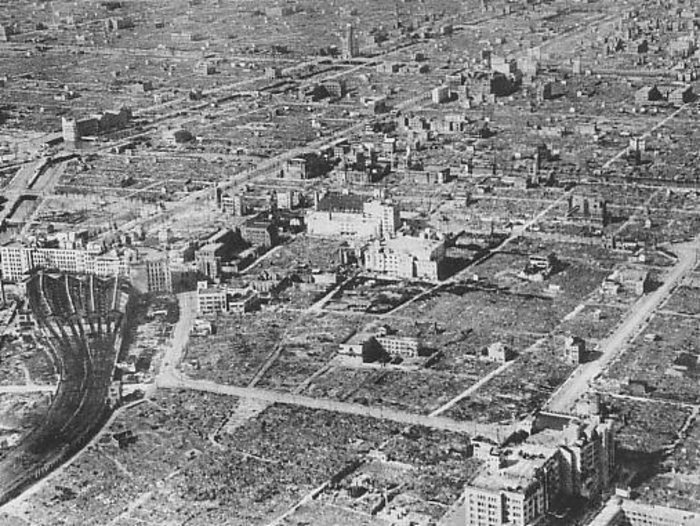
    Osaka

    Osaka in the aftermath of bombing

    Yet, even if the myth that the atomic bombing had ended the war were historically accurate, no historical or political justification can legitimate the criminality of the mass indiscriminate killing of civilians. We must be careful to ensure that the criminality of the atomic bombing of Hiroshima and Nagasaki not be blurred by historical or political arguments justifying such criminal conduct. In other words, the issue of criminality must not be evaded by any political or historical assessment of the event.

    For 15 long years, Japan embarked on a war of aggression in Asia and long after it became clear that defeat was inevitable, Japan refused to surrender. In my view, therefore, the then Japanese Government and its leader, Emperor Hirohito, share together with the US authorities, part of the responsibility—both legal and moral responsibility—to the A-bomb victims for the disaster caused by the atomic bombing of Hiroshima and Nagasaki. Forced laborers sent from Japanese colonies such as Korea and Taiwan, and people from occupied China and South East Asia also became victims. The Japanese Government bears at least a degree of moral responsibility to these people too, if not legal responsibility.

    Lessons from the Judgment

    It took eight and half years to complete the court case, in December 1963. During this time, the chief judge changed five times and Okamoto Shoichi died of a stroke in April 1958 without seeing the result of his efforts.25 The final judgment was delivered by chief judge Koseki Toshimasa together with two other supporting judges, Mibuchi Yoshiko and Takakuwa Akira.26

    On the issue of legality, the judgment clearly stated that the atomic bombing of Hiroshima and Nagasaki was a clear violation of international law and regulations respecting aerial warfare. The court cited a number of international laws including the Convention Respecting the Laws and Customs of War and Land of 1899, Declaration prohibiting aerial bombardment of 1907, the Hague Draft Rules of Air Warfare of 1922-1923, and Protocol prohibiting the use in war of asphyxiating, deleterious or other gases and bacteriological methods of warfare. It also said that ‘the prohibition in this case is understood to include not only the case where there is an express provision, but also the case where it is necessarily regarded that the use of new weapons is prohibited, from the interpretation and analogical application of exiting international laws and regulations (international customary laws and treaties).’ Thus the court dismissed the defense claim that since the use of atomic weapons was not expressly prohibited by either international law or international customary law, the question of a legal violation did not arise when the bombs were dropped. Thus the court found that ‘an aerial bombardment using an atomic bomb on both the cities of Hiroshima and Nagasaki was an illegal act of hostility as the indiscriminate aerial bombardment on undefended cities.’ It further stated that: ‘It is a deeply sorrowful reality that the atomic bombing on both the cities of Hiroshima and Nagasaki took the lives of many civilians, and that among the survivors there are people whose lives are still imperiled owing to the radial rays, even today 18 years later. In this sense, it is not too much to say that the pain brought by the atomic bombs is more severe than from poison-gas, and we can say that the act of dropping such a cruel bomb is contrary to the fundamental principle of the laws of war that unnecessary pain must not be inflicted.’

    Regarding the individual responsibility of U.S. President Harry Truman and other American war leaders, the court adopted the traditional sovereign immunity doctrine, claiming that: ‘compensation for damage cannot be claimed in international law against U.S. President Truman, who ordered the atomic bombing. It is a principle of international law that the State must directly assume responsibility for acts taken by a person as a state organ, and that the person who holds the position as a state organ does not assume responsibility as an individual.’ It must be noted that this ruling is a clear contravention of the Nuremberg principle, under which the individual responsibility of many German and Japanese war leaders was relentlessly examined, and many were tried and found guilty, and some executed. Among them was General Tojo Hideki, who held the position of Prime Minister, i.e., “the position as a state organ,” for many years during the Asia Pacific War. If President Truman was not responsible for killing and injuring tens of thousands of Japanese civilians with atomic bombs simply because he was the U.S. President at the time he ordered that the bombs be dropped, by the same token General Tojo, then Prime Minister of Japan, should have been exonerated of responsibility for ordering his troops to attack Pearl Harbor, Manila, Singapore, and other cities during the Asia-Pacific War. In other words, Tojo should not have been prosecuted and executed because of his “crime against peace.” It seems that the three judges who delivered the judgment on the Shimoda case did not carefully study the ruling of the Tokyo War Crimes Tribunal, although they appeared to have done considerable research on positive international laws, treaties and customary laws regarding the conduct of war. Consequently, Japan missed the opportunity to apply the Nuremberg principle to one of the most horrific crimes against humanity in the history of mankind, a principle which was established at the sacrifice of millions of lives of civilians and soldiers in the war.

    As far as the judgment on the issues of the waiver in Article 19(a) of the Peace Treaty and the plaintiffs’ claim for compensation are concerned, the court’s explanation for its decision seems extremely far-fetched. The court supported the argument of the Japanese government and ruled that individuals had no rights under international law unless specifically recognized in a treaty, thus there was no general way open for individuals to claim damages directly under international law. However, it admitted that Japan did waive all its claims, stating that: ‘It is clear that the “claims of Japan” which were waived by this provision includes all claims which Japan had in accordance with treaties and international customary laws. Accordingly, claims for compensation for damages caused to Japan by illegal acts of hostility, for example, are necessarily included.’

    The most convoluted aspect of the court’s decision comes from the judges’ statement that the claims of Japanese nationals waived in the Peace Treaty were claims valid under the municipal laws of Japan and under those of the Allied Powers and not claims in international law. Moreover, although it is not very clearly elucidated, the judgment seems to state that, because of the existence of sovereign immunity in the U.S., the plaintiffs had no right to claim damages against the Allied Powers either under Japanese municipal laws or under those of the Allied Powers. In other words, the court claimed that from the beginning, the plaintiffs’ claim for damages simply did not exist, and therefore ‘it follows that the plaintiffs had no rights to lose, and accordingly there is therefore no reason for asserting the defendant’s legal responsibility.’ This seems dubious as a legal argument, but because of this ruling the plaintiffs’ claims for damages were dismissed. As I have already discussed, however, the reasoning behind this ruling becomes invalid when the concept of sovereign immunity is nullified.

    In conclusion, it can be said that the atomic bomb survivors won a partial victory in this case, as it was acknowledged that they were victims of unlawful indiscriminate bombing conducted by the Americans. However, it seems that the judgment in this case had little impact on either the US or Japanese governments. Indeed, there is a general lack of awareness in both Japan and the U.S. of this Japanese legal case in which the atomic bombings were the main issue of contention, let alone the fact that the atomic bombings were declared a violation of international laws. Knowledge of the case should be disseminated widely and used in the service of anti-nuclear actions all over the world, particularly in the U.S. It should also be fully utilized, by overcoming the defects and emphasizing positive aspects of the ruling, to establish a nuclear weapons convention to abolish all nuclear weapons as soon as possible.


    Yuki Tanaka is Research Professor, Hiroshima Peace Institute, and author a coordinator of The Asia-Pacific Journal. He is the author most recently of Yuki Tanaka and Marilyn Young, eds., Bombing Civilians: A Twentieth Century History. He wrote this article for The Asia-Pacific Journal.

    Recommended citation: Yuki Tanaka and Richard Falk, “The Atomic Bombing, The Tokyo War Crimes Tribunal and the Shimoda Case: Lessons for Anti-Nuclear Legal Movements,” The Asia-Pacific Journal, Vol. 44-3-09, November 2, 2009.


    Notes

    1 R. John Pritchard, The Tokyo Major War Crimes Trial: The Records of the International Military Tribunal for the Far East (The Edwin Mellen Press, 1998) vol.2, p.200.
    2 Ibid., p.200.
    3 Ibid., p.206.
    4 Ibid., p.209.
    5 Ibid., p.212.
    6 R. John Pritchard, The Tokyo Major War Crimes Trial: The Records of the International Military Tribunal for the Far East, (The Edwin Mellen Press, 1998) vol.38, pp.17,655 – 17,663.
    7 R.B. Pal, International Military Tribunal for the Far East: Dissentient Judgment of Justice (1953) p.621.
    8 For details of this court case, see Ohoka Shohei, Nagai Tabi (A Long Journey) (Shincho-sha, 1982). The court’s judgement is here: Ryuichi Shimoda et al. v. The State
    In 2008, a feature film “Ashita e no yuigon (Best Wishes for Tomorrow)” was produced based upon this documentary book. The trailer of this film is available at this website.
    The Stars and Stripes review, Norio Murio, “Japanese film a poetic look at WWII war crimes trial,” can be found at this website.
    9 The introduction to “Genbaku Minso Wakumon (Questions and Answers on the Civil Lawsuit over the Atomic Bombings)” by Okamoto Shoichi is reprinted in, Matsui Yasuhiro, Genbaku Saiban: Kakuheiki Haizetu to Hibakusha Engo no Hori (The A-Bomb Trial:  Legal Principles for Abolishing Nuclear Weapons and Supporting A-bomb Survivors) (Shin-Nippon Shuppan-sha, 1986) pp.16 – 19.
    10 Maruyama Mutsuo, ‘Genbaku Saiban no Imisuru-mono (The Meaning of the A-bomb Trial),’ in Nippon Senryo: Kyodo Kenkyu (The Occupation of Japan: A Cooperative Research) ed. by Shiso no Kagaku Kenkyu-kai (Tokuma Shobo, 1972) p.383.
    11 Ibid., p.383; Matsui Yasuhiro, op.cit., pp.21 – 22.
    12 Maruyama Mutsuo, op.cit., pp.383 – 389; Matsui Yasuhiro, op.cit., pp.20 – 21.
    13 For details of the U.S. censorship on the Japanese publications concerning the effects
    of the Atomic bombing of Hiroshima and Nagasaki, see Monica Braw, The Atomic Bomb Suppressed: American Censorship in Occupied Japan (M.E. Sharpe, 1997).
    14 Maruyama Mutsuo, op.cit., p.383.
    15 The information on Shimoda’s personal background is included in the complaint submitted to the District Court of Tokyo on April 25, 1955. The full text of the complaint is reprinted in the aforementioned book by Matsui Yasuhiro. See Matsui Yasuhiro, op.cit., pp.24 – 36.
    16 Matsui Yasuhiro, op.cit., p.22. Regarding Matsui’s personal background, see Matsui Yasuhiro, Senso to Kokusai-ho: Genbaku Saiban kara Rasseru Hotei e (War and International Law: From the Atomic Bomb Trial to the Russell Tribunal) (Sanseido, 1968) pp.55 – 57; and Ushiomi Toshitaka, Kitano Hirohisa, Oda Shigemitsu and Toriu Chusuke eds., Gendai Shiho no Kadai (The Problems of Modern Judicature) (Saegusa Shobo 1982) pp.451 – 456.
    17 Richard Falk’s article was reproduced in his book, Legal Order in A Violent World (Princeton University Press, 1968) pp.374 – 413. Fujita’s work on this court case concentrates on the discussion of the illegality of the indiscriminate bombing and in no way deals with the issue of the plaintiffs’ claims for damages. Francis Boyle also discusses the criminality of the atomic bombing in conjunction with this court case in Chapter 2 of his book, The Criminality of Nuclear Deterrence: Could the U.S. War on Terrorism Go Nuclear? (Clarity Press, 2005).
    18 For details of the effects of the atomic bombing of Hiroshima and Nagasaki, see, for example, The Committee for the Compilation of Materials on Damage Caused By the Atomic Bombs in Hiroshima and Nagasaki, Hiroshima and Nagasaki – the Physical Medical and Social Effects of the Atomic Bombings (Hutchinson & Co., 1981); and Leif E. Peterson and Abrahamson Seymour, eds., Effects of Ionizing Radiation: Atomic Bomb Survivors and Their Children:1945-1995 (Joseph Henry Press, 1998).
    19 The court’s decision, including the summaries of the complaint and the defense argument, was translated into English and published in The Japanese Annual of International Law for 1964. The full text of the English translation is also reprinted in R. Falk and S. Mendlovitz eds., Towards A Theory of War Prevention (World Law Fund, 1966). The original Japanese text of the decision is reproduced in full in the aforementioned book by Matsui Yasuhiro. See Matsui Yasuhiro, op.cit., pp.206 – 246.
    20 See the full text of the complaint reproduced in Matsui Yasuhiro, op.cit., pp.24 – 36.
    21 See “The Summary of the Defense Argument” reproduced in Matsui Yasuhiro, op.cit., pp.218 – 225.
    22 The plaintiffs submitted a copy of this Japanese government’s official protest against the U.S to the court. This copy is reproduced in Matsui Yasuhiro, op.cit., pp.248 – 249.
    23 For details of the bombing of Japanese cities by the U.S. Army Air Force and its effects on Japanese policies, see, for example, Mark Selden, ‘A Forgotten Holocaust: U.S. Bombing Strategy, The Destruction of Japanese Cities, and American Way of War From the Pacific War to Iraq,’ in Bombing Civilians: A Twentieth Century History, ed.  by Yuki Tanaka and Marilyn Young (New Press, 2009) pp.76 – 96.
    24 Regarding the effect of the Soviet entry into the war and the invasion of Russian forces into Manchuria upon Japan’s decision to surrender, see Tsuyoshi Hasegawa, ‘Were the Atomic Bombings of Hiroshima and Nagasaki Justified?’ in Yuki Tanaka and Marilyn Young, op.cit., pp.97 – 134.
    25 Matsui Yasuhiro, op.cit., p.22.
    26 See “The Reason for the Decision,” reproduced in Matsui Yasuhiro, op.cit., 225 – 246.


    Comment on Yuki Tanaka’s “The Atomic Bombing: The Tokyo War Crimes Tribunal and the Shimoda Case: Lessons of U.S. Culpability for Anti-Nuclear Legal Movements”

    Richard Falk

    When I first learned of the Shimoda Case more than 45 years ago from a young Japanese diplomat who was a student in my course on international law at Princeton University, I was immediately moved and excited. Moved because of the initiative mounted by badly wounded survivors of the atomic bombings who were seeking symbolic compensation, while primarily dedicating themselves to an effort to have a court of law pronounce upon these horrifying atom bombs that demolished the cities of Hiroshima and Nagasaki at the end of World War II. Excited because I believed, naively it turns out, that such a judicial determination would have some bearing on the struggle to outlaw forever this weaponry of mass destruction, and discourage its development, possession, and deployment. Now that Yuki Tanaka has revived these issues in his informative essay, I find myself still moved by the Shimoda litigation, but no longer excited as it seems evident that the nuclear weapons states, most of all the United States, are as resistant as ever to acknowledging their past crime of dropping the atomic bomb and remain resolved to retain nuclear weaponry until the end of time.

    True, the current American president, Barack Obama, made a visionary speech in Prague on April 5, 2009, in which he dedicated himself to the goal of a world without nuclear weapons. Obama also acknowledged, and was the first president to do so in a semi-apologetic spirit, that the United States had a special “moral responsibility to act” as it was “the only nuclear power to have used a nuclear weapon.” But the engagement with a world without nuclear weapons was tempered, if not nullified, by a heavy dose of realism: “I’m not naïve. The goal will not be reached quickly—perhaps not in my lifetime.” This cautionary aside has been repeated often, presumably to reassure nuclearists that they can sleep comfortably because no serious move to eliminate nuclear weapons for the foreseeable future will be taken. After all, President Obama didn’t reinforce his words with a few concrete acts that would not in any way increase American security risks: for instance, he could have de-alerted the thousands of nuclear weapons deployed during the Cold War; he could have set new targets for the reduction and eventually elimination of nuclear weapons; he could more dramatically have pledged the United States to do what China has already pledged to do—never to be the first to use nuclear weapons; or even more boldly, he could have called upon Israel to join with Iran and others in the Middle East to renounce the option to acquire or possess nuclear weapons, dismantling the existing Israeli arsenal.

    It is likely that the Obama presidency, certainly as compared to their predecessors, will encourage a variety of arms control steps associated with inhibiting any further proliferation of nuclear weapons as well as lend support to measures such as the comprehensive nuclear weapons test ban treaty (CTBT). Such managerial steps are prudent, but do not advance the world one inch closer to the Obama denuclearizing vision.

    In these central respects the Shimoda case could just as well have been decided on another galaxy, or for that matter, never decided at all. It remains virtually unknown even among peace activists, except perhaps in Japan, whose interest is in nuclear disarmament, or for a few, in the World Court advisory opinion in 1996 that concluded by an 11-3 majority that nuclear weapons might be lawful in extreme circumstances, that is, if used to uphold the survival of a state facing destruction or conquest. In other words there exists very little legal consciousness about the status of nuclear weaponry, and what inhibitions do exist are mainly of an ethical or political character. Several decades ago E.P. Thompson reminded us that even the announced willingness of the nuclear weapons states to possess and possibly use such weaponry inscribes in the culture an ‘exterminist’ ethos that is extremely harmful, exhibiting a total disregard for the sacredness of life.

    As I read Tanaka, his concerns are associated with a revisiting of the past so as to impart lessons to the peace movements of the present that will produce a future that corresponds to the Obama vision of a world without nuclear weaponry. Of course, any recall of Hiroshima and Nagasaki possesses an inexhaustible resonance for peace oriented persons, but not the mainstream. Significantly, the Holocaust is different in this respect.  Evoking the Holocaust, visits to the death camps, are ritualistically relied upon by politicians and the mainstream to establish moral credibility. One benefit of Tanaka’s essay is to help us understand this enduring denial of the criminality of the atomic attacks on Japanese cities. In this regard, the comparison of the Tokyo War Crimes Tribunal (TWCT) and the Shimoda case is illuminating. The TWCT was essentially, although less so than its Nuremberg sibling, a morality play staged by the winners in an ugly war. At least in Tokyo there were several judges from neutral countries, and an angry Indian judge from still colonized India, whose long dissent impressively challenged the whole presupposition that Japan was the aggressor in the Far Eastern part of World War II.

    Let me put the issue in a very stark form: winners in a major war are unwilling to cast any shadow of responsibility onto their self-glorifying narrative of their victory. Is there the slightest doubt that if Germany or Japan had succeeded in developing the atomic bomb before the United States, then used it let’s say against Boston or Seattle, yet still went on to lose the war, that the use of such a weapon would have been the major charge leveled against their surviving leaders? It is notable that Germany as loser remains full of remorse about the Holocaust, and to this day Germans are reluctant to criticize Israel so as to avoid the slightest implication that the anti-semitic Nazi past has not been completely repudiated. The Shimoda case was so notable because it offered a glimmer of recognition to this legally neglected awesome atrocity that had been treated heretofore with respectful silence even by the Japanese Government.  In this sense, an informal, yet integral part of the American occupation policy was to silence critical voices in Japan while in Germany insisting on full disclosure and reparations for the horrors of Nazism. Revealingly, the Holocaust led directly to the Genocide Convention whereas the atomic bombings led to the nuclear arms race.

    Tanaka instructively relates the valiant efforts of Okamoto Shoichi to invoke international law both to ban the atom bomb forever, and to empower victims to impose some sort of liability on the perpetrators of the atomic attacks by recourse to American courts on the basis of a presumed appeal to ‘universal justice.’ But it turned out to be completely naïve to suppose that even American liberals were willing to have the wartime actions of their government in what was widely regarded as ‘a just war’ assessed by recourse to the international law of war. American ‘exceptionalism’ (so widely discussed recently in relation to the presidency of George W. Bush, particularly in relation to the ‘war on terror’) is nothing new. It is not surprising that Okamoto’s efforts were unappreciated at the time by Japanese officials, even by the mayor of Hiroshima. The loser in a major war experiences what might be called ‘loser’s justice,’ requiring acknowledgement  of your nation’s crimes, while refraining altogether from accusing or even criticising the victor.

    Yet fortunately, the people are not as subject to this geopolitical discipline as are governmental elites. As Tanaka shows very well, it was not Hiroshima and Nagasaki that caused an anti-nuclear populism to erupt in Japan but an incident in 1954 when an American nuclear test explosion in the Pacific destroyed a Japanese fishing boat, mysteriously named the Lucky Dragon, killing entire the crew. Even in this heightened atmosphere of anti-nuclearism, there was a reluctance among Japanese and American lawyers to push for any United States accountability in a judicial setting. It was only the determined efforts of Okamoto and some others that broke through the barriers of denial, initiating this private symbolic action in the Tokyo District Court in 1955, which produced this historic decision pronounced on December 7, 1963, the 22nd anniversary of the Pearl Harbor attacks.

    The Shimoda case stands alone as a legal condemnation of the atomic attacks, a precedent in international law that reinforces the moral and political rejection of nuclear weaponry, but only theoretically. The truth is that the Shimoda case never had much of an impact. It was not even cited by the judges in the International Court of Justice (ICJ) in their lengthy assessments of the legality of nuclear weaponry. Perhaps, this is partly because the deciding court was not a high court in Japan, and partly because even the ICJ was not willing to view even retrospectively the alleged criminality of the 1945 atomic attacks on Japanese cities. In this respect, decades later the exemption of victors from legal scrutiny has not dissipated. Nothing would have been more natural than for the judges in the ICJ to ground their legal assessment in the abstract upon the one instance in which such weaponry had been used.

    Tanaka understandably calls for the wide dissemination of the Shimoda text as part of the ongoing worldwide struggle to abolish nuclear weapons. It is a dramatic story that imparts a sense of tragedy and atrocity that resulted from the atomic attacks, but whether the legal assessment is of any great importance 46 years later is questionable. I believe that more than twenty years ago an obscure American playwright was inspired by the case to compose a theater piece built around the stories of the survivors. In this respect, the continuous retelling of the suffering inflicted at Hiroshima and Nagasaki is the most powerful means we have of resisting the efforts of power-wielders to bury concerns about nuclear war in the  abstractions of deterrence and arcane discussions of military strategy. Any sane person should realize without elaborate demonstrations by lawyers and judges that the use or threat of weapons of mass destruction to attack cities is a crime against humanity of genocidal proportions. And yet.

    As mentioned, the new American president has voiced his idealistic commitment to a world without nuclear weapons. We should be thankful for the articulation of such a sentiment, however belatedly it comes. But we should also insist that he follow through or else we who applauded the Prague speech will be properly dismissed as not serious. So far, the evidence is not encouraging. There still remains a global setting shaped by an American leadership in which the overriding concern about nuclear weapons is concentrated on countries without such weapons rather than on those that possess the weapons, and are  not even willing to renounce options to use them.  So long as nonproliferation is the preoccupation, and disarmament a goal situated beyond the horizon of feasibility, there may be lofty talk by leaders about getting rid of nuclear weapons, but expectations should remain low.

    The United States is particularly sensitive about pronouncements of unlawfulness and criminality. It should be remembered that the U.S. Government, during the Clinton presidency used its full weight in the UN General Assembly to discourage governments from asking the ICJ for a judicial opinion as to the legality of nuclear weapons. The fact that this geopolitical maneuver was unsuccessful suggests that at some level of policy many governments would like to see these weapons outlawed and eliminated.  It is also notable that the judges in the ICJ were unanimous in their insistence that nuclear weapons states had a legal obligation under Article VI of the Nonproliferation Treaty to pursue nuclear disarmament in good faith. It is equally notable that such an obligation, clearly spelled out, has been ignored without adverse consequences. Non-nuclear states could indicate that they would regard the NPT as void if the nuclear weapons states did not fulfill their obligations.  If this were to happen, then visionary rhetoric could begin to be taken seriously. Until then, it will be up to political activists around the world, probably most prominently in Japan and the United States, to keep the memories of Hiroshima and Nagasaki alive, as well as to insist that nuclear abolition is the path of human decency, and quite possibly of human survival.

    And part of this undertaking is to carry on the battle against forgetfulness in the manner of Tanaka’s essay recounting the background and significance of the nearly forgotten Shimoda case.

    As with so many issues of global justice, the struggle to eliminate nuclear weaponry depends mostly on societal activism. Even governments that are most threatened by nuclear weaponry have not challenged nuclearism. The UN has not been a notable site of struggle except through the use of the ICJ on one occasion. Little attempt was made to implement its finding as to questionable legality or the obligation to pursue nuclear disarmament. Maybe the Shimoda case will gain a more receptive hearing around the world in light of the Obama spark. It always comes as a surprise when the flames of opposition burst forth to challenge deeply ingrained human wrongs.  It was so with slavery and with colonialism. Let’s hope it will be soon so with respect to nuclearism.

    This article was originally published by Japan Focus

    Richard Falk is Chair of the Board of the Nuclear Age Peace Foundation and Professor Emeritus at Princeton University.

  • The Commitment to a Nuclear-Free World: A Historical Perspective

    This article was originally published on the History News Network

    Addressing a U.N. Security Council Summit on September 24, 2009, President Barack Obama observed that the resolution unanimously adopted by the Security Council earlier that day “enshrines our shared commitment to the goal of a world without nuclear weapons.”

    But the enthusiasm for this measure among the representatives of major nations should not obscure the fact that securing their commitment to a nuclear-free world was for years an uphill struggle—one that began, with some political sleight-of-hand, in a nuclear superpower, the Soviet Union.

    Of course, for the first four decades of the Cold War, the Soviet government had spoken glibly about abolishing nuclear weapons. But it was never serious about this enterprise. Such talk was meant for propaganda purposes—to convince people of other nations that the Soviet Union was a peace-loving nation with their best interests at heart. In practical terms, about the most that could be hoped for from the Kremlin was a series of rather modest arms control agreements.

    But, then, in March 1985, Mikhail Gorbachev was elected Soviet party secretary. And Gorbachev was dead serious about nuclear disarmament. Faced with the “self-destruction of the human race,” he declared, it was time to “burn the black book of nuclear alchemy” and make the next century one “of life without fear of universal death.” The “nuclear era requires new thinking from everybody,” he argued and “the backbone of the new way of thinking is . . . humankind’s survival.” Gorbachev’s ideas and rhetoric clearly came from the tumultuous popular campaign against nuclear weapons that swept around the world during the early 1980s. As the Soviet leader put it: “The new thinking took into account and absorbed the conclusions and demands . . . of the public and the scientific community, of the movements of physicians, scientists and ecologists, and of various antiwar organizations.”

    Gorbachev not only changed Soviet rhetoric, but Soviet policy. Shortly after taking office, he appointed sharp critics of the nuclear arms race as his key advisors on foreign and military affairs. In April 1985, he announced the cessation of the controversial SS-20 nuclear missile deployments in the Soviet Union and Eastern Europe. That July, he proclaimed a unilateral Soviet moratorium on nuclear testing and implored the U.S. government to join it. And by early 1986, the “new thinking” had produced a Soviet blueprint for a nuclear-free world. Announced by Gorbachev on January 15 of that year, it consisted of a three-stage plan to eliminate all nuclear weapons around the globe by the year 2000. Gorbachev recalled that it was not “another Soviet propaganda trick,” but a sincere effort to prevent nuclear war and create a peaceful world.

    But how did Gorbachev manage to secure the acquiescence of Soviet hawks in this official commitment to a nuclear-free world? It’s an intriguing story. In the spring of 1985, Soviet military officials were worried that Gorbachev and his advisors were getting ready to offer serious concessions to the U.S. government in negotiations over the removal of intermediate range nuclear missiles from Europe. To head off such concessions, they suggested what they considered would a good combination of useful propaganda and a non-negotiable proposal: a nuclear-free world! Nikolai Detinov, an official in the Soviet Ministry of Defense who drafted the nuclear abolition proposal, recalled: “They could show, on the one hand, that the Soviet Union and its General Secretary were eager to eliminate nuclear weapons and, on the other . . . that they understood that such a declaration hardly could lead to any practical results . . . or affect . . . the ongoing negotiations.” But Gorbachev outsmarted them, for he used the military’s backing of nuclear abolition to legitimize the proposal and, then, to make it official government policy. Thus, Detinov recalled, “the real authors of this idea became entrapped by their own gambit.”

    Things now moved rapidly forward. Sensitive to the strong public demand for nuclear disarmament, President Ronald Reagan responded eagerly to Gorbachev’s nuclear-free world proposal, asking: “Why wait until the end of the century for a world without nuclear weapons?” Although most national security officials in Washington and Moscow were horrified by the unexpected tilt toward nuclear abolition, Gorbachev and Reagan were considerably more enthusiastic. At the Reykjavik summit conference of October 1986, they came tantalizingly near a breakthrough on this score. And in the next two years, they did hammer out the basis for major nuclear disarmament agreements: the INF Treaty (1987); the START I Treaty (1991); and the START II Treaty (1993).

    Today, when the call for a nuclear-free world has been revived by the nuclear powers, skeptics might wonder if it is merely another propaganda ploy. Are the warriors and would-be warriors ready to forgo their nuclear toys? Probably not. But clever politicians, particularly when pushed along by popular pressure, can sometimes use public commitments in unexpected ways. And this might be such a time.

    Lawrence S. Wittner is Professor of History at the State University of New York/Albany. His latest book is Confronting the Bomb: A Short History of the World Nuclear Disarmament Movement (Stanford University Press).
  • President Obama and a Nuclear Weapons-Free World

    A dialogue between David Krieger and Richard Falk

    Krieger:      The last time that we got together to discuss nuclear weapons issues we were still in the final year of the Bush administration.  Our dialogue focused on being at the nuclear precipice.  We were reflecting on whether we were headed toward catastrophe or transformation.  Now the Bush administration has left office, and been replaced by the Obama administration.  President Obama has made a number of statements that reflect a different tone and a different set of objectives than were being pursued by the Bush administration.  The question that I’d like to explore with you today is this: How seriously should we take the changes that are being proposed by the Obama administration?  Do you see these proposals as a serious turning away from catastrophe toward transformation?

    Falk:           I think that this is a much more hopeful time to consider these various issues bearing on nuclear weapons and, at the same time, it’s a rather confusing and complicated time.  Of course it’s appropriate and accurate, I think, to welcome the kind of rhetorical leadership that President Obama has so far exhibited, particularly in his Prague speech of April 5th.  One has to hope that this is more than a rhetorical posture, but represents, as he said in the speech it did, a serious commitment to take concrete steps toward the objective of a world free from nuclear weapons.  But one has to look at two other factors here that make me, at any rate, somewhat less optimistic about the real tangible results.          The first is the continuing confrontation with Iran as a potential nuclear weapon state on the unspoken assumption that we still will be living in a world where some countries are allowed to have those weapons and others are forbidden.  It would be a very different confrontation, from my perspective, if it was coupled with a call for a Middle East free from nuclear weapons altogether or a dual call to Israel and Iran that would take account of the existence of a nuclear weapon state in the region already.  But as far as I can tell there is no disposition to do that.
    A second concern, it seems to me, is the degree to which the bureaucratic roots of the nuclear weapons establishment are still very deep in the governmental structure and very dedicated, as near as I can tell, to pursuing a path that has some of President Obama’s rhetoric, but really aims at managing and stabilizing the nuclear weapons arsenals of the world and, particularly, the US arsenal.  This would, in that sense, maintain this geopolitical structure of a world where some have the weapons and supposedly the great danger comes from the countries that don’t have the weapons.  I find that an untenable and basically unacceptable conception of world order in relation to this challenge posed by the continued existence of nuclear weaponry.

    Krieger:      You raise important concerns, and I think we should explore these.  I’ve just returned from the 2009 Preparatory Committee Meeting for the 2010 Non-Proliferation Treaty (NPT) Review Conference.  One of the things that I took note of there was that many of the countries in the Middle East were drawing attention to the fact that when the Non-Proliferation Treaty was extended indefinitely in 1995, at the same time there was a pledge on the part of all the parties to the NPT to work for a Middle East Nuclear Weapons-Free Zone.  And these countries in the Middle East are now saying that in their view the indefinite extension of the treaty was contingent upon fulfilling the other promises that were made at the time, including a Middle East Nuclear Weapons-Free Zone.  So I think that issue is going to have more and more salience because there are another dozen or so countries in the region that now want to pursue nuclear energy programs in their countries and are making reference to Article IV of the Non-Proliferation Treaty, which calls for them to get assistance in doing so.  With regard to nuclear weapons, the Middle East remains one of the more unsettled regions of the world.
    I agree with you that it’s a significant problem that the United States and other leading countries in the world don’t make reference to Israel’s nuclear weapons, while at the same time trying to shut down Iran’s program.  One way of interpreting what is going on with the new administration, with President Obama, is that he is saying the right things rhetorically to give the impression that the United States seeks a world free of nuclear weapons, but he is not yet prepared—and it’s a big yet—to make the difficult decisions that involve treating those we see as friends or potential foes with a single standard rather than a double standard.  It is clear that if nonproliferation is an objective of the administration, it will not be obtained without doing away with double standards on the one hand and showing by action that the United States and other nuclear weapons states are serious about fulfilling their Non-Proliferation Treaty (NPT) Article VI obligations of actually moving toward a nuclear weapons-free world within a reasonable timeframe.

    Falk:           That is all very persuasive, but even in the Prague speech there’s no hint of concern about this double standards problem as I read the speech.  At a time when the new prime minister of Israel is visiting the United States and there is a discussion of the future of the relationship between our two countries, they talk about Iran and they talk about the Palestinians, but there’s no willingness to raise the question of the regional nuclear weapons-free zone.  Nor is there pressure for Israel to do something about its nuclear weapons arsenal if it expects the United States to exert pressure on Iran to forego that option.  And from the point of view of the region, it’s perfectly tenable to view Israel as a greater threat than Iran.  Israel has attacked its neighbors on a few occasions, it has kept these weapons, it has even put them at the ready apparently in the 1973 war, and yet it’s been given a kind of silent pass as far as retaining its nuclear weapons arsenal.  So it’s an important issue and I believe that it’s our role in civil society to raise those uncomfortable issues that Congress is obviously unwilling to raise, the media is not very willing to discuss, much less press the issue of double standards or Israel’s exemption from scrutiny with respect to nuclear weaponry.  Unless independent voices in civil society raise these issues effectively they won’t be raised at all in my opinion.

    Krieger:      I agree with that.  The question is: Should we be pushing for President Obama to call for a Nuclear Weapons-Free Zone in the Middle East and for Israel to be a party to that zone?  Is that where our efforts should be focused, or should they be focused on taking some large steps, such as negotiating a new Strategic Arms Reduction Treaty with Moscow?  The United States and Russia have most of the nuclear weapons in the world, so that is where a good deal of progress could be made at this moment.  Other issues have been stalled for the eight years of the Bush administration, including the Comprehensive Test Ban Treaty, a Fissile Material Cut-off Treaty, gaining control of loose nuclear materials, and dealing with the potential threat posed by nuclear weapons falling into the hands of non-state extremists.  There is space at this time for considerable progress on those issues before moving to some of the tougher issues.  I would put a Middle East Nuclear Weapons-Free Zone into that tougher issue category, and a Northeast Asian Nuclear Weapons-Free Zone as well, dealing with concerns in North Korea, South Korea, Japan and China.  There are many practical questions, such as which issues should we be focusing on now, which ones can come later, as we actually move towards zero?  There seems to be some momentum now, at least in comparison to what we’ve had for the Bush years and largely for the Clinton years as well.

    Falk:           Yes, I think certainly there is a case to be made in favor of moving forward on these avenues of arms reduction and stabilization that have been blocked over a period when the conservatives controlled security policy for the US.  But I’m convinced that unless the difficult issues are raised alongside these other issues, they will never be raised, and there is, I think, a quite serious urgency in the Middle East, to some extent in the Indo-Pakistan region, central and south Asia, as well as in the Korean peninsula that you referred to.  And maybe one perspective to bring into the debate about next steps is to talk about these kinds of regional conflict zones, because they pose immediate problems that could lead to serious deterioration.  There is the possibility that Pakistan could come under the control of very extremist leadership and that India would be very nervous by such a development, and one could have the first war between nuclear weapon states easily taking place.  So I’m not convinced myself that these general denuclearizing steps should be privileged at this early stage of the Obama presidency.  I think they should certainly be supported, but to allow them to dominate the political agenda at this stage is, in my view, a tactical as well as a strategic mistake.

    Krieger:      In the Prague speech, President Obama talked about the importance of moving toward a world free of nuclear weapons, but he didn’t really indicate that it was something that needed to be done with a sense of urgency.  He said something to this effect: “I’m not naïve; this may take a long time.  It may not happen within my lifetime.”  Surely there is cause for concern in that lack of urgency because it’s a deferral of the end state until some time in a future that can’t yet be foreseen.  And that’s a similar point of view to what former officials like Kissinger, Shultz, Perry, Nunn and others are also articulating.  They think that a world free of nuclear weapons would be a good thing, but they can’t see “the top of the mountain,” as they put it.

    Falk:           I disagree with you a little bit there.  I think there is a difference between the visionary approach embodied in Obama’s Prague speech and the very realist assessment of the status of nuclear weapons in the Kissinger, Shultz, Perry and Nunn statements.  In their case, ironically, they see getting rid of nuclear weapons as a strategic benefit to the United States at this stage.  They’re worried about the spread of nuclear weapons, which they don’t think can be contained by the present nonproliferation regime, and they further believe that any further proliferation will neutralize whatever benefits nuclear weapons have had up to this point in  serving American security interests since the end of World War II.  Kissinger initially made his career as a policy advisor on the basis of advocating the reliance on US military superiority when it comes to nuclear weapons in confronting the Soviet Union, even endorsing the Cold War idea of ‘limited nuclear war.’  I believe Kissinger hasn’t changed his worldview; he just sees, and I think probably correctly from a realist point of view, that the US military dominance would be less inhibited in a world without nuclear weapons.

    Krieger:      And the United States would be less threatened in a world without nuclear weapons because of the power imbalance that nuclear weapons make possible?

    Falk:           Yes.

    Krieger:      I agree with you that they’re looking at nuclear disarmament from a realist point of view, and I think their greatest concern is that nuclear weapons could end up in the hands of extremist groups, which could lead to the destruction of United States’ cities, inflicting serious harm on the country.

    Falk:           They’re also concerned about proliferation because they don’t want to see a lot of other countries having these nuclear weapons because then it would likely make the United States much more cautious in pursuing its overseas interests, especially when these involve military intervention.  So it’s partly vulnerability, but it’s also partly military asymmetry that favors the United States that is at risk if further proliferation takes place.

    Krieger:      But nonetheless, I don’t see that they have articulated or even suggested that this is something that can be done relatively quickly.  Mayors for Peace have an agenda that calls for a nuclear weapons-free world by the year 2020.  The Kissinger group only talks, at this point, about building a base camp to get to the top of the mountain.  It has not talked about achieving the goal by a certain time, or even delving into that to look at what might be needed.  Two things are needed if there is going to be a serious attempt to go from where we are now to zero nuclear weapons—whether driven by the former officials’ view of the world or by President Obama’s view of the world.  The two things that are needed are: first, political will to go beyond a rhetorical commitment to actual action; and second, US leadership.  Without US leadership the project is going to be stalled.  If the US doesn’t lead, Russia won’t be particularly inclined to change its reliance on nuclear weapons more than it is being forced to do by economics, and other states won’t be pressed to move in that direction.  So, I see the real starting point is the United States now moving from the rhetoric that Obama has put on the table to the actual steps that will move us closer to a nuclear weapons-free world, not only in numbers of weapons but in how we treat the weapons, how we view them in our strategic outlook, and how much we rely upon them militarily.

    Falk:           Yes, I think those are certainly good ways of assessing the motivations associated with whatever steps are advocated by the United States in its natural position of leadership.  I am a little bit less convinced that the US has this special vocation of providing the leadership.  The most successful setting for real momentum toward the goal of elimination would be for mutually reinforcing developments to occur in the other nuclear weapon states, because that would both create a kind of encouragement here as well as not make others suspicious that this was a kind of US tactical, Kissinger-like move to shift the pieces on the global chess board so as to give the US a tighter grip on world politics.  So I would put a lot of emphasis on engaging the other nuclear weapon states in a more global process of denuclearization.  I think it would be very good, for instance, to have speeches by other leaders that responded in some way to the Obama Prague speech, and to have civil society alerted and mobilized to a much greater extent than it is at present in these other countries to see this as a moment of opportunity—stark opportunity.  I think as long as the climate in civil society is as passive as I believe it still remains, even here, there will not be much significant progress toward zero.  There will be some progress toward stabilization and management and reducing the risks of unintended use of nuclear weapons or perhaps making them more secure in relation to non-state actors and other essentially managerial initiatives.
    I believe quite strongly that without a movement from below there will be no challenge to the nuclear weapons establishment that is well situated in the governmental structure that operates from above.  I think President Obama’s political style is very much one of responding to pressure and not being willing to take big political risks to get out ahead of what he regards as the relation of forces within society.  I think he’s shown that in everything he’s done so far, including his appointments to important positions, the way he has handled the economic crisis, the way he has handled the Palestine-Israel conflict.  In all these areas he’s taken a very low-risk, low-profile strategy except rhetorically.

    Krieger:      So that leaves us with an important question:  Whether it’s possible to generate such a citizen movement around this issue?  Of course, that’s the reason for being of the Nuclear Age Peace Foundation, and we’ve struggled with generating such a movement for 27 years and continue to struggle with it.  I sense that Obama’s rhetoric has made our job somewhat easier because it has alerted people to the possibility that there may be some hope.  I think the years of Bush and to a lesser extent also Clinton before him, were on the side of the scale that tipped toward despair.  When you tip toward despair of change, it’s very difficult to engage people in action.  So now, with Obama, because of his rhetoric, we have a better chance to build a movement from below.  But, as you know, it’s a difficult challenge to get people to directly confront nuclear issues and believe that they can have an effective voice in those issues.  Even for civil society groups, like ours, that have been engaged for nearly three decades, it’s not so easy to believe that we can have a strong influence on policy, partly for the reasons you mentioned earlier having to do with the entrenched bureaucracy that surrounds this issue and seeks to maintain at least some level of superiority, if not dominance, with regard to maintaining the weapons.

    Falk:           Yes, I think it is difficult, but unless that difficulty is overcome I think we have to guard ourselves against an orgy of wishful thinking because over this kind of issue it’s very difficult to achieve meaningful change unless there is a sufficiently altered climate of opinion in the society.  Some of that has occurred, as you point out, but I think there’s a long way to go. It’s not an issue that currently is very high on the public’s agenda.  There are other concerns that seem more immediate, and pressing, and in the past when the nuclear issue has become briefly prominent, the prominence has resulted from fear rather than hope.  I don’t know how strong a political pillar hope is as the basis of change.  I’m not sure about fear either, which evinces concern but not often any transformative actions.  When one considers where and when change does occur and where and when it does not occur, it seems to me to be very dependent on some kind of significant mobilization of civil society that exerts pressure on the government and alters the way in which political officials in positions of responsibility understand and interpret these kinds of issues, and how they weigh the political consequences of their various policy options.

    Krieger:      Ordinary people need to understand that this is an issue of self-interest for them to push forward.  But the complexities of the issue are such that it’s very hard for ordinary citizens of the United States, and I’m sure of other countries, to make informed decisions about what’s in their interest regarding nuclear weapons.  There are important psychological issues at play.  One, and this is long-standing, is a mistaken sense that nuclear weapons actually protect people.  This idea has been sold by the nuclear weapons bureaucracy fairly well, so that people really have to stop and think to grasp that these weapons don’t protect them.  In fact, nuclear weapons make them and their families vulnerable to a counterattack if they happen to live in a country that has these weapons.  The other side of that coin is that when somebody like Obama comes along and says that he wants to move toward a world free of nuclear weapons, and it’s profoundly in American’s interest and the world’s interest to do so, the people who already have the glimmer of understanding that nuclear weapons aren’t in their interest are immediately mollified.  They have the sense that the problem is now taken care of because the president tells us that he sees the problem and he is going to do something about it.  They think that we can check that problem off and move on to more immediate and pressing problems having to do with the economy, health care, and other issues that are more tangible.

    Falk:           Yes, I think that’s a good way of describing the challenge and difficulty, and I think those of us that are involved in trying to make this rhetorical moment into a real political project are ourselves challenged to figure out what is the best way to do that.  How do we take this rhetorical moment given to us by President Obama and in a different way by the Kissinger group, how do we make this into something that is more than rhetoric, that becomes a political project that envisions a real process that ends with the elimination of nuclear weapons?  There’s no plausible reason that I understand why, if the project is meaningful at all, it needs to be treated as something that can only happen in the distant future.  If it can happen at all, it can happen in a meaningful chronology that is well within the dimensions of a human generation, which allows for reliable verification of a disarming process, for confidence to be built and trust to be established, and for international institutions of inspection and verification to gain respect and experience.  One way of testing the seriousness of the commitment to zero is to find, to concretize the process by which one moves from where we are to where we would like to be.  As long as zero nuclear weapons remain purely an abstract goal, I’m very suspicious about the contribution of small steps taken to this goal, even if these steps are not so small from a stabilization perspective.  Unless there is an influential roadmap to zero that has been adopted by political leaders and known to the public, I don’t believe these steps are likely to lead us toward the elimination of nuclear weapons.

    Krieger:      I think a roadmap is a litmus test of whether a country is serious.  If you say you want a world with no nuclear weapons, the logical next step is to figure out how we get from here to there.  That’s been done by civil society groups.  They’ve worked out a Model Nuclear Weapons Convention, a treaty similar to the treaties banning chemical and biological weapons.  I recently created a roadmap to satisfy my own curiosity about timeframes, and I think that a generous timeframe at the outer end would be somewhere around 17 years or perhaps 20 years.  But, at the same time, with the proper political will and leadership, the elimination of nuclear weapons could be accomplished in a 10-year timeframe with far lower risks of cheating than currently exist.  If there was a serious desire to move to zero nuclear weapons that was driven by an understanding that the people of any nation would be more secure in such a world, then I think it could happen relatively quickly.  There would be adjustments that would be necessary, and it would open up a lot of discussion about changes in the international system so that some countries wouldn’t end up being bullied by those countries with the strongest conventional power.  But you would end up, at a minimum, with an international system in which nuclear weapons would not continue to threaten the destruction of civilization, if not the species, and that seems like an intelligent starting point for moving this project forward.

    Falk:           Yes, I think it is.  It still raises the question of where an organization like the Nuclear Age Peace Foundation should put its major emphasis: Whether it should be primarily developing a framework and support for the process of total nuclear disarmament, or it should be reinforcing and encouraging the support for the initial steps in a denuclearizing process that would hopefully build some sense of momentum that would carry forward beyond that?  I feel that one needs some rather clear benchmarks that would give the Obama presidency both a kind of test of whether the goal of zero is merely rhetorical, or whether it was something that they are willing to fight for politically.  That’s why I would put stress both on the roadmap as something to be endorsed and look toward an early and largely symbolic renunciation by the United States of discretion to use these weapons as instruments of statecraft.  That’s why I feel the No First Use declaration by the U.S. would be an extremely significant affirmation of the claim that Obama is pursuing nuclear disarmament as well as reviving nuclear arms control.  I think such a pledge would also encourage other nuclear weapon states to join us—if the US has made a firm commitment to not use these weapons as instruments of statecraft, but temporarily retained only as instruments kept available for ultimate survival purposes until the end point of a roadmap is achieved.

    Krieger:      For the United States to commit publicly to limiting the use of its nuclear weapons under any circumstances to retaliation for a nuclear attack, that it was adopting a No First Use policy, would be a major step forward in demonstrating actual leadership toward diminishing the military importance of nuclear weapons.  Once there’s been sufficient diminishment of the importance of the weapons in any country’s military doctrine, then it would seem to me that the next steps toward actual abolition would be much easier to take.  China currently has a No First Use policy and it actually backs up that policy by not keeping its warheads attached to its delivery vehicles.  It would have to put them together in order to use them.  It has a declaratory policy that it will not under any circumstances use nuclear weapons first.  India has made a statement similar to that.  So, two of the nine nuclear weapon states have already taken this position.  At one point, the former Soviet Union had that position as well, but when the United States refused to adopt that position and as the Soviet Union was losing conventional military power, it withdrew its No First Use pledge.  It would be a significant area for leadership by the Obama administration to join China and India, and make a declaration of No First Use and urge others under our influence—which would include Britain, France, Israel and Pakistan—to adopt similar positions.  I think that would be a landmark step from which a roadmap would certainly follow.

    Falk:           But you have to ask the question, because it seems so persuasive, why hasn’t it been proposed?  It’s a no-brainer from a moral, legal, and political perspective to insist that if you are genuinely dedicated to a world without nuclear weapons such a step should be taken.  It also follows from the 1996 International Court of Justice advisory opinion.  It follows from any kind of moral calculus of the role of nuclear weapons, recollecting Hiroshima and Nagasaki, giving a sense of what it means humanly to use these weapons, and even to contemplate and plan for their use.  So the refusal and the failure to move toward such a declaration has to raise questions about whether this whole rhetoric that President Obama has deployed, whether wittingly or unwittingly, is really a blueprint for stabilizing the nuclear weapons arsenals of the world so as to avoid accidental and unintentional use or the diversion of these weapons to non-state actors.  These may be, no doubt are, desirable goals, but they should not be confused with a project to get rid of the weapons altogether. Until we have more indication from the Obama administration that their substantive commitments go beyond arms control, we should mount pressure to reinforce our enthusiasm for his visionary rhetoric.

    Krieger:      Another possibility is that President Obama doesn’t necessarily understand the implications of a first use policy.  That may be an area he hasn’t considered to any serious extent because the issue of No First Use hasn’t come up in any of his statements.  His administration has been more focused on bilateral engagement with Russia, strengthening the Non-Proliferation Treaty, gathering up loose nuclear materials, and preventing terrorists from getting nuclear weapons.  But it seems to me within the realm of possibility that even an intelligent individual like President Obama hasn’t given serious consideration to what it means to have a policy that allows for first use.  I think he may understand that a policy that allows for preemptive use is a bad policy, but I wonder whether he fully understands the implications of a first use policy.

    Falk:           If this is a matter of oversight or ignorance, then it provides a good reason for anti-nuclear activists to convey a deeper understanding to the society as a whole and hopefully to the leadership in Washington.  As I say, I think it’s a very good litmus test of what the real intentions are behind the advocacy of this new approach to nuclear weapons.  The embrace of a No First Use posture would be, it seems to me, a very specific departure from past American policy on nuclear weapons, and it would be a very powerful signal to other nuclear weapon states the US doesn’t intend any longer to base its military planning on a nuclear weapons dimension.  Until that is done, there is an inevitable ambiguity as to what the US is up to in trying to prevent its adversaries from getting these weapons, while sheltering its friends from criticism about possessing them and continuing to develop them.  What does it mean to enter a positive relationship with India on nuclear technology, which seemingly rewards the country for becoming a nuclear weapon state in defiance of nonproliferation goals?  Such developments confirm that, as far as nuclear weapons are concerned, geopolitics is alive and well, and as long as it is alive and well, I don’t think there’s been a real break or rupture with past American approaches to its nuclear weapons agenda, and if this is the case, then it is time for vigilance and criticism, not cheerleading.

    Krieger:      Most of what you refer to and particularly the US-India agreement, for the United States to supply nuclear materials and technology to a known proliferator of nuclear weapons, occurred primarily under the Bush administration.  So it’s too soon to tell whether that’s a policy that President Obama intends to follow.
    I think we agree that a No First Use policy would be a strong signal to the world that the United States is serious about moving toward a nuclear weapons-free world.  I think that we also agree that another signal would be for the United States to end its silence about Israel’s nuclear arsenal, and to be more proactive about a Middle East Nuclear Weapons-Free Zone.

    Falk:           A third point that I think is important is the serious commitment, either in collaboration with other governments or on our own, to develop a roadmap that sketched in a process that leads toward a world without nuclear weapons.

    Krieger:      I was just moving to that.  One of the actions that President Obama called for in his Prague speech was a Global Summit on Nuclear Security.  When he called for that global summit, what he was saying was in essence that we want to prevent nuclear terrorism.   If this Global Summit on Nuclear Security could be broadened, it could be a really valuable project.  The United States has the convening power to bring together the nations of the world that would be needed, including the nine nuclear weapons states, for such a global summit.  These states could actually look at the security issues related to nuclear weapons in all their dimensions, including the dimension of the existing nuclear weapons in the hands of the nine nuclear weapons states, and the potential for accidents, proliferation, and all of the other security issues that nuclear weapons pose.  It could include nuclear policy issues, such as No First Use.  It seems to me that if the Global Summit on Nuclear Security were broadened, that could actually be the place to initiate a joint effort at developing a roadmap on the way to a new treaty that would lead, with the appropriate confidence-building measures and assurances against cheating, to the phased, verifiable, irreversible, and transparent elimination of nuclear weapons.

    Falk:           I suspect that there will be a lot of pressure to keep the global summit narrowly focused on the terrorist issue, making the argument that if the focus is diluted nothing will come out of the summit.
                                  I think it’s important to bring into the discussion the role of the UN system and possibly regional groupings of states, as well as to look at what groups in civil society can do in relation to their own governments.  One of the important achievements in the latter stages of the Cold War was the transnational peace movement in Europe, which had a very strong, positive effect on opposition politics in Eastern Europe and created a kind of collaboration that was often described as détente from below.  A public climate of opposition was built through the mobilization of civil society that created a context able to take advantage of other opportunities for fundamental change. The most notable of these opportunities was presented by the new style of leadership in the Soviet Union under Mikhail Gorbachev.  Important changes that were completely unanticipated began to take place.  One has to try to think through the conditions under which a movement for the elimination of nuclear weapons can take shape and reinforce this kind of rhetorical initiative that President Obama has inserted into the whole dialogue on the role of nuclear weapons.

    Krieger:      His rhetoric provides a point of focus for civil society, a point of focus that wasn’t there previously.  The question I’m wrestling with is this: How can we make use of that point of focus, how can we take it as a serious commitment on his part and enlist civil society to stand up and support it with a strong enough voice that, even if it was more rhetoric than intention on the part of the administration, they won’t be able to back away from the expectations that they’ve engendered?  But, still, we’re faced with questions of how do we more effectively encourage more people to engage in this issue: How do we awaken people to the importance of the issue and the need to engage?  I think already at some basic level most people would agree that we would be better off in a world without nuclear weapons.  Then the question is: How do we get those people to engage in doing something about that and not simply defering to leaders taking it in their own direction  at their own pace?  That would require a very proactive citizenry and a democracy that was really working. The Nuclear Age Peace Foundation was formed on the basis that democracy can work and, at its best, does work, and that people do awaken to issues of importance to themselves and don’t always act against their interests, but can find a way to act in their interests.  I think our job continues to be to point out to more and more people and to create more and more enthusiasm for the idea that a world free of nuclear weapons is in the common interest of all Americans and all people of the world.

    Falk:           Yes, I completely agree, but we have to acknowledge that the place where democracy seems to be least effective is in relation to the national security agenda, and that ineffectiveness has been reinforced now for by decades of an essentially militarist state having emerged out of first World War II and then the long decades of the Cold War and intensified after 9/11.  In all these situations, what one has observed is a continuity of a governmental structure that is organized around the primacy of using military power in the world.  Eisenhower, of course warned long ago, about the military-industrial complex in his farewell address, but that’s almost 50 years ago and we now spend as much as the whole world put together on our military budget.  It’s an extraordinary thing.  I mean Defense Secretary Gates was quoted recently as saying that the American navy is stronger than the navies of the next 13 powers in the world, but despite this disparity we must still make it even stronger.  One needs to understand that a leader like Obama is faced with that enormous antidemocratic, militarized, bureaucratic structure and that he would probably receive a vicious backlash from this military establishment if he makes clear that his advocacy in favor of eliminating nuclear weapons is intended to become a real political project.  At the same time, such a move would be very, very reinforcing for his leadership and for US leadership, but it would almost certainly involve a fierce struggle with the national security bureaucracy and its links to the media and to certain think tanks and so on.  I think this entrenched militarism is a formidable obstacle astride the path to a nuclear free world.  It’s not so much just that the public is ill-informed; it is a matter of a hidden, unaccountable power structure that does not want to make basic changes.  Incremental changes are acceptable, but seeking basic cha`nges invariably arouses formidable bureaucratic resistance.

    Krieger:      We’ve seen some examples of that in the aftermath of Obama’s Prague speech.  There have been a number of opinion pieces that have taken the position that Obama is engaging in a fantasy, that his thoughts on a nuclear weapons-free world are an illusion, that there’s no possibility of achieving such a world, and that we should get back to reality as they see it.  Their reality is based on the premises that we’re the dominant military power, we’ll continue to be so, and nuclear weapons are essential to that dominance.  However, Obama’s rhetoric and his Prague speech seemed to be popular with a majority of Americans, if not with that bureaucratic elite.  To succeed, what Obama probably needs to do is to enlist elements of the military in support of his position.  That seems possible to me.  Without knowing the players specifically, it seems to me that a military leader, as opposed to a civilian bureaucrat, would be less likely to think that nuclear weapons are useful as a matter of national defense to the United States.

    Falk:           Yes, I hope so.  We’ll have to wait and see whether this issue is sufficiently alive on his policy agenda to elicit this sort of more constructive response and to what degree he follows up on the Prague rhetoric with a renewal of that kind of rhetoric, and gives evidence of a serious intention to move toward implementation. We need to recall that there have been past well-intentioned attempts by American leaders to talk about getting rid of nuclear weapons in a serious way.  Jimmy Carter did it at his Notre Dame speech.  Very early in his presidency he said he would work every day of his administration to get rid of nuclear weapons, but the backlash from the national security establishment was so strong that he dropped the issue altogether, and even moved in the opposite direction by issuing Presidential Directive 59, a thinly disguised threat to use nuclear weapons if provoked by the Soviet Union in the Middle East. Of course, this was during the Cold War.  And then Reagan, even Reagan, had the backlash experience after Reykjavik where he and Gorbachev seemed to have come very close to an agreement on getting rid entirely of strategic nuclear weapons.  As soon as he returned to Washington he was savagely attacked as naïve about the role of nuclear weapons and their importance for national interests by bipartisan circles.  So we have to see first, whether zero nuclear weapons is a policy priority and second, whether the assured backlash from places like The Wall Street Journal and elsewhere will be sufficiently intimidating. Perhaps even then Obama would not explicitly abandon the disarming goal, but would likely signal an intention not to challenge any further the nuclear weapons establishment.

    Krieger:      Another signal may be what comes out of the US-Russia negotiations that have begun.  The last agreement that Bush made in 2002, which is still being implemented, is to reduce the deployed strategic arsenals on both the US and Russian sides to between 1,700 and 2,200 nuclear weapons each.  Under the Bush agreement with Putin, the strategic weapons that are taken off deployed status can either be put in storage – the core can be placed in storage – or they can be dismantled and destroyed.  There’s no limit to the number of weapons that can be kept in reserve.  The Bush-Putin treaty only dealt with deployed strategic weapons, so there’s no limit to the number that can be kept in reserve.  Right now the US does have, as does Russia, a number of weapons awaiting dismantlement, but they also have a number of other weapons that are considered strategic reserve weapons.  How to count remains an issue.  Should there be one overall number—strategic, tactical and reserve—or should there be several numbers?  Under the Bush plan, there was one upper limit specified (2,200), but only for deployed strategic weapons.  Other numbers, for the overall arsenal, for instance, were unspecified and unknown.  They were not subject to accounting.  I think there should be one number of nuclear weapons, and it should be the same formula for each country.  It should include reserves and deployed weapons.

    Falk:           That seems to me essential to the credibility of any kind of disarming process in relation to other nuclear weapon states.

    Krieger:      We don’t yet know how the new negotiations will handle the number, and we also don’t know if they’ll actually make any significant reduction below the current level that has been agreed to.  There have been a number of people who have suggested that going down to 1,000 or less would be a good next step, but the numbers that I’ve heard referred to in relation to the Obama administration are around 1,500, which would be a rather minimal incremental step downward.  I’m not sure how much emphasis to put on that kind of incrementalism, or even on the number itself, when in the bigger picture it is not the number that is critical as much as it is the demonstration of political will to achieve zero.  At the same time, if it turns out that it’s not a very significant reduction, I think that may be a warning sign that the bureaucrats working on stabilization and wanting to continue American nuclear dominance are in more control than perhaps Obama is.

    Falk:           That’s always a question as to how much leadership is possible in the national security domain of policy because of the strength of the permanent bureaucracy—its nonaccountability and its links to influential media.  That’s why I feel it is so important to have this counter pressure mounted by a mobilized civil society to the extent possible.  The question is whether it is possible to mobilize civil society around this kind of issue in the absence of existential fear of the sort that existed from time to time in the Cold War. When the American or European public became very scared about the prospect of a nuclear war, then the climate of opinion changed in favor of denuclearizing initiatives and visions.

    Krieger:      But it was mobilized for lesser objectives.  It was mobilized last for the nuclear freeze, and that was a minimalist demand.  It was only to stop the increase in the size of arsenals.  One thing that I do take heart from is that there is at least a discussion going on beyond civil society and into the level of former policymakers and, in Obama’s case, up to the presidency, talking about a world free of nuclear weapons as though it is a serious possibility.  You mentioned Carter and Reagan as also taking it seriously at some level in their presidencies.  In both cases the presidents appeared sincere in their desire and were stymied by the advisors and bureaucracies that surrounded them.  If we had to make an informed guess at this point, it would be that there will be a serious attempt by the advisors and bureaucracies that surround Obama to limit his degrees of freedom in moving toward a nuclear weapons-free world.

    Falk:           Do you think the Obama speech would have had more resonance if it had been given, let’s say, at the commencement at West Point or in the United States rather than at Prague?

    Krieger:      That is a good question.  It seems to me he chose Prague because he saw it as a global issue, and I think he saw it as an issue that would have resonance for people around the world.  I suppose, though, that had he given that speech at the Air Force Academy, for example, it would have focused far more attention in the country on the speech and on his expressed desire to eliminate nuclear weapons.  My guess is that cadets would have reacted quite favorably to it.

    Falk:           That would have been very positive.  Doesn’t that suggest that one objective of anti-nuclear activists should be to encourage some kind of follow-up speech here in the United States, preferably delivered in a national security venue.  Such an undertaking would convey a seriousness of intention that went beyond making a rhetorical appeal to world public opinion. It would give more ground to believe that we have a president who is dedicated, as I believe Obama may be, to serve the global public interest, and not just a champion of American national interests.

    Krieger:      The negotiators are acting right now on the US-Russian talks, so there is going to be a need for President Obama to speak to the public about those negotiations.  When he speaks to the pubic about the progress that’s been made and that he hopes to see achieved in those negotiations toward a new treaty, he can also take that opportunity to reiterate that this is a step toward a nuclear weapons-free world and that it is only a step.  As important as negotiations may be after these many years without them, we in this country need to view the progress as only a next step on the way to going to zero.  I’d love to see him do that, and I’d love to see him do it in front of the cadets as well.  I can’t think of a better audience for him than the Air Force Academy.

    Falk:           There are a number of places where it would be more or less equivalent, but I think doing that in the United States, especially in a security-oriented venue, would be a very clear indication that this is a genuine and principal commitment of his presidency.

    Krieger:      When you expand the conversation to look at the larger picture of US militarism, you have to also ask what is the relationship of nuclear weapons to the build-up now taking place in Afghanistan.  I think that deserves some more thought and exploration.  The other issue that I think deserves more thought and exploration is built into the Non-Proliferation Treaty, and that is the promise of assistance in spreading so-called peaceful nuclear technology, particularly nuclear power plants, around the world.  The question that comes up is whether that is compatible with actually moving to zero nuclear weapons; whether there is a means of oversight that could be implemented that would sufficiently control fissionable materials so that countries could feel assured that they could go to zero nuclear weapons without the risks of weapons proliferation stemming from nuclear power plants being too great.

    Falk:           In order to do that convincingly, it would be necessary to begin treating equals equally.  In other words, it is untenable to have some of the older nuclear states retaining this capacity to convert fissionable materials into weapons while insisting that other states are not entitled to develop a full nuclear fuel cycle.

    Krieger:      I think it’s a given that, if we’re going to get anywhere with any of these major global issues related to nuclear weapons abolition, double standards need to be eliminated from the international system.

    Falk:           But double standards are deeply embedded in the structure of the Nuclear Age.

    Krieger:      Right.  I think the greater problem in relation to nuclear energy is the intense desire of many countries around the world to proceed with development of nuclear energy, in part because they believe it shows a high level of technological achievement.  They have bought-in to the promotional arguments that nuclear power will provide a country with its energy needs at a relatively low cost.  I don’t think that’s a correct understanding, but it’s widespread.  When I was at the 2009 Non-Proliferation Treaty Preparatory Committee meeting, I didn’t hear one country denounce the idea of the spread of nuclear energy technology, and most of them were continuing to enthusiastically embrace it.

    Falk:           I think the oil squeeze with rising prices and the prospect of supply scarcities, as well as skepticism about the contribution of solar and wind energy, is making opposition to nuclear energy a losing battle.  I don’t think you can stop the spread of nuclear energy capabilities.  What can be done is to insist on a safeguarding and monitoring superstructure that makes diversion for military development much more difficult. Even this will be difficult to accomplish without reciprocating denuclearizing moves by the nuclear weapons states.

    Krieger:      You absolutely have to stop the production and use of highly enriched uranium; convert existing stockpiles of highly enriched uranium to low-enriched uranium only for power plants; have safeguards that involve international challenge inspections; and control all fissionable materials, including any reprocessing of plutonium.  It will be a major undertaking.  It will make the job of achieving a world free of nuclear weapons harder by many degrees.

    Falk:           Incredibly difficult, and it will be very difficult to get countries, like the US, to accept the same kind of regulatory standards that it would want to impose on others and without mutuality nothing very significant can be achieved.

    Krieger:      We’re very accustomed to such double standards.  But going back to Obama, he’s a `pretty good dad, and in that sense he must understand something about double standards.  If he gets it at a basic level, maybe he will be able to apply it to global politics.

    Falk:           He may get it at a level of equity and fairness, but he’s also a person that is very adept at the power game and he may conclude that unless he feels very strong counterpressure from peace groups, that the only way he can be effective as a leader is by adhering to this two-tier, double standard structure.  It is built very deeply into the way in which world politics has been practiced for centuries, and especially in the Nuclear Age where membership in the nuclear club has operated as such a prime geopolitical status symbol.

    Krieger:      I’d like to end on a positive note.  Even should it prove that Obama’s statements are only rhetoric, which I don’t believe they are, he has raised the expectations of civil society and hopefully energized civil society to believe that there is a greater opportunity now than we’ve experienced in decades, perhaps ever, to end the nuclear weapons era.  Hopefully these expectations will be transformed into a larger level of public support and a course of action on the part of the Obama administration that will prove to be irreversible.

    David Krieger is President of the Nuclear Age Peace Foundation (www.wagingpeace.org) and a Councilor on the World Future Council. Richard Falk is Professor Emeritus of International Law and Practice at Princeton University and the Chair of the Nuclear Age Peace Foundation. Falk and Krieger have written widely on nuclear dangers, and are co-editors of the book, At the Nuclear Precipice: Catastrophe or Transformation? (New York: Palgrave Macmillan, 2008).
  • Nobel Laureates Call for the Abolition of Nuclear Weapons

    “A world in which nuclear weapons are eliminated … is possible.”
    –Ottawa, September 24, 2009.

    In the wake of US President Obama’s call at the UN Security Council for greater commitment by nations towards disarmament and non-proliferation of nuclear weapons, a group of 17 Nobel Laureates today issued a call for the abolition of nuclear weapons.

    The group—which includes Archbishop Desmond Tutu, His Holiness The Dalai Lama, F.W. de Klerk, Shirin Ebadi, Jody Williams, Mairead Maguire and John Hume—is calling for a comprehensive international ban on nuclear weapons.

    The call notes that “nuclear weapons are indiscriminate and thus already illegal under international humanitarian law”.  The Laureates are calling for a plan for “safe disarmament under effective international control”.

    Here is the complete statement:

    WHEREAS the nuclear age has unleashed unprecedented destructive force that can destroy our planet in an afternoon, as well as radioactive poison that will contaminate it for 250,000 years;

    WHEREAS waste from every aspect of the nuclear fuel chain is a threat in all forms to the human gene pool and the sustainability of our environment;

    WHEREAS nuclear weapons are indiscriminate and thus already illegal under international humanitarian law;

    WHEREAS the 8 July 1996 Advisory Opinion of the International Court of Justice on the Legality of the Threat or Use of Nuclear Weapons found that “there exists an obligation to pursue in good faith and bring to a conclusion negotiations leading to nuclear disarmament in all its aspects under strict and effective international control”;

    WHEREAS the call for nuclear disarmament and a Nuclear Weapons Convention is growing, including from former military and political decision makers who once oversaw nuclear weapons policy; and

    RECOGNIZING that while the linkage between nuclear power and the building of nuclear weapons is clear and a clear threat to security, nuclear energy is an issue that will likely be addressed in other frameworks;

    WE CALL FOR:

    A comprehensive ban on nuclear weapons: their development, production, testing, deployment, stockpiling, or use; and

    A plan for the safe disarmament and disposal of all nuclear weapons under effective international control.
     
    A world in which nuclear weapons are recognized as indiscriminate, illegal and immoral and thus rejected and eliminated is possible. Working together, we can make that vision a reality.

    Mairead Maguire, Nobel Peace Prize (1976)
    Betty Williams, Nobel Peace Prize (1976)
    Adolfo Pérez Esquivel, Nobel Peace Prize (1980)
    Archbishop Desmond Tutu, Nobel Peace Prize (1984)
    Elie Wiesel, Nobel Peace Prize (1986)
    His Holiness The Dalai Lama, Nobel Peace Prize (1989)
    Rigoberta Menchú Tum, Nobel Peace Prize (1992)
    F.W. de Klerk, Nobel Peace Prize (1993)
    President José Ramos-Horta, Nobel Peace Prize (1996)
    Jody Williams, Nobel Peace Prize (1997)
    John Hume, Nobel Peace Prize (1998)
    Kim Dae-jung, Nobel Peace Prize (2000) *
    Shirin Ebadi, Nobel Peace Prize (2003)
    Wangari Maathai, Nobel Peace Prize (2004)
    Muhammad Yunus, Nobel Peace Prize (2006)
    ~
    Leon M. Lederman, Nobel Prize in Physics (1988)
    Richard J. Roberts, Nobel Prize in Physiology or Medicine (1993)
    September 2009
    * (President Kim Dae-jung signed onto this call some months before his passing.)

  • The Man in the TNT Vest

    Imagine a man wearing a TNT vest were to come into the room and, before you could escape, managed to tell you that he wasn’t a suicide bomber. He didn’t have the button to set off the explosives. Rather, there were two buttons in very safe hands. One was with President Obama and the other was with President Medvedev, so there was nothing to worry about. You’d still get out of that room as fast as you can!

    Just because we can’t see the nuclear weapons controlled by those two buttons, why do we stay in this room? As we would if confronted by the man in the TNT vest, we need to be plotting a rapid escape. Instead, we have sat here complacently for roughly 50 years, trusting that because Earth’s explosive vest hasn’t yet gone off, it never will.

    Before society will look for an escape route, we have to overcome its mistaken belief that threatening to destroy the world is somehow risk free. Changing societal thinking is a huge task, but as with achieving the seemingly impossible goals of ending slavery and getting women the vote, the first step in correcting this misperception is for courageous individuals to speak the truth: The nuclear emperor has no clothes — except for that stupid vest!

    You have an advantage that the abolitionists and the suffragettes did not. You can propagate the needed message to all your friends merely by emailing them a link to this page http://nuclearrisk.org/email21.php, or whatever you think would be most effective. While communicating with friends may seem trivial compared to the immense task we face, as explained in the resource section below, at this early stage of the process it is the essential action. I hope you will consider doing that, so that Earth’s explosive vest can become but a distant nightmare to future generations.

    Drawing of a man with a vest made of nuclear missiles

    Illustration is ©2009 NewsArt.com

    This article was originally published at the Nuclear Risk website
    Martin E. Hellman is a member of the National Academy of Engineering and Professor Emeritus at Stanford University. His current project applies risk analysis to nuclear deterrence, and is described in detail at NuclearRisk.org.
  • Statement of Hope in a Year of Opportunity: Seeking a Nuclear Weapon-Free World

    This statement was adopted by the Central Committee of the World Council of Churches on September 1, 2009

    The production and deployment as well as the use of nuclear weapons are a crime against humanity and must be condemned on ethical and theological grounds.” -William Thompson, Presbyterian Church USA, Vancouver Assembly, 1983

    1. The international community is in a season of hope. Eminent world and national figures now advocate for a world without nuclear weapons, reversing longstanding policies. Global majorities for nuclear disarmament are astir in cities, parliaments, the sciences and religions. President Barack Obama has acknowledged that, as the only nation ever to use nuclear weapons in war, the United States must lead in their elimination. The 65-nation United Nations (UN) Conference on Disarmament has adopted a program of work after a dozen years of political and procedural stalemate. Africa has brought its 1996 nuclear-weapon-free zone (NWFZ) treaty into force and, with it, nuclear weapons are banned from a majority of the world’s countries for the first time. These positive developments must be encouraged and deepened.
    2. Seven decades into the nuclear age, the onus for international peace bears down ever harder on the five permanent members of the UN Security Council. Their possession of nuclear weapons is fundamentally incompatible with their privileged responsibility for international peace and security. The 183 non-nuclear-weapon states still await the five nuclear states to fulfil the pledge to eliminate their nuclear weapons.
    3. Meanwhile, nuclear forces remain on high alert, nuclear know-how, technology and materials are accessible to diverse groups, more nuclear power plants cause increased security and pollution problems, militaries routinely break norms on the use of force and the protection of civilians, and progress toward global public goods is pre-empted by national sovereignty. India, Pakistan, Israel, and, in all likelihood, North Korea possess nuclear weapons outside the treaty. The time to act is now.
    4. It is essential for the international community to face up to this great challenge together and to take advantage of a number of promising opportunities that the coming year presents. Churches, international civil society groups, and a world public will be watching governments for convincing evidence of progress, while taking responsibility for action and advocacy themselves. The focus for participation and concern includes:
    • International Day of Peace, 21 September 2009 – The UN-sponsored day merits wide observance. This year it comes with 100 reasons to disarm and builds on the UN secretary general’s Five Point Proposal for nuclear disarmament.
    • International Day of Prayer for Peace, 21 September 2009 – In an agreement with the UN, and as part of the Decade to Overcome Violence, the World Council of Churches (WCC) invites member churches worldwide to make this an annual day of prayer for peace.
    • US president chairs UN Security Council, 24 September 2009 – A special disarmament session for heads of state chaired by President Obama presents a unique opportunity for the Council’s permanent members to acknowledge the essential link between nuclear disarmament and non-proliferation. A collective commitment to far greater transparency in reporting on their nuclear arsenals would be a welcome first step in turning today’s inspiring disarmament rhetoric into action. Transparency is feasible, indispensable and long overdue.
    • UN General Assembly and its First Committee, September-October 2009 – With the spectre of renewed stalemate arising again at the Conference on Disarmament (CD) in Geneva, remedial action at the General Assembly in New York may be needed. If the CD cannot negotiate a Fissile Materials Cut-off Treaty now, as it has agreed, it may be necessary for the UN General Assembly and First Committee to charge another appropriate body with the task.
    • Strategic Arms Reduction Treaty (START) renewal, 5 December 2009 – The US and Russia have added hope to this year of opportunity by commencing negotiations. It is urgent that START II sets the target for weapons reductions at the lowest stated level, namely 1,500 nuclear warheads each.
    • African Nuclear-Weapon-Free Zone – We salute the African states that have ratified the Treaty of Pelindaba and brought it into force, most recently Burundi, Malawi, Mozambique and Ethiopia. We welcome Namibia’s progress in this regard and urge completion of all remaining ratifications. We ask that Russia and the US join China, Britain and France in ratifying the treaty protocols that give Africa added protections. Africa’s success demonstrates the new leadership of a 116-country world majority in protecting national territory from nuclear dangers. The Southern Hemisphere and much of the global South thus send an urgent signal to the nuclear-dominated north.
    • Meeting of nuclear-weapon-free zones, April 2010 – An important political and geographic majority will gather prior to the 2010 Nuclear Non-Proliferation Treaty (NPT) Review Conference. Its agenda is likely to include confidence-building measures these zones can undertake, particularly in areas of tension including the Middle East and northeast Asia. Representatives from civil societies, including churches, will be present. States that have established NWFZs will seek to consolidate their strength around practical measures. These include accessions to existing treaties, security protocols with nuclear weapon states, and expert groups to address key issues for future NWFZs.
    • Conclusion of the North Atlantic Treaty Organization (NATO) security policy review, 2010 – The WCC, the National Council of the Churches of Christ in the US, the Canadian Council of Churches and the Conference of European Churches have called upon NATO to abandon the notion that nuclear weapons preserve peace, and to take full advantage of the current political momentum to eliminate its reliance on nuclear arms, including the removal of foreign nuclear weapons based in five NATO member countries. The recent joint letter to NATO leaders stated that “security must be sought through constructive engagement with neighbours and that authentic security is found in affirming and enhancing human interdependence in God’s one creation”.
    • NPT Review Conference, 2010 – By this much-anticipated mid-year meeting, the nuclear-weapon states must have made agreements that confirm their good faith commitment to fulfil more of their disarmament obligations. At minimum, this will include entry into force of the Comprehensive Test Ban Treaty, consensus on an advanced draft of the Fissile Materials Cut-off Treaty, and agreement on the transparency measures mentioned above. It will also require clear commitment to progress in the next cycle of the NPT including a plan to begin intensive work on a Nuclear Weapons Convention.

    The international community stands before a year of opportunity. The central committee of the WCC, meeting in Geneva, Switzerland, 26 August – 2 September 2009:

    A. Encourages governments and other parties involved to look to this year of disarmament opportunities with urgency and hope.

    B. Challenges the nuclear-weapon states to fulfil their “unequivocal undertaking to accomplish the total elimination of their nuclear arsenals leading to nuclear disarmament” (2000 Nuclear Non-Proliferation Treaty Review Conference).

    C. Invites churches to support their governments in making whole regions of the world safer from nuclear weapons through the establishment and strengthening of nuclear weapon free zones.

    D. Calls upon member churches to declare to their national leaders, “Transform opportunity into action. Signal your intentions to the global majority who want the elimination of nuclear weapons, and supply the proof of progress. Let a year of cooperation reverse a decade of nuclear deadlock. Reject weapons that should never have been made and that must never be used. Begin now to fulfil the international treaty promise to free the world from nuclear weapons. Put a deadline on this obligation to us all.”

    Prayer

    The following prayer is offered as a resource to enable the churches’ engagement with the issue articulated above:

    God of all times and seasons, You have presented us with a season of hope and a time of opportunity for a nuclear-weapon-free world. May we not squander this opportunity but find ways of working together to make a difference for the whole global family.

    Fill us with the vision of your kingdom, where the lion lies down with the lamb, and weapons are turned into farming tools. Empower us to declare that authentic security is found in enhancing our human interdependence in your one creation. Enable us to live this declaration in our relationships with neighbors, near and far and to you be all glory and praise, now and forever.