|
Issue #257 – December 2018 |
| Our work doesn’t happen without generous and committed supporters. And so, as 2018 draws to a close: Will you share in our vision for a just and peaceful world by making a gift to the Foundation? In 2019 we have big things to do—let’s do them together.
|
Perspectives
U.S. Nuclear Weapons Policy
Nuclear Disarmament
War and Peace
Nuclear Insanity
Resources
Foundation Activities
Take Action
Quotes PerspectivesWithdrawing from the INF Treaty: A Massive MistakeIt would be a mistake of significant proportions for the U.S. to unilaterally withdraw from the Intermediate-range Nuclear Forces (INF) Treaty. It would end an important arms limitation treaty, one that eliminated a whole category of nuclear-armed missiles with a range from 500 km to 5,500 km. The treaty eliminated 846 U.S. nuclear missiles and 1,846 Soviet nuclear missiles, for a combined total of 2,692 nuclear missiles. President Reagan and Soviet leader Mikhail Gorbachev signed the treaty in 1987. It was an agreement that followed their realization, “A nuclear war cannot be won, and must never be fought.” To read the full article, which was originally published by The Hill, click here. How The New York Times Deceived the Public on North KoreaLike many of his North Korea stories over the years, David Sanger’s account of what he basically described as a betrayal by Kim Jong-un seemed perfectly timed to interject public skepticism of the North at a crucial moment for the U.S. negotiations with both Koreas to resolve the nuclear standoff and pave the way for a final peace settlement on the Korean Peninsula. Over the past month, while the two Koreas have made spectacular leaps in reducing military tensions along their border, the U.S. dialogue with North Korea has stalled. The primary issues dividing them are Trump’s insistence on keeping his pressure campaign of economic sanctions in place until the North denuclearizes, and the North’s demand that Trump join the two Koreas in publicly declaring an end to the Korean War. To read the full article in The Nation, click here. The Myth of the MiddleAmidst all this tension [at this year’s UN First Committee], it’s no surprise that appeals for a “middle ground” are also on repeat. It sounds rational: so many cracks and fissures have begun to split wide open, and a number of delegations are keen to “build bridges.” But this impulse for the middle is misguided and dangerous. What is the middle ground on nuclear weapons? What is in between those who categorically reject the bomb and those who say it is instrumental to (their) security and for maintaining “stability” in the world? To read more, click here. The Fate of the Earth Depends on WomenRecognizing the threat to humanity from climate change, ecological destruction, and nuclear weapons, we ask: “What is the fate of the earth?” I’d answer that by borrowing from former secretary of state Hillary Clinton: “The fate of women is the fate of the earth, and the fate of the earth is the fate of women.” To state this more explicitly: The survival of the human species depends on women wresting power from men. For too long, we have left foreign policy to a small number of men, and look where it has gotten us. I should be careful here to make a distinction. I often say, “The leaders are not the problem; the weapon is.” This is a key point: While we might feel safer with Theresa May or Hillary Clinton in charge of our nuclear arsenals, we are not in fact safe. I don’t believe that having these weapons in the hands of women is a solution. That is not what I mean by wresting power from men. When you are concerned about the ease of one person’s access to world-destroying firepower, the answer is not to choose the most level-headed person; the answer is to remove the possibility that anyone could be in that position in the first place. That is the power we must wrest from men and the feminist foreign policy we need. To read the full article in The Nation, click here. U.S. Nuclear Weapons PolicyU.S. Outlines Nuclear Weapon Production Plans for Next 25 YearsThe National Nuclear Security Administration (NNSA) has published its fiscal 2019 Stockpile Stewardship and Management Plan, which lays out the investments that it says it will need. NNSA is part of the Department of Energy, and only deals with the development, maintenance, and “disposal” of nuclear warheads. Meanwhile, the Department of Defense manages the delivery systems, such as missiles, submarines, and bomber aircraft. President Trump’s Nuclear Posture Review has piled on an extra load of work on top of what NNSA already had planned from President Obama’s plan to overhaul the nation’s nuclear arsenal. Aaron Mehta, “Here’s When All of America’s New Nuclear Warhead Designs Will Be Active – and How Much They’ll Cost,” Defense News, November 2, 2018. Groups Challenge U.S. Plutonium Pit Production PlansThree environmental safety and nuclear watchdog groups have joined together to challenge the U.S. government’s plans to produce 80 plutonium pits per year at sites in New Mexico and South Carolina. The groups are demanding that the National Nuclear Security Administration (NNSA) halt its plans because it is in violation of the National Environmental Policy Act (NEPA). “NEPA clearly requires that proposed major federal actions be subject to public environmental review,” a letter from the three organizations said. Nuclear Watch New Mexico, Savannah River Site Watch, and Tri-Valley CAREs believe that without the proper environmental analysis, plutonium pit production at these high levels cannot begin. “Nuclear Groups Challenge Pit Program Expansion,” Los Alamos Monitor, November 5, 2018. U.S. Conducts Another Nuclear-Capable Missile TestOn election day in the U.S., November 6, the U.S. test-fired a Minuteman III Intercontinental Ballistic Missile from Vandenberg Air Force Base. The previous test, on July 31, ended in failure when the nuclear-capable missile self-destructed over the Pacific Ocean. While the U.S. claims that these missile tests are benign, U.S. officials regularly express outrage when countries such as North Korea or Iran conduct missile tests. Janene Scully, “Air Force Says Minuteman III Missile Test Launch from Vandenberg AFB Hit Target,” Noozhawk, November 7, 2018. Nuclear DisarmamentICAN Launches Cities AppealThe International Campaign to Abolish Nuclear Weapons (ICAN) launched a new appeal entitled “ICAN Save My City,” which calls on cities to take steps to support the Treaty on the Prohibition of Nuclear Weapons. Cities are also urged to cease business with financial institutions that support the nuclear weapons industry. Major cities have already signed the appeal, including Los Angeles, Toronto, Sydney, Manchester (England), and many others. Tony Robinson, “ICAN Launches Its New Cities Appeal in Support of the Nuclear Ban Treaty in Madrid,” Pressenza, November 8, 2018. War and PeaceU.S. Military Spending Set To Rise Even HigherThe bipartisan National Defense Strategy Commission has concluded that the nation’s astronomical spending on the military is insufficient, and that the country should slash “domestic entitlement programs” and “interest payments on the national debt” and instead funnel that additional money to weapons development. The U.S. military budget is already ten times larger than Russia’s and four times larger than China’s. The co-chair of the National Defense Strategy Commission, Admiral Gary Roughead, served as chief of Naval operations in 2007 and now sits on the board of Northrup Grumman, a weapons company that profits greatly from U.S. military contracts. Matt Taibbi, “Trump’s Defense Spending Is Out of Control, and Poised to Get Worse,” Rolling Stone, November 15, 2018. Nuclear InsanityU.S. Plans to Solve High-Level Radioactive Waste Problem by Calling It Low-LevelThe U.S. Department of Energy has spent billions of dollars at the Hanford Nuclear Reservation in Washington State in an attempt to clean up millions of gallons of highly-radioactive waste from the production of nuclear weapons. The liquid waste is stored in leaking underground tanks, and the government has yet to devise a solution to the environmental catastrophe. Instead of continuing to work on a meaningful solution, the Department of Energy now proposes to simply re-classify the waste as “low-level,” which would allow them to fill the leaking tanks with grout, cover them, and leave them in place. Ari Natter, “Plan to Leave Buried Nuclear Bomb Waste Underground Draws Fire,” Bloomberg, November 29, 2018. Southern California Wildfire Burns Area of 1958 Nuclear MeltdownThe Woolsey Fire, which started in southern California on November 8, burned over 100,000 acres and killed three people. The fire is likely to have started on the grounds of the Santa Susana Field Laboratory, the site of a partial nuclear meltdown in 1958. Dr. Bob Dodge, President of Physicians for Social Responsibility – Los Angeles, said, “The Woolsey Fire has most likely released and spread both radiological and chemical contamination that was in the Santa Susana Field Laboratory’s soil and vegetation via smoke and ash.” Dahr Jamail, “California Wildfire Likely Spread Nuclear Contamination from Toxic Site,” Truthout, November 26, 2018. ResourcesResponding to the Unique Challenge of Nuclear WeaponsThe Parliament of the World’s Religions has adopted a strong statement in opposition to nuclear weapons and in favor of efforts to eliminate nuclear weapons worldwide. The statement reads in part, “The destructive capacity of nuclear weapons is beyond imagination, poisoning the Earth forever. These horrific devices place before us every day the decision whether we will be the last human generation.” The statement continues, “We thus make a passionate plea to the leaders of all religions, all people of good will, and all leaders of nations both with and without nuclear weapons to commit to work to eliminate these horrific devices forever.” To read the full statement, click here. U.S. Strategic Nuclear ForcesThe Congressional Research Service has published a report entitled “U.S. Strategic Nuclear Forces: Background, Developments, and Issues.” The report examines U.S. nuclear weapons force structure during the Cold War and the present day, and raises issues for Congress to consider in the future. To read the full report, click here. Foundation ActivitiesHoliday Gifts for Your Peace-Loving Friends and FamilyThe NAPF Peace Store has books, t-shirts, tote bags, and more. There’s something for every peace lover on your holiday shopping list. There are original NAPF books like “Speaking of Peace,” as well as our “Nukes Are Nuts” tote bags, t-shirts, and onesies. Click here to go to the NAPF Peace Store. Shipping rates are automatically available for shipping within the United States. For shipping outside the United States, please contact rwayman@napf.org for a quote. Peace Literacy Team at Work in CanadaNAPF Peace Literacy Director Paul K. Chappell, and three others who are a part of the Peace Literacy international team of educators, recently completed a week-long trip to Canada, with events in the provinces of Alberta and Manitoba. Highlights included a Peace Literacy Jumpstart Day at Olds High School, a UNESCO school in Olds, Alberta; a keynote at a Winnipeg youth summit on nuclear weapons abolition; and a day-long Peace Literacy Workshop with the Manitoba Teachers’ Society. To read more about this action-packed trip, click here. Women Waging PeaceThe Nuclear Age Peace Foundation’s online campaign, Women Waging Peace, highlights the outstanding work of women for peace and nuclear disarmament. Though progress is made every day, women’s voices are still often ignored, their efforts stonewalled and their wisdom overlooked regarding issues of peace and security, national defense, and nuclear disarmament. Our fourth profile features Christine Ahn, founder and international coordinator of Women Cross DMZ, and a member of the NAPF Advisory Council. Click here to read our interview with Christine Ahn. Letter in the Washington TimesOn November 8, the conservative Washington, DC-based newspaper Washington Times published a letter to the editor written by NAPF Deputy Director Rick Wayman. His letter was in response to an op-ed that encouraged the U.S. to resume nuclear weapons testing. Wayman wrote, “There is a good reason that no country except North Korea has conducted a To read the full letter, click here. Take ActionCongress Must Act to Save the INF TreatyPresident Trump has announced plans to withdraw the United States from the Intermediate-Range Nuclear Forces (INF) Treaty, a key nuclear arms control pact with Russia signed by President Ronald Reagan in 1987 and approved by the U.S. Senate. Congress must take action to keep the United States in the treaty. Click here to email your Representative and your two Senators. Quotes
“War is an invention of the human mind. The human mind can invent peace with justice.” — Norman Cousins. This quote appears in the book Speaking of Peace: Quotations to Inspire Action, which is available to purchase in the NAPF Peace Store.
“The government has set up a religion of nuclearism. It is terrifying and dead, dead wrong. It is a form of idolatry in this culture, spoken about with a sense of awe. It’s a total contradiction to our faith. It puts trust in weapons, not trust in God.” — Elizabeth McAlister, a member of the Kings Bay Plowshares, on trial for breaking into Naval Station Kings Bay in Georgia to non-violently protest U.S. nuclear weapons at the site. An update on the Kings Bay Plowshares case is here.
“Nuclear weapons should be understood as suicide bombs. Even the ‘successful’ use of our own nuclear weapons against an enemy that doesn’t fire back could potentially destroy the world as we know it.” — Dr. Ira Helfand, co-President of International Physicians for the Prevention of Nuclear War and a member of the NAPF Advisory Council, writing in an op-ed for CNN. Editorial Team
Katie Conover |
Tag: military spending
-

Sunflower Newsletter: December 2018
-
Although Two Out of Three Americans Oppose Increasing U.S. Military Spending, the U.S. Government Is Boosting It to Record Levels
Early this February, the Republican-controlled Congress passed and President Donald Trump signed new federal budget legislation that increased U.S. military spending by $165 billion over the next two years. Remarkably, though, a Gallup public opinion poll, conducted only days before, found that only 33 percent of Americans favored increasing U.S. military spending, while 65 percent opposed it, either backing reductions (34 percent) or maintenance of the status quo (31 percent).
What is even more remarkable for a nation where military spending has grown substantially over the decades, is that, during the past 49 years that Gallup has asked Americans their opinions on U.S. military spending, in only one year (1981) did a majority of Americans (in that case, 51 percent) favor increasing it. During the other years, clear and sometimes very substantial majorities opposed spending more on the military.
Although the Gallup survey appears to be the only one that has covered American attitudes toward military spending in 2018, reports by other polling agencies for earlier years reveal the same pattern. The Pew Research Center, for example, found that, from 2004 to 2016, the percentage of Americans that favored increasing U.S. military spending only ranged from 13 to 35 percent. By contrast, the percentage of Americans that favored decreasing U.S. military spending or continuing it at the same level ranged from 64 to 83 percent.
This opposition to boosting U.S. military spending became even stronger when pollsters provided Americans with information about the actual level of federal government spending and arguments for and against particular programs. In March 2017, before opinion polling began by the University of Maryland’s Program for Public Integrity, it distributed a rough outline of the federal budget and a series of statements about spending programs vetted for fairness by opposing groups. The result was that a majority of survey respondents reported that they favored cutting the military budget by $41 billion.
Current public opinion on military spending has a clear partisan dimension. In its February 2018 polling, Gallup found that, among Republicans and independents leaning Republican, 54 percent said that the U.S. government was spending too little on the military. Conversely, among Democrats and independents leaning Democratic, 53 percent said the federal government was spending too much on it. Today, with Republicans dominating both Congress and the White House, it’s not surprising that U.S. military spending is once again soaring to record heights.
It’s hard to say, of course, where the current vast U.S. military buildup will lead. Critics―and there have been many―predict war, bankruptcy, or both. Kevin Martin, president of Peace Action, the largest grassroots peace organization in the United States, remarked: “Our tax dollars pay for military policies that spur a global arms race―one that increasingly endangers our country’s security and undermines its economic viability.”
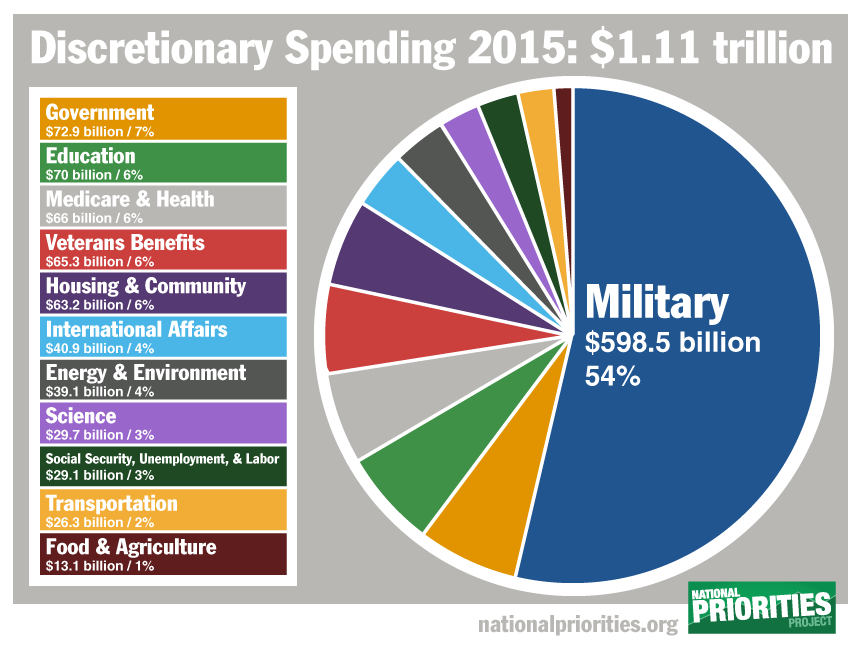
Americans might also want to ponder the fact that, with $700 billion per year now being pumped into the Pentagon by U.S. taxpayers, military spending consumes 54 percent of the federal discretionary budget. And, if President Trump’s official recommendations for future years are followed, the military’s share of the federal budget will surge to 65 percent by fiscal 2023. Combined with the huge budget deficits that will be produced by the GOP tax cuts for the wealthy and their corporations, this will almost certainly lead to devastating slashes in federal spending for education, healthcare, parks and recreation facilities, food distribution, jobs, infrastructure, and other public programs.
Of course, there are possibilities for blocking the current flood of military spending and its consequences. The political mobilization of the widespread, but thus far latent, constituency against increased funding for the Pentagon, coupled with enough Democratic victories at the polls in 2018 to return of the House of Representative to Democratic control, would slow―and perhaps halt―the drift toward an overwhelmingly military-oriented public policy.
Short of these developments, however, it seems likely that the U.S. government’s discretionary spending will be devoted primarily to preparations for war.
Dr. Lawrence Wittner (http://www.lawrenceswittner.com) is Professor of History emeritus at SUNY/Albany and the author of Confronting the Bomb (Stanford University Press).
-
Where Is That Wasteful Government Spending?
In early September 2016, Donald Trump announced his plan for a vast expansion of the U.S. military, including 90,000 new soldiers for the Army, nearly 75 new ships for the Navy, and dozens of new fighter aircraft for the Air Force. Although the cost of this increase would be substantial―about $90 billion per year―it would be covered, the GOP presidential candidate said, by cutting wasteful government spending.
 But where, exactly, is the waste? In fiscal 2015, the federal government engaged in $1.1 trillion of discretionary spending, but relatively small amounts went for things like education (6 percent), veterans’ benefits (6 percent), energy and the environment (4 percent), and transportation (2 percent). The biggest item, by far, in the U.S. budget was military spending: roughly $600 billion (54 percent). If military spending were increased to $690 billion and other areas were cut to fund this increase, the military would receive roughly 63 percent of the U.S. government’s discretionary spending.
Well, you might say, maybe it’s worth it. After all, the armed forces defend the United States from enemy attack. But, in fact, the U.S. government already has far more powerful military forces than any other country. China, the world’s #2 military power, spends only about a third of what the United States does on the military. Russia spends about a ninth. There are, of course, occasional terrorist attacks within American borders. But the vast and expensive U.S. military machine―in the form of missiles, fighter planes, battleships, and bombers―is simply not effective against this kind of danger.
Furthermore, the U.S. Department of Defense certainly leads the way in wasteful behavior. As William Hartung, the director of the Arms and Security Project of the Center for International Policy, points out, “the military waste machine is running full speed ahead.” There are the helicopter gears worth $500 each purchased by the Army at $8,000 each, the $2.7 billion spent “on an air surveillance balloon that doesn’t work,” and “the accumulation of billions of dollars’ worth of weapons components that will never be used.” Private companies like Halliburton profited handsomely from Pentagon contracts for their projects in Afghanistan, such as “a multimillion-dollar `highway to nowhere,’” a $43 million gas station in nowhere, a $25 million `state of the art’ headquarters for the U.S. military in Helmand Province . . . that no one ever used, and the payment of actual salaries to countless thousands of no ones aptly labeled `ghost soldiers.’” Last year, Pro Publica created an interactive graphic revealing $17 billion in wasteful U.S. spending uncovered by the U.S. Special Inspector General for Afghan Reconstruction.
Not surprisingly, as Hartung reports, the Pentagon functions without an auditing system. Although, a quarter century ago, Congress mandated that the Pentagon audit itself, it has never managed to do so. Thus, the Defense Department doesn’t know how much equipment it has purchased, how much it has been overcharged, or how many contractors it employs. The Project on Government Oversight maintains that the Pentagon has spent about $6 billion thus far on “fixing” its audit problem. But it has done so, Hartung notes, “with no solution in sight.”
The story of the F-35 jet fighter shows how easily U.S. military spending gets out of hand. Back in 2001, when the cost of this aircraft-building program was considered astronomical, the initial estimate was $233 billion. Today, the price tag has more than quadrupled, with estimates ranging from $1.1 trillion to $1.4 trillion, making it the most expensive weapon in human history. The planes reportedly cost $135 million each, and even the pilots’ helmets run $400,000 apiece. Moreover, the planes remain unusable. Although the U.S. Marine Corps and the U.S. Air Force recently declared their versions of the F-35 combat ready, the Pentagon’s top testing official blasted that assertion in a 16-page memo, deriding them as thoroughly unsuitable for combat. The planes, he reported, had “outstanding performance deficiencies.” His assessment was reinforced in mid-September 2016, when the Air Force grounded ten of its first F-35 fighters due to problems with their cooling lines.
U.S. wars, of course, are particularly expensive, as they require the deployment of large military forces and hardware to far-flung places, chew up very costly military equipment, and necessitate veterans’ benefits for the survivors. Taking these and other factors into account, a recent study at Brown University’s Watson Institute for International and Public Affairs put the cost to U.S. taxpayers of the U.S. wars in Iraq and Afghanistan at nearly $5 trillion thus far. According to the report’s author, Neta Crawford, this figure is “so large as to be almost incomprehensible.”
Even without war, another military expense is likely to create a U.S. budgetary crisis over the course of the next thirty years: $1 trillion for the rebuilding of the U.S. nuclear weapons complex, plus the construction of new nuclear missiles, nuclear submarines, and nuclear-armed aircraft. Aside from the vast cost, an obvious problem with this expenditure is that these weapons will either never be used or, if they are used, will destroy the world.
Wasted money, wasted lives, or maybe both. That’s the promise of increased military spending.
[Dr. Lawrence Wittner (http://www.lawrenceswittner.com) is Professor of History emeritus at SUNY/Albany. His latest book is a satirical novel about university corporatization and rebellion, What’s Going On at UAardvark?]
-
Are We in for Another Increase in Military Spending?
At the present time, an increase in U.S. military spending seems as superfluous as a third leg. The United States, armed with the latest in advanced weaponry, has more military might than any other nation in world history. Moreover, it has begun a $1 trillion program to refurbish its entire nuclear weapons complex. America’s major military rivals, China and Russia, spend only a small fraction of what the United States does on its armed forces―in China’s case about a third and in Russia’s case about a ninth. Furthermore, the economic outlay necessary to maintain this vast U.S. military force constitutes a very significant burden. In fiscal 2015, U.S. military spending ($598.5 billion) accounted for 54 percent of the U.S. government’s discretionary spending.
Certainly most Americans are not clamoring for heightened investments in war and war preparations. According to a Gallup poll conducted in February 2016, only 37 percent of respondents said the U.S. government spent too little “for national defense and military purposes,” compared to 59 percent who said it spent too much (32 percent) or about the right amount (27 percent).
These findings were corroborated by a Pew Research Center survey in April 2016, which reported that 35 percent of American respondents favored increasing U.S. military spending, 24 percent favored decreasing it, and 40 percent favored keeping it the same. Although these latest figures show a rise in support for increasing military spending since 2013, this occurred mostly among Republicans. Indeed, the gap in support for higher military spending between Republicans and Democrats, which stood at 25 percentage points in 2013, rose to 41 points by 2016.
Actually, it appears that, when Americans are given the facts about U.S. military spending, a substantial majority of them favor reducing it. Between December 2015 and February 2016, the nonpartisan Voice of the People, affiliated with the University of Maryland, provided a sample of 7,126 registered voters with information on the current U.S. military budget, as well as leading arguments for and against it. The arguments were vetted for accuracy by staff members of the House and Senate appropriations subcommittees on defense. Then, when respondents were asked their opinion about what should be done, 61 percent said they thought U.S. military spending should be reduced. The biggest cuts they championed were in spending for nuclear weapons and missile defense systems.
When it comes to this year’s presumptive Presidential candidates, however, quite a different picture emerges. The Republican nominee, Donald Trump, though bragging about building “a military that’s gonna be much stronger than it is right now,” has on occasion called for reducing military expenditures. On the other hand, his extraordinarily aggressive foreign policy positions have led defense contractors to conclude that, with Trump in the White House, they can look forward to sharp increases in U.S. military spending. Indeed, insisting that U.S. military power has shrunk to a pitiful level under President Obama, he has promised that, under his presidency, it would be “funded beautifully.” In March 2016, when Trump appeared on Fox News, he made that commitment more explicit by promising to increase military spending.
Given the considerably more dovish orientation of the Democratic electorate, one would expect Hillary Clinton to stake out a position more opposed to a military buildup. But, thus far, she has been remarkably cagey about this issue. In September 2015, addressing a campaign meeting in New Hampshire, Clinton called for the creation of a high-level commission to examine U.S. military spending. But whether the appointment of such a commission augurs increases or decreases remains unclear. Meanwhile, her rather hawkish foreign policy record has convinced observers that she will support a military weapons buildup. The same conclusion can be drawn from the “National Security” section of her campaign website, which declares: “As president, she’ll ensure the United States maintains the best-trained, best-equipped, and strongest military the world has ever known.”
Although the big defense contractors generally regard Clinton, like Trump, as a safe bet, they exercise even greater influence in Congress, where they pour substantially larger amounts of money into the campaign coffers of friendly U.S. Senators and Representatives. Thus, even when a President doesn’t back a particular weapons system, they can usually count on Congress to fund it. As a Wall Street publication recently crowed: “No matter who wins the White House this fall, one thing is clear: Defense spending will climb.”
Will it? Probably so, unless public pressure can convince a new administration in Washington to adopt a less militarized approach to national and international security.
Dr. Lawrence Wittner (http://www.lawrenceswittner.com) is Professor of History emeritus at SUNY/Albany. His latest book is a satirical novel about university corporatization and rebellion, What’s Going On at UAardvark? He is also a NAPF Associate.
-
The United States Is No. 1 – But In What?
[Dr. Lawrence Wittner (http://lawrenceswittner.com) is Professor of History emeritus at SUNY/Albany. His latest book is a satirical novel about university corporatization and rebellion, What’s Going On at UAardvark?]
 American politicians are fond of telling their audiences that the United States is the greatest country in the world. Is there any evidence for this claim?
Well, yes. When it comes to violence and preparations for violence, the United States is, indeed, No. 1. In 2013, according to a report by the Stockholm International Peace Research Institute, the U.S. government accounted for 37 percent of world military expenditures, putting it far ahead of all other nations. (The two closest competitors, China and Russia, accounted for 11 percent and 5 percent respectively.) From 2004 to 2013, the United States was also the No. 1 weapons exporter in the world. Moreover, given the U.S. government’s almost continuous series of wars and acts of military intervention since 1941, it seems likely that it surpasses all rivals when it comes to international violence.
This record is paralleled on the domestic front, where the United States has more guns and gun-related deaths than any other country. A study released in late 2013 reported that the United States had 88 guns for every 100 people, and 40 gun-related deaths for every 400,000 people―the most of any of the 27 economically developed countries surveyed. By contrast, in Britain there were 6 guns per 100 people and 1 gun-related death per 400,000 people.
Yet, in a great many other areas, the United States is not No. 1 at all.
Take education. In late 2013, the Program for International Student Assessment released a report on how 15-year old students from 65 nations performed on its tests. The report showed that U.S. students ranked 17th in reading and 21st in math. An international survey a bit earlier that year by the Organization for Economic Cooperation and Development found that the ranking was slightly worse for American adults. In 2014, Pearson, a multinational educational services company, placed the United States 20th in the world in “educational attainment”―well behind Poland and the Slovak Republic.
American healthcare and health fare even worse. In a 2014 study of healthcare (including infant mortality, healthy life expectancy, and mortality from preventable conditions) in 11 advanced industrial countries, the Commonwealth Fund concluded that the United States ranked last among them. According to the World Health Organization, the U.S. healthcare system ranks 30th in the world. Other studies reach somewhat different conclusions, but all are very unflattering to the United States, as are studies of American health. The United States, for example, has one of the world’s worst cancer rates (the seventh highest), and life expectancy is declining compared to other nations. An article in the Washington Post in late 2013 reported that the United States ranked 26th among nations in life expectancy, and that the average American lifespan had fallen a year behind the international average.
What about the environment? Specialists at Yale University have developed a highly sophisticated Environmental Performance Index to examine the behavior of nations. In the area of protection of human health from environmental harm, their 2014 index placed the United States 35th in health impacts, 36th in water and sanitation, and 38th in air quality. In the other area studied―protection of ecosystems―the United States ranked 32nd in water resources, 49th in climate and energy, 86th in biodiversity and habitat, 96th in fisheries, 107th in forests, and 109th in agriculture.
These and other areas of interest are dealt with by the Social Progress Index, which was developed by Michael Porter, an eminent professor of business (and a Republican) at Harvard. According to Porter and his team, in 2014 the United States ranked 23rd in access to information and communications, 24th in nutrition and basic medical care, 31st in personal safety, 34th in water and sanitation, 39th in access to basic knowledge, 69th in ecosystem sustainability, and 70th in health and wellness.
The widespread extent of poverty, especially among children, remains a disgrace in one of the world’s wealthiest nations. A 2013 report by the United Nations Children’s Fund noted that, of the 35 economically advanced countries that had been studied, only Rumania had a higher percentage of children living in poverty than did the United States.
Of course, the United States is not locked into these dismal rankings and the sad situation they reveal about the health, education, and welfare of its citizens. It could do much better if its vast wealth, resources, and technology were employed differently than they are at present.
Ultimately, it’s a matter of priorities. When most U.S. government discretionary spending goes for war and preparations for war, it should come as no surprise that the United States emerges No. 1 among nations in its capacity for violence and falls far behind other nations in providing for the well-being of its people.
Americans might want to keep this in mind as their nation embarks upon yet another costly military crusade.
-
The Limits of Military Power
Is overwhelming national military power a reliable source of influence in world affairs?
If so, the United States should certainly have plenty of influence today. For decades, it has been the world’s Number 1 military spender. And it continues in this role. According to a recent report by the Stockholm International Peace Research Institute, the United States spent $640 billion on the military in 2013, thus accounting for 37 percent of world military expenditures. The two closest competitors, China and Russia, accounted for 11 percent and 5 percent respectively. Thus, last year, the United States spent more than three times as much as China and more than seven times as much as Russia on the military.

Image via National Priorities Project. In this context, the U.S. government’s inability to get its way in world affairs is striking. In the current Ukraine crisis, the Russian government does not seem at all impressed by the U.S. government’s strong opposition to its behavior. Also, the Chinese government, ignoring Washington’s protests, has laid out ambitious territorial claims in the East and South China Seas. Even much smaller, weaker nations have been snubbing the advice of U.S. officials. Israel has torpedoed U.S. attempts to forge an Israeli-Palestinian peace settlement, the embattled Syrian government has been unwilling to negotiate a transfer of power, and North Korea remains as obdurate as ever when it comes to scuttling its nuclear weapons program.
Of course, hawkish critics of the Obama administration say that it lacks influence in these cases because it is unwilling to use the U.S. government’s vast military power in war.
But is this true? The Obama administration channeled very high levels of military manpower and financial resources into lengthy U.S. wars in Iraq and Afghanistan, and ended up with precious little to show for this investment. Furthermore, in previous decades, the U.S. government used its overwhelming military power in a number of wars without securing its goals. The bloody Korean War, for example, left things much as they were before the conflict began, with the Korean peninsula divided and a ruthless dictatorship in place in the north. The lengthy and costly Vietnam War led to a humiliating defeat for the United States — not because the U.S. government lacked enormous military advantages, but because, ultimately, the determination of the Vietnamese to gain control of their own country proved more powerful than U.S. weaponry.
Even CIA ventures drawing upon U.S. military power have produced a very mixed result. Yes, the CIA, bolstered by U.S. military equipment, managed to overthrow the Guatemalan government in 1954. But, seven years later, the CIA-directed, -funded, and -equipped invasion at Cuba’s Bay of Pigs failed to topple the Castro government when the Cuban public failed to rally behind the U.S.-instigated effort. Although the U.S. government retains an immense military advantage over its Cuban counterpart, with which it retains a hostile relationship, this has not secured the United States any observable influence over Cuban policy.
The Cold War confrontation between the U.S. and Soviet governments is particularly instructive. For decades, the two governments engaged in an arms race, with the United States clearly in the lead. But the U.S. military advantage did not stop the Soviet government from occupying Eastern Europe, crushing uprisings against Soviet domination in Hungary and Czechoslovakia, or dispatching Soviet troops to take control of Afghanistan. Along the way, U.S. hawks sometimes called for war with the Soviet Union. But, in fact, U.S. and Soviet military forces never clashed. What finally produced a love fest between Ronald Reagan and Mikhail Gorbachev and ended the Cold War was a strong desire by both sides to replace confrontation with cooperation, as indicated by the signing of substantial nuclear disarmament agreements.
Similarly, the Iranian and U.S. governments, which have been on the worst of terms for decades, appear to be en route to resolving their tense standoff — most notably over the possible development of Iranian nuclear weapons — through diplomacy. It remains unclear if this momentum toward a peaceful settlement results from economic sanctions or from the advent of a reformist leadership in Tehran. But there is no evidence that U.S. military power, which has always been far greater than Iran’s, has played a role in fostering it.
Given this record, perhaps military enthusiasts in the United States and other nations should consider whether military power is a reliable source of influence in world affairs. After all, just because you possess a hammer doesn’t mean that every problem you face is a nail.
Dr. Lawrence Wittner is Professor of History emeritus at SUNY/Albany. His latest book is a satirical novel about university corporatization and rebellion, What’s Going On at UAardvark?
-
The Shame of Nations: A New Record is Set for Spending on War

This article was originally published by the History News Network.
On April 17, 2012, as millions of Americans were filing their income tax returns, the highly-respected Stockholm International Peace Research Institute (SIPRI) released its latest study of world military spending. In case Americans were wondering where most of their tax money — and the tax money of other nations — went in the previous year, the answer from SIPRI was clear: to war and preparations for war.
World military spending reached a record $1,738 billion in 2011 — an increase of $138 billion over the previous year. The United States accounted for 41 percent of that, or $711 billion.
Some news reports have emphasized that, from the standpoint of reducing reliance on armed might, this actually represents progress. After all, the increase in “real” global military spending — that is, expenditures after corrections for inflation and exchange rates — was only 0.3 percent. And this contrasts with substantially larger increases in the preceding thirteen years.
But why are military expenditures continuing to increase — indeed, why aren’t they substantially decreasing — given the governmental austerity measures of recent years? Amid the economic crisis that began in late 2008 (and which continues to the present day), most governments have been cutting back their spending dramatically on education, health care, housing, parks, and other vital social services. However, there have not been corresponding cuts in their military budgets.
Americans, particularly, might seek to understand why in this context U.S. military spending has not been significantly decreased, instead of being raised by $13 billion — admittedly a “real dollar” decrease of 1.2 percent, but hardly one commensurate with Washington’s wholesale slashing of social spending. Yes, military expenditures by China and Russia increased in 2011. And in “real” terms, too. But, even so, their military strength hardly rivals that of the United States. Indeed, the United States spent about five times as much as China (the world’s #2 military power) and ten times as much as Russia (the world’s #3 military power) on its military forces during 2011. Furthermore, when U.S. allies like Britain, France, Germany, and Japan are factored in, it is clear that the vast bulk of world military expenditures are made by the United States and its military allies.
This might account for the fact that the government of China, which accounts for only 8.2 percent of world military spending, believes that increasing its outlay on armaments is reasonable and desirable. Apparently, officials of many nations share that competitive feeling.
Unfortunately, the military rivalry among nations — one that has endured for centuries — results in a great squandering of national resources. Many nations, in fact, devote most of their available income to funding their armed forces and their weaponry. In the United States, an estimated 58 percent of the U.S. government’s discretionary tax dollars go to war and preparations for war. “Almost every country with a military is on an insane path, spending more and more on missiles, aircraft, and guns,” remarked John Feffer, co-director of Foreign Policy in Focus. “These countries should be confronting the real threats of climate change, hunger, disease, and oppression, not wasting taxpayers’ money on their military.”
Of course, defenders of military expenditures reply that military force actually protects people from war. But does it? If so, how does one explain the fact that the major military powers of the past century — the United States, Russia, Britain, Germany, France, Italy, Japan, and China — have been almost constantly at war during that time? What is the explanation for the fact that the United States — today’s military giant — is currently engaged in at least two wars (in Iraq and Afghanistan) and appears to be on the verge of a third (with Iran)? Perhaps the maintenance of a vast military machine does not prevent war but, instead, encourages it.
In short, huge military establishments can be quite counterproductive. Little wonder that they have been condemned repeatedly by great religious and ethical leaders. Even many government officials have decried war and preparations for war — although usually by nations other than their own.
Thus, the release of the new study by SIPRI should not be a cause for celebration. Rather, it provides an appropriate occasion to contemplate the fact that, this past year, nations spent more money on the military than at any time in human history. Although this situation might still inspire joy in the hearts of government officials, top military officers, and defense contractors, people farther from the levers of military power might well conclude that it’s a hell of a way to run a world.
-
The High Costs of Nuclear Arsenals
 Nuclear weapons are costly in many ways. They change our relationship to other nations, to the earth, to the future and to ourselves.
In the mid-1990s a group of researchers at the Brookings Institution did a study of US expenditures on nuclear weapons. They found that the US had spent $5.8 trillion between 1940 and 1996 (in constant 1996 dollars).
This figure was informally updated in 2005 to $7.5 trillion from 1940 to 2005 (in constant 2005 dollars). Today the figure is approaching $8 trillion, and that amount is for the US alone.
There are currently nine countries with a total of over 20,000 nuclear weapons, spending $105 billion annually on their nuclear arsenals and delivery systems. That will amount to more than $1 trillion over the next decade. The US accounts for about 60 percent of this amount.
The World Bank has estimated that $40 to $60 billion in annual global expenditures would be sufficient to meet the eight agreed-upon United Nations Millennium Development Goals for poverty alleviation by 2015.
Meeting these goals would eradicate extreme poverty and hunger; achieve universal primary education; promote gender equality/empowerment; reduce child mortality; improve maternal health; combat HIV/AIDS and other diseases; ensure environmental sustainability; and develop partnerships for development.
The US is now spending over $60 billion annually on nuclear weapons and this is expected to rise to average about $70 billion annually over the next decade. The US spends more than the other eight nuclear weapons states combined.
We are now planning to modernize our nuclear weapons infrastructure and also our nuclear weapons and their delivery systems. This was part of the deal that President Obama agreed to for getting the New START agreement ratified in the Senate. It may prove to be a bad bargain.
The US foreign aid contribution in 2010 was $30 billion; in the same year, we spent $55 billion on our nuclear arsenal. Which expenditures keep us safer?
Another informative comparison is with the regular annual United Nations budget of $2.5 billion and the annual UN Peacekeeping budget of $7.3 billion. UN and Peacekeeping expenditures total to about $10 billion, which is less than one-tenth of what is being spent by the nine nuclear weapon states for maintaining and improving their nuclear arsenals.
The annual UN budget for its disarmament office (United Nations Office of Disarmament Affairs) is $10 million. The nuclear weapons states spend more than that amount on their nuclear weapons every hour. Or, to put it another way, the nine nuclear weapons states annually spend 10,000 times more for their nuclear arsenals than the United Nations spends to pursue all forms of disarmament, including nuclear disarmament.
The one place the US is saving money on its nuclear weapons is where it should be spending the most, and that is on the dismantlement of the retired weapons. The amount that the US spends on dismantlement of its nuclear weapons has dropped significantly under the Obama administration from $186 million in 2009 to $96 million in 2010 to $58 million in 2011. In the 1990s the US dismantled more than 1,000 nuclear weapons annually. We dismantled 648 weapons in 2008 and only 260 in 2010.
The US has about 5,000 nuclear weapons awaiting dismantlement, which, at the current rate of dismantlement, will take the US about 20 years. There are another 5,000 US nuclear weapons that are either deployed or held in reserve.
Beyond being very costly to maintain and improve, nuclear weapons have changed us and cost us in many other ways.
They have undermined our respect for the law. How can a country respect the law and be perpetually engaged in threatening mass murder?
These weapons have also undermined our sense of reason, balance and morality. They are designed to kill massively and indiscriminately – men, women and children.
They have increased our secrecy and undermined our democracy. Can you put a cost on losing our democracy?
Uranium mining, nuclear tests and nuclear waste storage for the next 240,000 years have incalculable costs. They are a measure of our hubris, as are the weapons themselves.
Nuclear weapons – perhaps more accurately called instruments of annihilation – require us to play Russian Roulette with our common future. What is the cost of threatening to foreclose the future? What is the cost of actually doing so?
-
Militarist Madness
This article was originally published on the History News Network.
Despite the vast rivers of blood and treasure poured into wars over the centuries, the nations of the world continue to enhance their military might.
According to a recent report from the prestigious Stockholm International Peace Research Institute (SIPRI), world military expenditures grew to a record $1.63 trillion in 2010. Middle East nations alone spent $111 billion on the military, with Saudi Arabia leading the way.
Arms sales have also reached record heights. SIPRI’s Top 100 of the world’s arms-producing companies sold $401 billion in weaponry during 2009 (the latest year for which figures are available), a real dollar increase of eight percent over the preceding year and 59 percent since 2002. These military companies do a particularly brisk business overseas, where they engage in fierce battles for weapons contracts. “There is intense competition between suppliers for big-ticket deals in Asia, the Middle East, North Africa and Latin America,” reports Dr. Paul Holtom, Director of the SIPRI Arms Transfers Program. Until recently, in fact, defense contractors scrambled vigorously to sell arms to Libya.
In numerous ways, the United States is at the head of the pack. Of the $20.6 billion increase in world military expenditures during 2010, the U.S. government accounted for $19.6 billion. Indeed, between 2001 and 2010, the U.S. government increased its military spending by 81 percent. As a result, it now accounts for about 43 percent of global military spending, some six times that of its nearest military rival, China.
U.S. weapons producers are also world leaders. According to SIPRI, 45 of its Top 100 weapons-manufacturers are based in the United States. In 2009, they generated nearly $247 billion in weapons sales—nearly 62 percent of income produced by the Top 100. Not surprisingly, the United States is also the world’s leading exporter of military equipment, accounting for 30 percent of global arms exports in the 2006-2010 period.
Being Number 1 might be exciting, even thrilling, among children. But adults might well ask if the benefits are worth the cost. Are they?
Let’s take a look at the issue of terrorism. Much of the last decade’s huge military buildup by the United States was called for in the context of what President George W. Bush called the “War on Terror.” And the costs, thus far, have been high, including an estimated $1.19 trillion that Americans have paid for the wars in Afghanistan and Iraq, plus thousands of Americans and vast numbers of Afghans and Iraqis who have been slaughtered. By contrast, the benefits are certainly dubious. Neither war resulted in the capture or killing of the terrorist mastermind, Osama bin Laden, who was tracked down in another country thanks to years of painstaking intelligence work and dispatched by a quick commando raid. Wouldn’t Americans (and people in other lands) be a lot safer from terrorism with fewer wars and better intelligence?
Of course, there is also the broader national security picture. Even without terrorism, the world is a dangerous place. War is certainly a hardy perennial. Nevertheless, simply increasing national military spending does not make nations safer. After all, when one country engages in a military buildup, others—frightened by this buildup—often do so as well. The result of this arms race is all too often international conflict and war. Wouldn’t nations be more secure if they worked harder at cooperating with one another rather than at threatening one another with military might? Even if they were not the best of friends, they might find it to their mutual advantage to agree to decrease their military spending by an equal percentage, thus retaining the current military balance among them. Also, they could begin turning over a broader range of international security issues to the United Nations.
Maintaining a vast military apparatus also starves other areas of a society. Currently, in the United States, most federal discretionary spending goes for war and preparations for war—and this despite an ongoing crisis over unemployment and a stagnating economy. Continuing this pattern, the Obama administration’s proposed federal budget for fiscal 2012, while increasing military spending, calls for sharp cuts in funding for education, income security, food safety, and environmental protection. Even as congress wrestles with the thorny issue of priorities, huge numbers of teachers, firemen, health care workers, social workers, policemen, and others—told that government revenues are no longer sufficient to fund their services—are being dismissed from their jobs. Other public servants are having their salaries and benefits slashed. Social welfare institutions are being closed. Thus, instead of defending the home front in the United States, the immensely costly U.S. military apparatus is helping to gut it.
Ultimately, as many people have learned through bitter experience, militarism undermines both peace and prosperity. Perhaps it’s time for government officials to learn this fact.
-
The Chance for Peace
This speech, commonly referred to as the “Cross of Iron” speech, was delivered by President Eisenhower to the American Society of Newspaper Editors on April 16, 1953.
In this spring of 1953 the free world weighs one question above all others: the chance for a just peace for all peoples.
To weigh this chance is to summon instantly to mind another recent moment of great decision. It came with that yet more hopeful spring of 1945, bright with the promise of victory and of freedom. The hope of all just men in that moment too was a just and lasting peace.
The 8 years that have passed have seen that hope waver, grow dim, and almost die. And the shadow of fear again has darkly lengthened across the world.
Today the hope of free men remains stubborn and brave, but it is sternly disciplined by experience. It shuns not only all crude counsel of despair but also the self-deceit of easy illusion. It weighs the chance for peace with sure, clear knowledge of what happened to the vain hope of 1945.
In that spring of victory the soldiers of the Western Allies met the soldiers of Russia in the center of Europe. They were triumphant comrades in arms. Their peoples shared the joyous prospect of building, in honor of their dead, the only fitting monument-an age of just peace. All these war-weary peoples shared too this concrete, decent purpose: to guard vigilantly against the domination ever again of any part of the world by a single, unbridled aggressive power.
This common purpose lasted an instant and perished. The nations of the world divided to follow two distinct roads.
The United States and our valued friends, the other free nations, chose one road.
The leaders of the Soviet Union chose another.
The way chosen by the United States was plainly marked by a few clear precepts, which govern its conduct in world affairs.
First: No people on earth can be held, as a people, to be enemy, for all humanity shares the common hunger for peace and fellowship and justice.
Second: No nation’s security and well-being can be lastingly achieved in isolation but only ineffective cooperation with fellow-nations.
Third: Any nation’s right to form of government and an economic system of its own choosing isinalienable.
Fourth: Any nation’s attempt to dictate to other nations their form of government is indefensible.
And fifth: A nation’s hope of lasting peace cannot be firmly based upon any race in armaments but rather upon just relations and honest understanding with all other nations.
In the light of these principles the citizens of the United States defined the way they proposed to follow, through the aftermath of war, toward true peace.
This way was faithful to the spirit that inspired the United Nations: to prohibit strife, to relieve tensions, to banish fears. This way was to control and to reduce armaments. This way was to allow all nations to devote their energies and resources to the great and good tasks of healing the war’s wounds, of clothing and feeding and housing the needy, of perfecting a just political life, of enjoying the fruits of their own free toil.
The Soviet government held a vastly different vision of the future.
In the world of its design, security was to be found, not in mutual trust and mutual aid but in force: huge armies, subversion, rule of neighbor nations. The goal was power superiority at all costs. Security was to be sought by denying it to all others.
The result has been tragic for the world and, for the Soviet Union, it has also been ironic.
The amassing of the Soviet power alerted free nations to a new danger of aggression. It compelled them in self-defense to spend unprecedented money and energy for armaments. It forced them to develop weapons of war now capable of inflicting instant and terrible punishment upon any aggressor.
It instilled in the free nations-and let none doubt this-the unshakable conviction that, as long as there persists a threat to freedom, they must, at any cost, remain armed, strong, and ready for the risk of war.
It inspired them-and let none doubt this-to attain a unity of purpose and will beyond the power of propaganda or pressure to break, now or ever.
There remained, however, one thing essentially unchanged and unaffected by Soviet conduct: the readiness of the free nations to welcome sincerely any genuine evidence of peaceful purpose enabling all peoples again to resume their common quest of just peace.
The free nations, most solemnly and repeatedly, have assured the Soviet Union that their firm association has never had any aggressive purpose whatsoever. Soviet leaders, however, have seemed to persuade themselves, or tried to persuade their people, otherwise.
And so it has come to pass that the Soviet Union itself has shared and suffered the very fears it has fostered in the rest of the world.
This has been the way of life forged by 8 years of fear and force.
What can the world, or any nation in it, hope for if no turning is found on this dread road?
The worst to be feared and the best to be expected can be simply stated.
The worst is atomic war.
The best would be this: a life of perpetual fear and tension; a burden of arms draining the wealthand the labor of all peoples; a wasting of strength that defies the American system or the Soviet system or any system to achieve true abundance and happiness for the peoples of this earth.
Every gun that is made, every warship launched, every rocket fired signifies, in the final sense, a theft from those who hunger and are not fed, those who are cold and are not clothed.
This world in arms in not spending money alone.
It is spending the sweat of its laborers, the genius of its scientists, the hopes of its children.
The cost of one modern heavy bomber is this: a modern brick school in more than 30 cities.
It is two electric power plants, each serving a town of 60,000 population.
It is two fine, fully equipped hospitals.
It is some 50 miles of concrete highway.
We pay for a single fighter with a half million bushels of wheat.
We pay for a single destroyer with new homes that could have housed more than 8,000 people.
This, I repeat, is the best way of life to be found on the road the world has been taking.
This is not a way of life at all, in any true sense. Under the cloud of threatening war, it is humanity hanging from a cross of iron.
These plain and cruel truths define the peril and point the hope that come with this spring of 1953.
This is one of those times in the affairs of nations when the gravest choices must be made, if there is to be a turning toward a just and lasting peace.
It is a moment that calls upon the governments of the world to speak their intentions with simplicity and with honest.
It calls upon them to answer the questions that stirs the hearts of all sane men: is there no other way the world may live?
The world knows that an era ended with the death of Joseph Stalin. The extraordinary 30-year span of his rule saw the Soviet Empire expand to reach from the Baltic Sea to the Sea of Japan, finally to dominate 800 million souls.
The Soviet system shaped by Stalin and his predecessors was born of one World War. It survived the stubborn and often amazing courage of second World War. It has lived to threaten a third.
Now, a new leadership has assumed power in the Soviet Union. It links to the past, however strong, cannot bind it completely. Its future is, in great part, its own to make.
This new leadership confronts a free world aroused, as rarely in its history, by the will to stay free.
This free world knows, out of bitter wisdom of experience, that vigilance and sacrifice are the price of liberty.
It knows that the defense of Western Europe imperatively demands the unity of purpose and action made possible by the North Atlantic Treaty Organization, embracing a European Defense Community.
It knows that Western Germany deserves to be a free and equal partner in this community and that this, for Germany, is the only safe way to full, final unity.
It knows that aggression in Korea and in southeast Asia are threats to the whole free community to be met by united action.
This is the kind of free world which the new Soviet leadership confront. It is a world that demands and expects the fullest respect of its rights and interests. It is a world that will always accord the same respect to all others.
So the new Soviet leadership now has a precious opportunity to awaken, with the rest of the world, to the point of peril reached and to help turn the tide of history.
Will it do this?
We do not yet know. Recent statements and gestures of Soviet leaders give some evidence that they may recognize this critical moment.
We welcome every honest act of peace.
We care nothing for mere rhetoric.
We are only for sincerity of peaceful purpose attested by deeds. The opportunities for such deeds are many. The performance of a great number of them waits upon no complex protocol but upon the simple will to do them. Even a few such clear and specific acts, such as the Soviet Union’s signature upon the Austrian treaty or its release of thousands of prisoners still held from World War II, would be impressive signs of sincere intent. They would carry a power of persuasion not to be matched by any amount of oratory.
This we do know: a world that begins to witness the rebirth of trust among nations can find its way to a peace that is neither partial nor punitive.
With all who will work in good faith toward such a peace, we are ready, with renewed resolve, to strive to redeem the near-lost hopes of our day.
The first great step along this way must be the conclusion of an honorable armistice in Korea.
This means the immediate cessation of hostilities and the prompt initiation of political discussions leading to the holding of free elections in a united Korea.
It should mean, no less importantly, an end to the direct and indirect attacks upon the security of Indochina and Malaya. For any armistice in Korea that merely released aggressive armies to attack elsewhere would be fraud.
We seek, throughout Asia as throughout the world, a peace that is true and total.
Out of this can grow a still wider task-the achieving of just political settlements for the otherserious and specific issues between the free world and the Soviet Union.
None of these issues, great or small, is insoluble-given only the will to respect the rights of all nations.
Again we say: the United States is ready to assume its just part.
We have already done all within our power to speed conclusion of the treaty with Austria, which will free that country from economic exploitation and from occupation by foreign troops.
We are ready not only to press forward with the present plans for closer unity of the nations of Western Europe by also, upon that foundation, to strive to foster a broader European community, conducive to the free movement of persons, of trade, and of ideas.
This community would include a free and united Germany, with a government based upon free and secret elections.
This free community and the full independence of the East European nations could mean the end of present unnatural division of Europe.
As progress in all these areas strengthens world trust, we could proceed concurrently with the next great work-the reduction of the burden of armaments now weighing upon the world. To this end we would welcome and enter into the most solemn agreements. These could properly include:
The limitation, by absolute numbers or by an agreed international ratio, of the sizes of the military and security forces of all nations.
A commitment by all nations to set an agreed limit upon that proportion of total production of certain strategic materials to be devoted to military purposes.
International control of atomic energy to promote its use for peaceful purposes only and to insure the prohibition of atomic weapons.
A limitation or prohibition of other categories of weapons of great destructiveness.
The enforcement of all these agreed limitations and prohibitions by adequate safe-guards, including a practical system of inspection under the United Nations.
The details of such disarmament programs are manifestly critical and complex. Neither the United States nor any other nation can properly claim to possess a perfect, immutable formula. But the formula matters less than the faith-the good faith without which no formula can work justly and effectively.
The fruit of success in all these tasks would present the world with the greatest task, and the greatest opportunity, of all. It is this: the dedication of the energies, the resources, and the imaginations of all peaceful nations to a new kind of war. This would be a declared total war, not upon any human enemy but upon the brute forces of poverty and need.
The peace we seek, founded upon decent trust and cooperative effort among nations, can be fortified, not by weapons of war but by wheat and by cotton, by milk and by wool, by meat and by timber and by rice. These are words that translate into every language on earth. These are needs that challenge this world in arms.
This idea of a just and peaceful world is not new or strange to us. It inspired the people of the United States to initiate the European Recovery Program in 1947. That program was prepared to treat, with like and equal concern, the needs of Eastern and Western Europe.
We are prepared to reaffirm, with the most concrete evidence, our readiness to help build a world in which all peoples can be productive and prosperous.
This Government is ready to ask its people to join with all nations in devoting a substantial percentage of the savings achieved by disarmament to a fund for world aid and reconstruction. The purposes of this great work would be to help other peoples to develop the underdeveloped areas of the world, to stimulate profitability and fair world trade, to assist all peoples to know the blessings of productive freedom.
The monuments to this new kind of war would be these: roads and schools, hospitals and homes, food and health.
We are ready, in short, to dedicate our strength to serving the needs, rather than the fears, of the world.
We are ready, by these and all such actions, to make of the United Nations an institution that can effectively guard the peace and security of all peoples.
I know of nothing I can add to make plainer the sincere purpose of the United States.
I know of no course, other than that marked by these and similar actions, that can be called the highway of peace.
I know of only one question upon which progress waits. It is this:
What is the Soviet Union ready to do?
Whatever the answer be, let it be plainly spoken.
Again we say: the hunger for peace is too great, the hour in history too late, for any government to mock men’s hopes with mere words and promises and gestures.
The test of truth is simple. There can be no persuasion but by deeds.
Is the new leadership of Soviet Union prepared to use its decisive influence in the Communist world, including control of the flow of arms, to bring not merely an expedient truce in Korea but genuine peace in Asia?
Is it prepared to allow other nations, including those of Eastern Europe, the free choice of their own forms of government?
Is it prepared to act in concert with others upon serious disarmament proposals to be made firmly effective by stringent U.N. control and inspection?
If not, where then is the concrete evidence of the Soviet Union’s concern for peace?
The test is clear.
There is, before all peoples, a precious chance to turn the black tide of events. If we failed to strive to seize this chance, the judgment of future ages would be harsh and just.
If we strive but fail and the world remains armed against itself, it at least need be divided no longer in its clear knowledge of who has condemned humankind to this fate.
The purpose of the United States, in stating these proposals, is simple and clear.
These proposals spring, without ulterior purpose or political passion, from our calm conviction that the hunger for peace is in the hearts of all peoples–those of Russia and of China no less than of our own country.
They conform to our firm faith that God created men to enjoy, not destroy, the fruits of the earth and of their own toil.
They aspire to this: the lifting, from the backs and from the hearts of men, of their burden of arms and of fears, so that they may find before them a golden age of freedom and of peace.