The War Crimes Trials and the Issue of Indiscriminate Bombing
On May 14, 1946, ten days after the opening of the International Military Tribunal for the Far East (popularly known as the Tokyo War Crimes Tribunal), Captain George Furness, a member of the defense counsel, cast serious doubt on the fairness of the Tribunal conducted by the victorious nations in World War II:
‘We say that regardless of the known integrity of the individual Members of this Tribunal they cannot, under the circumstances of their appointment, be impartial; that under such circumstances this trial, both in the present day and history, will never be free from substantial doubt as to its legality, fairness, and impartiality.’1
For this reason Captain Furness urged that the trial be conducted “by representatives of neutral nations free from the heat and hatred of war.”2
After Furness’ presentation, Major Ben Bruce Blakeney, another American member of the defense counsel, turned to the issue of “Crimes Against Peace,” and argued that such crimes “do not constitute charges of any offense known to or defined by any law.”3 He reasoned that war, and even waging a war of aggression, is not a crime, and cannot be defined as just or unjust. It is neither legal nor illegal. Moreover, he pointed out that, if considered a crime, waging war is an ex post facto crime, so that a ‘Crime Against Peace should be dismissed by the Tribunal as beyond its jurisdiction to entertain.’4
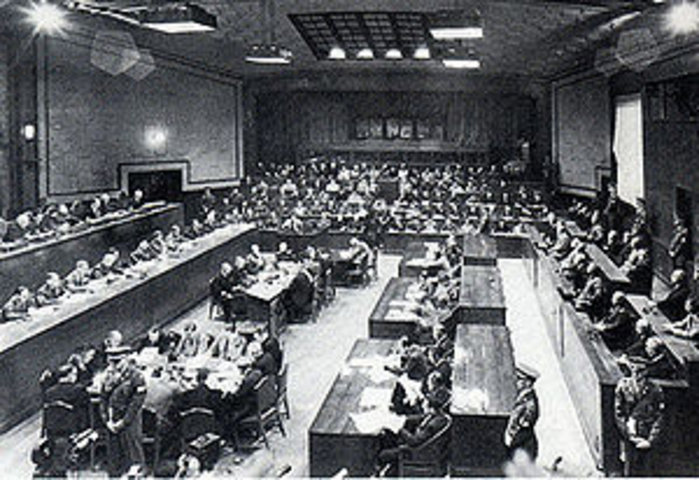
The International Military Tribunal for the Far East in session
Blakeney then argued that war is the act of a nation, not of individuals, so that killing in war cannot be charged as murder. In order to emphasize his point, he took the bold step of addressing the extremely sensitive issue of the atomic bombing of Hiroshima:
‘If the killing of Admiral Kidd by the bombing of Pearl Harbor is murder, we know the name of the very man who[se] hands loosed the atomic bomb on Hiroshima, we know the chief of staff who planned the act, we know the chief of the responsible state. Is murder on their consciences? We may well doubt it. We may well doubt it, and not because the event of armed conflict has declared their cause just and their enemies unjust, but because the act is not murder. Show us the charge, produce the proof of the killing contrary to the laws and customs of war, name the man whose hand dealt the blow, produce the responsible superior who planned, ordered, permitted or acquiesced in this act, and you have brought a criminal to the bar of justice.’5
Thus he implied that if the killing of combatants of the U.S. forces by Japanese forces during the Pearl Harbor attack was regarded as “murder,” by the same token the U.S. President, Harry S. Truman, and the U.S. Army Chief of Staff, George C. Marshall, i.e., two of the American leaders ultimately responsible for the atomic bombing of Hiroshima, could be accused of “murder” as well. In order to invalidate the new legal definition of “Crimes Against Peace,” he directly challenged the dominant popular American idea at the time that the atomic bombing of Hiroshima and Nagasaki was a rightful act of revenge for the surprise attack on Pearl Harbor. In fact Blakeney was convinced that the atomic bombing of Japanese citizens was clearly a violation of the Hague Convention IV, the Laws and Customs of War on Land. He clearly pointed this out in court on March 3, 1947. However, the evidence the defense counsel asked the court to examine in assessing the atomic bombing was rejected by a majority decision by the judges, and deliberation on this issue was never conducted.6
At the Tokyo War Crimes Tribunal, the issue of the indiscriminate bombing of many Chinese cities by Japanese Imperial Forces during the Asia Pacific War was never raised, despite repeated wartime condemnation by the US government of Japan’s aerial attacks on Chinese civilians. It is obvious that the reason for not bringing this matter before the court lay in America’s own conduct against Japanese civilians, which took the form of the most extensive aerial campaign against civilians, destroying sixty four Japanese cities with incendiary bombs and two with atomic bombs. The fact that the Nazis’ indiscriminate bombing of various cities in Europe and England was never a topic of criminal investigation at Nuremberg was probably due to the same reason.
In the end, Judge Pal from India, was the only person, among eleven judges who presided over the Tokyo War Crimes Tribunal, who made a critical comment on the atomic bombing, albeit briefly. In his dissenting judgment, he wrote:
‘It would be sufficient for my present purpose to say that if any indiscriminate destruction of civilian life and property is still illegitimate in warfare, then, in the Pacific war, this decision to use the atom bomb is the only near approach to the directives of German Emperor during the first world war and of the Nazi leaders during the second world war. Nothing like this could be traced to the credit of the present accused.’7
Interestingly, there was one exception at a B class trial conducted in Yokohama, in which the indiscriminate bombing of Japanese cities by American forces became the focus of a heated discussion in court. This was at the trial of General Okada Tasuku, who issued orders to execute several crew members of B-29 bombers, who had been captured by the Japanese after being shot down near Nagoya city, without conducting proper court-martial trials. Dr. Joseph Featherstone, an American lawyer acting as chief defense counsel for General Okada, argued that, because the American B-29 crews were engaged in unlawful indiscriminate bombings which killed and wounded many Japanese civilians, they were criminals rather than POWs. Featherstone claimed that the execution of those Americans was therefore legitimate. Although the court found General Okada guilty and sentenced him to death, it seems that Featherstone’s argument and the evidence he presented to the court had considerable influence on the relatively lenient judgments handed down to Okada’s subordinates who had carried out Okada’s orders. A number of American judges and prosecutors sent petitions to General MacArthur, requesting that he commute the death sentence to life imprisonment, however their appeals failed to change MacArthur’s decision.8
Okamoto’s Struggle for Justice for the Victims of the Atomic Bombings
One of the Japanese members of the defense counsel of the Tokyo War Crimes Tribunal was a lawyer named Okamoto Shoichi, who also acted as a member of the defense counsel for General Okada and assisted Featherstone. Okamoto’s experience with these American lawyers seems to have had considerable influence on his thinking concerning justice for the Japanese victims of aerial indiscriminate bombings, including the atomic bombings of Hiroshima and Nagasaki. Okamoto pursued a legal struggle to bring justice to the A-bomb survivors long after the conclusion of the Tokyo War Crimes Tribunal. In February 1953, Okamoto sent a copy of a booklet he had made to 64 lawyers in Hiroshima and Nagasaki. In “Genbaku Minso Wakumon (Questions and Answers on the Civil Lawsuit over the Atomic Bombings),” he requested the assistance and cooperation of his colleagues in Hiroshima and Nagasaki in order to file an action against the U.S. government over the atomic bombings of these two cities. The introduction explained how he came to entertain this idea.
‘I was a member of the defense council of the International Military Tribunal for the Far East for over two and half years from June 1946. What was always in my mind during this period was how unfair it was that, due to the simple fact that they won the war, the victor nations had never been questioned about their responsibility for some of their actions which violated international law. I was, however, quietly hoping that the leaders of the victor nations would at least express remorse for the atomic bombing of Hiroshima and Nagasaki after the peace treaty had been concluded.
A year has already passed, yet there is no sign of such action. It is utterly deplorable to see the U.S. and the U.K., nations in which Christianity is the dominant religion and humanism the base of democracy, behave in this manner.
While I was working as a member of the defense council of the IMTFE, I was already thinking of bringing a civil suit to pursue the responsibility for at least the atomic bombing of Hiroshima and Nagasaki after the peace treaty had come into effect. Thus I told my friends that I would like to file a suit in the court of jurisdiction against the leaders and nations who participated in this illegal action.
As the peace treaty became effective last year, I have renewed my decision and conducted some research on this issue. Consequently I now believe that it is possible to carry out this lawsuit in the U.S. and U.K., in particular in the U.S.’9
In this booklet, Okamoto explained the essential legal issues pertaining to the atomic bombing, providing his own answers to the important questions surrounding this contentious issue. It is clear from his arguments that he wished to apply the Nuremberg principle to the atomic bombing of Hiroshima and Nagasaki. His arguments can be summarized in the following four points.
1) The use of atomic bombs should be banned in accordance with the Regulations respecting the Law and Customs of War on Land annexed to the Hague Convention IV.
2) The atomic bomb is one of the most inhumane and brutal weapons ever created, capable of exterminating the entire human race. Therefore, the immunity of liable individuals in the name of “act of state” must not be applied in this case. The Nuremberg Trial and Tokyo Trial set precedents for this.
3) The liability for individual or corporate victims can be placed with two groups: one is that of the American individuals who participated in the decision making for the atomic bombings, the other is the U.S. government.
4) This case should be brought to an American court, as one of the main purposes of this trial is to judge the crime committed by the victor nation, and to this end it requires close assistance and cooperation from American lawyers with a strong sense of universal justice.10
It is clear that Okamoto was hoping to gain support from American lawyers, believing that many American law professionals would share the views of Furness, Blakeney, and Featherstone, who had made concerted efforts to defend accused Japanese wartime leaders by utilizing their knowledge of international criminal law. However, he realized that his trust in American lawyers was misplaced when Roger Baldwin, a well-known American pacifist and chairman of the International League for the Rights of Man, now known as the International League for Human Rights, responded to Okamoto’s request in March 1954. Baldwin was known in Japan as a human rights activist, having come to the country in 1947 on the invitation of General Douglas MacArthur, Supreme Commander of the Allied Powers, to foster the growth of civil liberties in that country. In Japan, he founded the Japan Civil Liberties Union, and later the Japanese government awarded him the Order of the Rising Sun for this contribution. Baldwin informed Okamoto that he was in complete opposition to Okamoto’s plan, as he believed the case had no legal base whatsoever and that it would be harmful for the U.S. – Japan bilateral relationship. Two months later, A. Wiling and F. Auckland, two members of the Los Angeles branch of the American Civil Liberties Union, for which Baldwin was the national leader until 1950, contacted Okamoto and offered their assistance as attorneys for this controversial case. For this service, however, they requested US$25,000 (equivalent to 9 million yen) as a minimum fee. At that time this was an unimaginably large sum of money for the A-bomb survivors, most of whom were suffering from various kinds of illness and struggling to survive without adequate medical and social welfare support from their own government. In fact, Okamoto was conducting his work at no charge and personally covered all operating costs, including the production cost of the aforementioned booklet.11
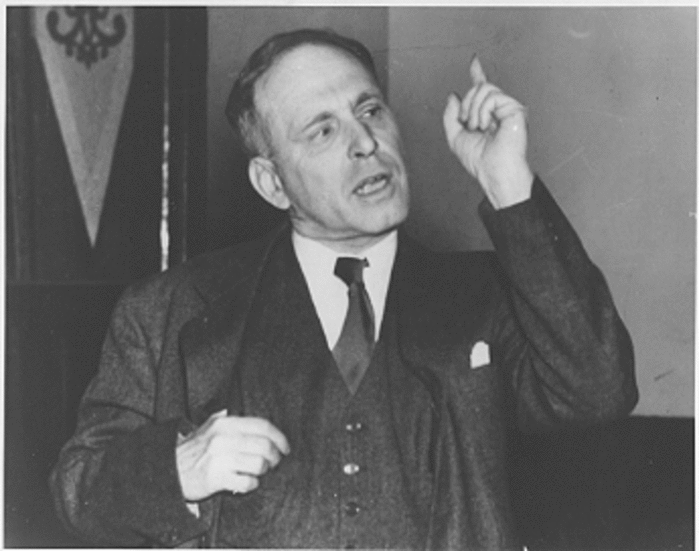
Roger Baldwin
Not only American human rights activists and lawyers but also Japanese lawyers and local politicians in Hiroshima and Nagasaki were reluctant to support Okamoto’s bold proposal. For example, the then mayor of Hiroshima and A-bomb survivor, Hamai Shinzo, declined Okamoto’s request to join this scheme, claiming that it could become a mud-slinging political contest with the U.S., although he said that he would not oppose private citizens joining the plan to pursue the judgment of the atomic bombing in strict accordance with international law. Most lawyers in the two cities, including those who were A-bomb survivors, were also unenthusiastic about taking legal action against the biggest economic and military world power. They regarded such action as unrealistic and success impossible, although some doubtless shared Okamoto’s view that indiscriminate attack on civilians with atomic bombs clearly constituted a war crime. It was the official opinion of both the Lawyers Association of Hiroshima and that of Nagasaki that an international tribunal established upon the international treaty should be created to deal with international crimes such as the atomic bombing of Hiroshima and Nagasaki, but they recognized that it would be extremely difficult to instigate legal action against the U.S. government to claim damages, given the language of the peace treaty concluded in 1951. Article 19 (a) of the Peace Treaty between the Allied Powers and Japan stated that ‘Japan waives all claims of Japan and its nationals against the Allied Powers and their nationals arising out of the war or out of actions taken because of the existence of a state of war, and waives all claims arising from the presence, operations or actions of forces or authorities of any of the Allied Powers in Japanese territory prior to the coming into force of the present Treaty.’12
The socio-political atmosphere in Japan during the occupation may also have deterred popular willingness to pursue justice for the victims of the atomic bombings. The U.S. occupation policy in Japan to suppress all information on the atomic bombings remained in effect until April 1952, when the Allied occupation ended.13 Because of the lack of accessible information due to this policy, the Japanese people at that time knew little of the nature of the atomic bombings and their aftereffects. It was not until 1954 that strong anti-nuclear sentiment suddenly erupted and spread all over Japan as a result of an incident in which radioactive dust from the American hydrogen bomb test called the Bravo shot fell, not only on many Marshall Islanders, but famously on a Japanese tuna fishing boat called the Lucky Dragon No.5, irradiating all twenty-three fishermen. Captain Kuboyama Aikichi died on September 23 in 1954. Nationwide anti-nuclear sentiment led to the creation of Gensuikyo (Japan Council Against A- and H-Bombs) in 1955, which launched a powerful movement opposing U.S. use of nuclear weapons in the Korean War. Yet even this active anti-nuclear trend did not directly transfer to nor invigorate support for Okamoto’s plan to seek legal justice for surviving A-bomb victims. It is difficult to understand the general passivity towards the “legal movement” in contrast to the vigorous popular anti-nuclear “political movement” of this period. It may have been due in part to the Japanese popular notion that, as a nation defeated in war, it was necessary to accept the consequences of defeat. In addition, many who were deeply involved in the anti-nuclear movement of this period were acutely aware of Japan’s responsibility for atrocities committed against Asian nations, hence may have been reluctant to support a movement to claim damages from the atomic bombing, even damages for victims.
Faced with the lack of support both from American and Japanese lawyers as well as from the public, Okamoto gave up the plan to bring the case to the U.S. court. He decided instead to appeal to a Japanese court. Fortunately a small group of A-bomb survivors in Hiroshima called “Genbaku Higaisha no Kai (The Association of A-bomb Survivors)” expressed full support and willingness to cooperate with Okamoto. Although this small group of A-bomb survivors later became the core of the large nation-wide A-bomb victims’ lobbying organization, “Nippon Gensuibaku Higaisha Dantai Kyogikai (Japan Confederation of A- and H-Bomb Sufferers Organization), at that time it was still a minor, non-political organization set up predominantly for mutual help among survivors, who had little public assistance or aid to cope with their harsh living conditions and protracted illness. Through the Association of the A-bomb Survivors in Hiroshima and those in Nagasaki who had contact with this organization, eventually five A-bomb survivors from Hiroshima and Nagasaki were selected in 1955 to become plaintiffs, ten years after the atomic bombings.14 Amongst them, the hardship experienced by Shimoda Ryuichi, a then 57-year-old man from Hiroshima, seemed to symbolically represent the lives of all the A-bomb survivors. The operator of a small, family-based factory, he lost four daughters and one son, aged between 4 and 16, as a result of the atomic bombing. He, his wife (40 years old at the time of the A-bomb attack) and their youngest child (a two-year-old boy), survived. In 1955 he had keloid burns all over his body caused by the bombing and suffered from liver and kidney disorder. Due to these health problems, he was unable to work, and both his wife and child suffered from persistent fatigue, headache and listlessness, i.e., the so-called “A-bomb disease,” a typical symptom of irradiated survivors. They were living in poverty, relying upon a small amount of money sent to them by his sister once a month.15
A 33-year-old lawyer born in Mihara City of Hiroshima Prefecture, Matsui Yasuhiro, joined Okamoto’s struggle to bring justice to the A-bomb survivors. Matsui had entered Kansai University Law School in Osaka in 1941, but was sent to China as a young army trainee paymaster in December 1943 before completing his study. He lost many relatives in the atomic bombing. His brother and an uncle were A-bomb survivors. After the war he entered and graduated from the Law School of Waseda University, beginning work as a lawyer in Tokyo in 1949. Okamoto, who was based in Osaka, often came up to Tokyo to discuss with Matsui important issues surrounding their case and to examine the opinions of various international law scholars. Together they prepared a complaint, and in April 1955, appealed to the District Court of Tokyo.16
There have been only a few scholarly analyses of this so-called Shimoda case both in Japan and the United States. Amongst them are the work of Professor Richard Falk, ‘The Shimoda Case: A Legal Appraisal of the Atomic Attacks on Hiroshima and Nagasaki,’ published in the American Journal of International Law in 1965, and a Japanese article written by Professor Fujita Hisakazu, entitled ‘Genbaku Hanketsu no Kokusaihoteki Saikento (A Re-examination of the Judgment of the A-bomb Trial),’ published in the Law School Journal of Kansai University in 1975. As both articles were written specifically for readers in legal profession, their analyses involve highly jurisprudential discussions. Hence, for general readers, many parts of their discussions are not easy to follow and fully comprehend. The aim of this paper is therefore to explain the important points of contention in this case as plainly as possible with the intention of learning lessons from the judgment and utilizing them for civil movements towards the abolishment of nuclear weapons.17
Damages Caused by the Atomic Bombings
Before assessing the arguments put forward by the plaintiffs as well as the defense of this controversial case, let us first objectively analyze the actual damages caused by the atomic bombings.18
At 8:15 am on the 6th of August, 1945, the world’s first atomic bomb was dropped on Hiroshima, and at 11:02 am on the 9th of August a second atomic bomb was dropped on Nagasaki. The bomb used on Hiroshima was a uranium type atomic bomb referred to as ‘Little Boy.’ It exploded 580 meters above the ground with a force equivalent to 12.5 kilotons of TNT. The bomb used on Nagasaki was a plutonium type atomic bomb known as ‘Fat Man’. It exploded 503 meters above the ground with a force equivalent to 22 kilotons of TNT. Of the total amount of energy that rained down to the ground, 35% was heat rays, 50% was the blast and the remaining 15% was radiation. The effects of these three elements of the bomb can be summarized respectively as follows:
(1) Heat rays: Estimates suggest that after the atomic bomb was detonated, powerful heat rays were released for a period of approximately 0.2 to 0.3 seconds, heating the ground to temperatures ranging from 3,000 to 4,000ºC. These heat rays burnt people near the hypocenter to ashes and melted bricks and rocks. It is said that people suffered burns up to 3.5 kilometers from the hypocenter in Hiroshima and up to 4 kilometers in Nagasaki. In addition, the heat rays burnt buildings, triggered large-scale fires and ignited an enormous firestorm.
(2) The Blast: The blast from the atomic bomb completely destroyed all surrounding structures in an area of 4.7 square miles by US estimate. In the areas surrounding the hypocenter, people were slammed into walls and crushed to death by collapsing houses. Injuries were sustained from flying glass and other debris even in areas a long distance from the hypocenter.
(3) Radiation: The most characteristic devastating feature of the atomic bomb was radiation. Of the total energy released by the explosion, 5% was comprised of initial radiation and 10% of residual radiation. The initial radiation was caused by the nuclear fission of uranium or plutonium. Gamma and neutron rays emitted at this time penetrated people on the ground. Neutron rays caused soil and above ground structures to become radioactive. Fission products were picked up and carried in the atmosphere by upward wind currents turning into ‘Black Soot’ and when in the atmosphere tiny particles became moist and fell to the ground in the form of ‘Black Rain.’ These radioactive particles caused both internal and external damage. Many of those killed in the months following the bomb displayed acute symptoms such as hair loss, diarrhea, purpuric skin lesions, bleeding gums and fever. Cancer, leukemia and various other after-effects also became apparent.
The compound effects of the heat rays, blast and radiation had a far greater effect than any of these would have had individually. Heat rays caused the outbreak of fires. Blast destroyed buildings causing secondary fires and the ensuing firestorm created upward wind currents that spread radioactive matter on the ground and through the atmosphere. Exposure to radiation seriously damaged the health and eventually took the lives of many people.
The atomic bomb wiped out the lives of many people in an instant. The victims of the bombs were not only Japanese nationals, but also many Koreans and Chinese who were working in Japan as well as some prisoners of war from the Allied forces captured by the Japanese military. Tens of thousands of others died soon after the bombs were dropped through lack of medical supplies. By the end of 1945, an estimated 140,000 people had died in Hiroshima and 70,000 in Nagasaki. Since 1945, countless more have died as a result of various after-effects. Many of those who experienced this ‘hell on earth’ also suffered serious psychological damage.
Radiation from the atomic bombs damaged genes, which later became a cause of cancer and left various other physical impediments that scientists still do not fully understand. Today, over 64 years after the end of the war, new after-effects are still appearing and the survivors live in constant fear. It is further thought that damage to health, particularly from radiation, has in some cases been passed on to children and grandchildren. Disfigurement also brought about many forms of anguish and discrimination. Marriage and employment became difficult and life became cut off from the healthy society. The atomic bombings made it impossible for many surviving hibakusha to live normal lives.
The Argument of the Plaintiffs
The following is the summary of the argument in the complaint filed by the plaintiffs:
‘The plaintiffs, Japanese nationals, were all residents either in Hiroshima or Nagasaki when atomic bombs were dropped on these cities by bombers of the United States [Army] Air Force in August 1945. Most of the members of their families were killed and many, including some of the plaintiffs themselves, were seriously wounded as a result of these bombings. The plaintiffs jointly brought the present action against the defendant, the State (of Japan), for damages on the following grounds: (a) that they suffered injury through the dropping of atomic bombs by members of the [Army] Air Force of the United States of America; (b) that the dropping of these atomic bombs as an act of hostility was illegal under the rules of positive international law then in force (taking both treaty law and customary law into consideration), for which the plaintiffs had a claim for damages; (c) that the dropping of atomic bombs also constituted a wrongful act under municipal law, ascribable to the United States and its President, Mr. Harry Truman: (d) that Japan had waived, by virtue of the provisions of Article 19 (a) of the Treaty of Peace with Japan of 1951, the claims of the plaintiffs under international law and municipal law, with the result that the plaintiffs had lost their claims for damages against the United States and its President; and (e) that this waiver of the plaintiffs’ claims by the defendant, the State, gave rise to an obligation on the part of the defendant to pay damages to the plaintiffs.’19
Let us examine this argument in more detail.20
The plaintiffs argued that the effects of heat rays, blast and radiation from the atomic bomb extended over 4 kilometers from the epicenter, which inevitably caused indiscriminate mass killing of the people in Hiroshima and Nagasaki. They claimed that the use of the atomic bomb was a clear breach of Article 23 (a) of the regulations of the Law and Customs of War on Land annexed to the Hague Convention IV on October 18, 1907, which states that it is specially forbidden ‘to employ poison or poisonous weapons,’ and ‘to employ arms, projectiles, or material calculated to cause unnecessary suffering.’ They claimed that it was also a breach of the Geneva Protocol of June 17, 1925, which prohibits ‘the use in war of asphyxiating, poisonous or other gases and all materials or devices.’ Given the fact that the effects of the atomic bomb were far more devastating than poisonous gases, they argued that the use of an atomic weapon was contrary to the fundamental principle of the laws of war that unnecessary pain must not be inflicted.
Concerning the indiscriminate nature of the atomic bomb attacks, the plaintiffs contended that it was a crime as defined by Article 25 of the regulations of the Law and Customs of War on Land of 1899, which states that ‘the attack or bombardment, by whatever means, of towns, villages, dwellings, or buildings which are undefended is prohibited.’ They also claimed that Articles 22 and 24 of the Draft Rules of Air Warfare of 1923 prohibit the indiscriminate aerial bombing of non-combatants. Article 24 allows only the aerial bombings of military targets such as military forces, military works, military establishments or depots, and factories engaged in the manufacture of arms, ammunitions, or distinctively military supplies. Article 22 states that ‘aerial bombardment for the purpose of terrorizing the civilian population, of destroying or damaging private property not of military character, or of injuring non-combatants, is prohibited.’ They argued that, although the Draft Rules of Air Warfare was not positive law at the time the atomic bombings were carried out, it was regarded as authoritative customary law by international jurists.
The plaintiffs alleged that President Truman, the supreme commander of the U.S. Forces, must have been well aware of the above-mentioned international treaty and customary laws. They also asserted that Truman must have had full knowledge, from the report of the test conducted a few weeks before ordering their use against Japan, how powerful and destructive the atomic bombs would be. The plaintiffs argued that one could have easily predicted that atomic bombs could annihilate the entire human race because of their immense destructiveness and their extraordinarily harmful effects on human bodies, so that the use of the atomic weapon was clearly prohibited by “natural law” or the “principle of international law” even if the positive laws could not have been applied to it. It was argued that atomic bombing is an act of massacre and thus cannot be seen as a plain military action, and that Truman and other war leaders of the U.S. who participated in the decision-making process of the atomic bombings of Hiroshima and Nagasaki, knowing that they would result in indiscriminate mass killings, clearly committed war crimes. Consequently, the plaintiffs contended that President Truman and other U.S. leaders were liable for compensating the damage caused by this deliberate act of inhumanity. It was their opinion that the sovereign immunity doctrine must not be applied to this case due to the fact that the atomic bombs were not used simply for the purpose of destroying the fighting power of the enemy nation but with the clear intention to indiscriminatingly kill large numbers of residents.
Finally, the plaintiffs argued that the Japanese government had violated their constitutional and vested rights by agreeing to the waiver provision of the Peace Treaty with the U.S. government (concluded in September 1951 and effective from April 1952) and was therefore legally responsible for satisfying the claims wrongfully waived. They also asserted that if the Japanese government had no choice but to renounce the plaintiffs’ claims for damages in order to conclude the Peace Treaty with the U.S., this action meant that the Japanese government surrendered these claims for the benefit of the nation. Hence, the Japanese government was accordingly responsible, the plaintiffs claimed, to properly compensate them in accordance with Article 29 (3) of Constitution.
The Argument of the Defense
Of course the defense conceded the fact of the atomic bombing of Hiroshima and Nagasaki, but it claimed that the Japanese government did not know whether the damage caused by these bombings was exactly as the plaintiffs claimed, and that it did not know the extent of the power of the atomic bomb. In fact, the casualty figures that the defense submitted to the court were considerably lower than what the plaintiffs claimed.21
The Japanese government contended that, as the use of atomic weapons was not expressly prohibited by international law, the question of a violation of international law did not arise when the bombs were dropped. Furthermore, the defense argued that ‘From the viewpoint of international law, war is originally the condition in which a country is allowed to exercise all means deemed necessary to cause the enemy to surrender,’ and that ‘Since the Middle Ages, belligerents have been permitted to choose the means of injuring the enemy in order to attain the special purpose of war, subject to certain conditions imposed by international customary law and treaties adapted to the times.’ In other words, the defense implied that any weapon could be utilized no matter how destructive, lethal and inhumane it would be, as long as there was no positive law or treaty to explicitly prohibit the use of such a weapon. It is truly surprising to hear such a defense of the use of the atomic bomb, expressed by the government of the nation which fell victim to the world’s first nuclear attacks and, as a result, established a Constitution explicitly adopting the principle of peace and non-violence.
In fact, since its surrender on August 15th 1945, the Japanese government has never lodged an official protest with the U.S. government concerning the atomic bombing of Hiroshima and Nagasaki, or, for that matter, the firebombing of more than one hundred Japanese cities and towns. The first and last official protest that the Japanese government made came immediately after the bombing of Nagasaki on August 9th, when the Japanese government sent a protest note to the U.S. government through the Swiss government under the name of then Minster of Foreign Affairs, Togo Shigenori.
In this protest note, the Japanese government clearly stated that ‘it is the fundamental principle of international law in war time that belligerents do not possess unlimited rights regarding the choice of the means of harming the enemy, and that we must not employ arms, projectiles, or material calculated to cause unnecessary suffering. They are each clearly defined by the Annex to the Hague Convention respecting the Law and Customs of War on Land, and by Article 22 and Article 23 (e) of the Regulations respecting the Law and Customs of War on Land.’ Furthermore, this note severely condemned the U.S., claiming that:
‘The indiscriminateness and cruelty of the bomb that the U.S. used this time far exceed those of poisonous gases and similar weapons, the use of which is prohibited because of these very qualities. The U.S. has ignored the fundamental principle of international law and humanity and has been widely conducting the indiscriminate bombing of the cities of our Empire, killing many children, women and old people, and burning and destroying shrines, schools, hospitals and private dwellings. Withal, they used a novel bomb, the power of which exceeds any existing weapons and projectiles in its indiscriminateness and cruelty. The use of such a weapon is a new crime against human culture.’22
There is no doubt that this note was drafted by a person knowledgeable in international law, indeed the Japanese government’s legal interpretation of the atomic bombing at that time was almost identical to that the plaintiffs of the Shimoda case put forward. It is therefore not at all surprising that the plaintiffs pointed to this fact in the courtroom and criticized the opportunistic change in the defense’s argument. The defense stated however, that ‘taking an objective view, apart from the position of a belligerent, and having considered the fact that the use of an atomic weapon is not yet regarded as illegal in accordance with international law, we reached the conclusion that it is not possible to hastily define it illegal.’ It is ironic that, from the view point of legal logic, the argument that the Japanese government advanced in the above mentioned protest note of August 1945 sounds far more “objective” and rational than that presented to the court by the defense twenty years later.
Regarding the plaintiffs’ claims for damages, the defense argued that because the atomic bombing is not a violation of international law, claims for damages are baseless. The claims for damages could become reality, the defense asserted, only if the nations in negotiation recognize them in a peace treaty. Therefore, the defense held, a legal right to damages is simply an abstract concept unless it is officially acknowledged in a peace treaty. To further confirm this argument, the defense asserted that no defeated nation has ever claimed damages for its nationals against a victorious nation. On the issue of the waiver, the defense stated that only the claims of Japan as a state were waived by Article 19(a) of the Peace Treaty, and therefore the plaintiffs’ claims for damages are irrelevant to the waiver provision of the treaty even if they could exist. The Japanese government further argued that, even if the waiver in Article 19(a) was construed as a violation of Article 29 of the Japanese Constitution, there would be no basis for recovery for damages as the Constitution ‘does not directly grant the people a concrete claim for compensation.’ According to its argument, the purpose of Article 29 of the Japanese Constitution is to establish a law by which the people are entitled to be compensated in the case that the state uses or expropriates their private properties for the public good. Thus, the defense asserted that it is only when such a law is enacted that the people are able to claim for compensation.
Overall, the basic argument advanced by the Japanese government is that a defeated nation has no right to condemn the wrong doings committed by a victorious nation, and that the citizens of the defeated nation must accept this as their unchangeable fate no matter how badly they are victimized. In other words, the Japanese government forced its citizens to accept that the law of the jungle applies: the weak (the defeated) are obliged to endure any injustice imposed by the powerful (the victor). This thinking clearly reflects the Japanese government policy issued immediately after the war – “Ichioku So Zange (collective repentance by the entire Japanese population for defeat in war),” – in which the government demanded that the Japanese people blame themselves for the misery caused by the war, and not condemn Emperor Hirohito or other war leaders. The real issue of “responsibility” for the war was thus blurred as it entailed no process of self-criticism of wrongdoing at the highest levels of power.
In court, the Japanese government tried to use the same non-legal argument that the U.S. government invented shortly after the war in order to justify the mass killing of Japanese civilians through the atomic bombing of Hiroshima and Nagasaki. This argument held that it was necessary to use atomic weapons against Japan in order to end the war, and that if the war had continued, millions more people —Japanese, Americans, Asians of many nations — would have died. We must be careful not to intermingle non-legal and legal arguments. A justification predicated on utility has nothing to do with the question of the legality of the use of atomic bombs. It must be emphasized that the criminality of a particular act defined by law cannot be justified by any non-legal argument which defends the conduct itself.
The U.S. government has persistently used this non-legal self-justification since the end of the Pacific War to defend the use of the atomic bombs. However, as conclusively demonstrated in the scholarly literature, the atomic bombing of Hiroshima and Nagasaki was not decisive in ending the war. Its political justification was a myth created by the American government and tacitly endorsed by the Japanese government for self-serving reasons. This explanation leaves open why the Japanese government did not concede to the Allies immediately after the atomic bombing of Hiroshima and Nagasaki. On 10 August 1945 – the day after the bombing of Nagasaki – the cities of Kumamoto and Miyazaki in Kyushu Prefecture and Sakata in Yamagata Prefecture were bombed. Two days later, Kurume, Saga and Matsuyama were targeted, and on 13 August Nagano, Matsumoto, Ueda and Otuki were bombed. On 14 August, in addition to a massive attack on Osaka with 700 heavy one-ton bombs dropped from 150 B-29 bombers, Akita, Takasaki, Kumagaya, Odawara and Iwakuni became the victims of the last U.S. bombing raids of the Asia Pacific War. The plain fact is that the massive destruction of Japanese cities, from the Tokyo raids of March 9-10 to those of August 14 failed to break the will of Japan’s leaders.23 Other political and strategic factors, notably the Soviet entry into the war and the invasion of Russian forces into Manchuria, as well as the US easing of the Potsdam surrender terms to protect the emperor played vital roles in bringing Japan’s final surrender.24
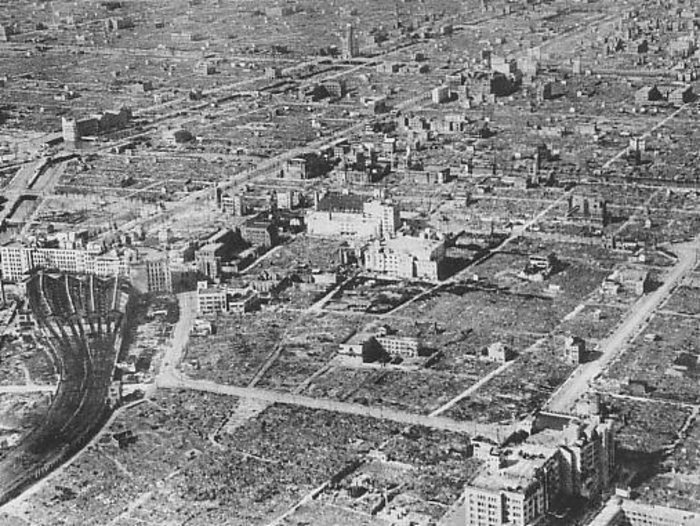
Osaka in the aftermath of bombing
Yet, even if the myth that the atomic bombing had ended the war were historically accurate, no historical or political justification can legitimate the criminality of the mass indiscriminate killing of civilians. We must be careful to ensure that the criminality of the atomic bombing of Hiroshima and Nagasaki not be blurred by historical or political arguments justifying such criminal conduct. In other words, the issue of criminality must not be evaded by any political or historical assessment of the event.
For 15 long years, Japan embarked on a war of aggression in Asia and long after it became clear that defeat was inevitable, Japan refused to surrender. In my view, therefore, the then Japanese Government and its leader, Emperor Hirohito, share together with the US authorities, part of the responsibility—both legal and moral responsibility—to the A-bomb victims for the disaster caused by the atomic bombing of Hiroshima and Nagasaki. Forced laborers sent from Japanese colonies such as Korea and Taiwan, and people from occupied China and South East Asia also became victims. The Japanese Government bears at least a degree of moral responsibility to these people too, if not legal responsibility.
Lessons from the Judgment
It took eight and half years to complete the court case, in December 1963. During this time, the chief judge changed five times and Okamoto Shoichi died of a stroke in April 1958 without seeing the result of his efforts.25 The final judgment was delivered by chief judge Koseki Toshimasa together with two other supporting judges, Mibuchi Yoshiko and Takakuwa Akira.26
On the issue of legality, the judgment clearly stated that the atomic bombing of Hiroshima and Nagasaki was a clear violation of international law and regulations respecting aerial warfare. The court cited a number of international laws including the Convention Respecting the Laws and Customs of War and Land of 1899, Declaration prohibiting aerial bombardment of 1907, the Hague Draft Rules of Air Warfare of 1922-1923, and Protocol prohibiting the use in war of asphyxiating, deleterious or other gases and bacteriological methods of warfare. It also said that ‘the prohibition in this case is understood to include not only the case where there is an express provision, but also the case where it is necessarily regarded that the use of new weapons is prohibited, from the interpretation and analogical application of exiting international laws and regulations (international customary laws and treaties).’ Thus the court dismissed the defense claim that since the use of atomic weapons was not expressly prohibited by either international law or international customary law, the question of a legal violation did not arise when the bombs were dropped. Thus the court found that ‘an aerial bombardment using an atomic bomb on both the cities of Hiroshima and Nagasaki was an illegal act of hostility as the indiscriminate aerial bombardment on undefended cities.’ It further stated that: ‘It is a deeply sorrowful reality that the atomic bombing on both the cities of Hiroshima and Nagasaki took the lives of many civilians, and that among the survivors there are people whose lives are still imperiled owing to the radial rays, even today 18 years later. In this sense, it is not too much to say that the pain brought by the atomic bombs is more severe than from poison-gas, and we can say that the act of dropping such a cruel bomb is contrary to the fundamental principle of the laws of war that unnecessary pain must not be inflicted.’
Regarding the individual responsibility of U.S. President Harry Truman and other American war leaders, the court adopted the traditional sovereign immunity doctrine, claiming that: ‘compensation for damage cannot be claimed in international law against U.S. President Truman, who ordered the atomic bombing. It is a principle of international law that the State must directly assume responsibility for acts taken by a person as a state organ, and that the person who holds the position as a state organ does not assume responsibility as an individual.’ It must be noted that this ruling is a clear contravention of the Nuremberg principle, under which the individual responsibility of many German and Japanese war leaders was relentlessly examined, and many were tried and found guilty, and some executed. Among them was General Tojo Hideki, who held the position of Prime Minister, i.e., “the position as a state organ,” for many years during the Asia Pacific War. If President Truman was not responsible for killing and injuring tens of thousands of Japanese civilians with atomic bombs simply because he was the U.S. President at the time he ordered that the bombs be dropped, by the same token General Tojo, then Prime Minister of Japan, should have been exonerated of responsibility for ordering his troops to attack Pearl Harbor, Manila, Singapore, and other cities during the Asia-Pacific War. In other words, Tojo should not have been prosecuted and executed because of his “crime against peace.” It seems that the three judges who delivered the judgment on the Shimoda case did not carefully study the ruling of the Tokyo War Crimes Tribunal, although they appeared to have done considerable research on positive international laws, treaties and customary laws regarding the conduct of war. Consequently, Japan missed the opportunity to apply the Nuremberg principle to one of the most horrific crimes against humanity in the history of mankind, a principle which was established at the sacrifice of millions of lives of civilians and soldiers in the war.
As far as the judgment on the issues of the waiver in Article 19(a) of the Peace Treaty and the plaintiffs’ claim for compensation are concerned, the court’s explanation for its decision seems extremely far-fetched. The court supported the argument of the Japanese government and ruled that individuals had no rights under international law unless specifically recognized in a treaty, thus there was no general way open for individuals to claim damages directly under international law. However, it admitted that Japan did waive all its claims, stating that: ‘It is clear that the “claims of Japan” which were waived by this provision includes all claims which Japan had in accordance with treaties and international customary laws. Accordingly, claims for compensation for damages caused to Japan by illegal acts of hostility, for example, are necessarily included.’
The most convoluted aspect of the court’s decision comes from the judges’ statement that the claims of Japanese nationals waived in the Peace Treaty were claims valid under the municipal laws of Japan and under those of the Allied Powers and not claims in international law. Moreover, although it is not very clearly elucidated, the judgment seems to state that, because of the existence of sovereign immunity in the U.S., the plaintiffs had no right to claim damages against the Allied Powers either under Japanese municipal laws or under those of the Allied Powers. In other words, the court claimed that from the beginning, the plaintiffs’ claim for damages simply did not exist, and therefore ‘it follows that the plaintiffs had no rights to lose, and accordingly there is therefore no reason for asserting the defendant’s legal responsibility.’ This seems dubious as a legal argument, but because of this ruling the plaintiffs’ claims for damages were dismissed. As I have already discussed, however, the reasoning behind this ruling becomes invalid when the concept of sovereign immunity is nullified.
In conclusion, it can be said that the atomic bomb survivors won a partial victory in this case, as it was acknowledged that they were victims of unlawful indiscriminate bombing conducted by the Americans. However, it seems that the judgment in this case had little impact on either the US or Japanese governments. Indeed, there is a general lack of awareness in both Japan and the U.S. of this Japanese legal case in which the atomic bombings were the main issue of contention, let alone the fact that the atomic bombings were declared a violation of international laws. Knowledge of the case should be disseminated widely and used in the service of anti-nuclear actions all over the world, particularly in the U.S. It should also be fully utilized, by overcoming the defects and emphasizing positive aspects of the ruling, to establish a nuclear weapons convention to abolish all nuclear weapons as soon as possible.
Yuki Tanaka is Research Professor, Hiroshima Peace Institute, and author a coordinator of The Asia-Pacific Journal. He is the author most recently of Yuki Tanaka and Marilyn Young, eds., Bombing Civilians: A Twentieth Century History. He wrote this article for The Asia-Pacific Journal.
Recommended citation: Yuki Tanaka and Richard Falk, “The Atomic Bombing, The Tokyo War Crimes Tribunal and the Shimoda Case: Lessons for Anti-Nuclear Legal Movements,” The Asia-Pacific Journal, Vol. 44-3-09, November 2, 2009.
Notes
1 R. John Pritchard, The Tokyo Major War Crimes Trial: The Records of the International Military Tribunal for the Far East (The Edwin Mellen Press, 1998) vol.2, p.200.
2 Ibid., p.200.
3 Ibid., p.206.
4 Ibid., p.209.
5 Ibid., p.212.
6 R. John Pritchard, The Tokyo Major War Crimes Trial: The Records of the International Military Tribunal for the Far East, (The Edwin Mellen Press, 1998) vol.38, pp.17,655 – 17,663.
7 R.B. Pal, International Military Tribunal for the Far East: Dissentient Judgment of Justice (1953) p.621.
8 For details of this court case, see Ohoka Shohei, Nagai Tabi (A Long Journey) (Shincho-sha, 1982). The court’s judgement is here: Ryuichi Shimoda et al. v. The State
In 2008, a feature film “Ashita e no yuigon (Best Wishes for Tomorrow)” was produced based upon this documentary book. The trailer of this film is available at this website.
The Stars and Stripes review, Norio Murio, “Japanese film a poetic look at WWII war crimes trial,” can be found at this website.
9 The introduction to “Genbaku Minso Wakumon (Questions and Answers on the Civil Lawsuit over the Atomic Bombings)” by Okamoto Shoichi is reprinted in, Matsui Yasuhiro, Genbaku Saiban: Kakuheiki Haizetu to Hibakusha Engo no Hori (The A-Bomb Trial: Legal Principles for Abolishing Nuclear Weapons and Supporting A-bomb Survivors) (Shin-Nippon Shuppan-sha, 1986) pp.16 – 19.
10 Maruyama Mutsuo, ‘Genbaku Saiban no Imisuru-mono (The Meaning of the A-bomb Trial),’ in Nippon Senryo: Kyodo Kenkyu (The Occupation of Japan: A Cooperative Research) ed. by Shiso no Kagaku Kenkyu-kai (Tokuma Shobo, 1972) p.383.
11 Ibid., p.383; Matsui Yasuhiro, op.cit., pp.21 – 22.
12 Maruyama Mutsuo, op.cit., pp.383 – 389; Matsui Yasuhiro, op.cit., pp.20 – 21.
13 For details of the U.S. censorship on the Japanese publications concerning the effects
of the Atomic bombing of Hiroshima and Nagasaki, see Monica Braw, The Atomic Bomb Suppressed: American Censorship in Occupied Japan (M.E. Sharpe, 1997).
14 Maruyama Mutsuo, op.cit., p.383.
15 The information on Shimoda’s personal background is included in the complaint submitted to the District Court of Tokyo on April 25, 1955. The full text of the complaint is reprinted in the aforementioned book by Matsui Yasuhiro. See Matsui Yasuhiro, op.cit., pp.24 – 36.
16 Matsui Yasuhiro, op.cit., p.22. Regarding Matsui’s personal background, see Matsui Yasuhiro, Senso to Kokusai-ho: Genbaku Saiban kara Rasseru Hotei e (War and International Law: From the Atomic Bomb Trial to the Russell Tribunal) (Sanseido, 1968) pp.55 – 57; and Ushiomi Toshitaka, Kitano Hirohisa, Oda Shigemitsu and Toriu Chusuke eds., Gendai Shiho no Kadai (The Problems of Modern Judicature) (Saegusa Shobo 1982) pp.451 – 456.
17 Richard Falk’s article was reproduced in his book, Legal Order in A Violent World (Princeton University Press, 1968) pp.374 – 413. Fujita’s work on this court case concentrates on the discussion of the illegality of the indiscriminate bombing and in no way deals with the issue of the plaintiffs’ claims for damages. Francis Boyle also discusses the criminality of the atomic bombing in conjunction with this court case in Chapter 2 of his book, The Criminality of Nuclear Deterrence: Could the U.S. War on Terrorism Go Nuclear? (Clarity Press, 2005).
18 For details of the effects of the atomic bombing of Hiroshima and Nagasaki, see, for example, The Committee for the Compilation of Materials on Damage Caused By the Atomic Bombs in Hiroshima and Nagasaki, Hiroshima and Nagasaki – the Physical Medical and Social Effects of the Atomic Bombings (Hutchinson & Co., 1981); and Leif E. Peterson and Abrahamson Seymour, eds., Effects of Ionizing Radiation: Atomic Bomb Survivors and Their Children:1945-1995 (Joseph Henry Press, 1998).
19 The court’s decision, including the summaries of the complaint and the defense argument, was translated into English and published in The Japanese Annual of International Law for 1964. The full text of the English translation is also reprinted in R. Falk and S. Mendlovitz eds., Towards A Theory of War Prevention (World Law Fund, 1966). The original Japanese text of the decision is reproduced in full in the aforementioned book by Matsui Yasuhiro. See Matsui Yasuhiro, op.cit., pp.206 – 246.
20 See the full text of the complaint reproduced in Matsui Yasuhiro, op.cit., pp.24 – 36.
21 See “The Summary of the Defense Argument” reproduced in Matsui Yasuhiro, op.cit., pp.218 – 225.
22 The plaintiffs submitted a copy of this Japanese government’s official protest against the U.S to the court. This copy is reproduced in Matsui Yasuhiro, op.cit., pp.248 – 249.
23 For details of the bombing of Japanese cities by the U.S. Army Air Force and its effects on Japanese policies, see, for example, Mark Selden, ‘A Forgotten Holocaust: U.S. Bombing Strategy, The Destruction of Japanese Cities, and American Way of War From the Pacific War to Iraq,’ in Bombing Civilians: A Twentieth Century History, ed. by Yuki Tanaka and Marilyn Young (New Press, 2009) pp.76 – 96.
24 Regarding the effect of the Soviet entry into the war and the invasion of Russian forces into Manchuria upon Japan’s decision to surrender, see Tsuyoshi Hasegawa, ‘Were the Atomic Bombings of Hiroshima and Nagasaki Justified?’ in Yuki Tanaka and Marilyn Young, op.cit., pp.97 – 134.
25 Matsui Yasuhiro, op.cit., p.22.
26 See “The Reason for the Decision,” reproduced in Matsui Yasuhiro, op.cit., 225 – 246.
Comment on Yuki Tanaka’s “The Atomic Bombing: The Tokyo War Crimes Tribunal and the Shimoda Case: Lessons of U.S. Culpability for Anti-Nuclear Legal Movements”
Richard Falk
When I first learned of the Shimoda Case more than 45 years ago from a young Japanese diplomat who was a student in my course on international law at Princeton University, I was immediately moved and excited. Moved because of the initiative mounted by badly wounded survivors of the atomic bombings who were seeking symbolic compensation, while primarily dedicating themselves to an effort to have a court of law pronounce upon these horrifying atom bombs that demolished the cities of Hiroshima and Nagasaki at the end of World War II. Excited because I believed, naively it turns out, that such a judicial determination would have some bearing on the struggle to outlaw forever this weaponry of mass destruction, and discourage its development, possession, and deployment. Now that Yuki Tanaka has revived these issues in his informative essay, I find myself still moved by the Shimoda litigation, but no longer excited as it seems evident that the nuclear weapons states, most of all the United States, are as resistant as ever to acknowledging their past crime of dropping the atomic bomb and remain resolved to retain nuclear weaponry until the end of time.
True, the current American president, Barack Obama, made a visionary speech in Prague on April 5, 2009, in which he dedicated himself to the goal of a world without nuclear weapons. Obama also acknowledged, and was the first president to do so in a semi-apologetic spirit, that the United States had a special “moral responsibility to act” as it was “the only nuclear power to have used a nuclear weapon.” But the engagement with a world without nuclear weapons was tempered, if not nullified, by a heavy dose of realism: “I’m not naïve. The goal will not be reached quickly—perhaps not in my lifetime.” This cautionary aside has been repeated often, presumably to reassure nuclearists that they can sleep comfortably because no serious move to eliminate nuclear weapons for the foreseeable future will be taken. After all, President Obama didn’t reinforce his words with a few concrete acts that would not in any way increase American security risks: for instance, he could have de-alerted the thousands of nuclear weapons deployed during the Cold War; he could have set new targets for the reduction and eventually elimination of nuclear weapons; he could more dramatically have pledged the United States to do what China has already pledged to do—never to be the first to use nuclear weapons; or even more boldly, he could have called upon Israel to join with Iran and others in the Middle East to renounce the option to acquire or possess nuclear weapons, dismantling the existing Israeli arsenal.
It is likely that the Obama presidency, certainly as compared to their predecessors, will encourage a variety of arms control steps associated with inhibiting any further proliferation of nuclear weapons as well as lend support to measures such as the comprehensive nuclear weapons test ban treaty (CTBT). Such managerial steps are prudent, but do not advance the world one inch closer to the Obama denuclearizing vision.
In these central respects the Shimoda case could just as well have been decided on another galaxy, or for that matter, never decided at all. It remains virtually unknown even among peace activists, except perhaps in Japan, whose interest is in nuclear disarmament, or for a few, in the World Court advisory opinion in 1996 that concluded by an 11-3 majority that nuclear weapons might be lawful in extreme circumstances, that is, if used to uphold the survival of a state facing destruction or conquest. In other words there exists very little legal consciousness about the status of nuclear weaponry, and what inhibitions do exist are mainly of an ethical or political character. Several decades ago E.P. Thompson reminded us that even the announced willingness of the nuclear weapons states to possess and possibly use such weaponry inscribes in the culture an ‘exterminist’ ethos that is extremely harmful, exhibiting a total disregard for the sacredness of life.
As I read Tanaka, his concerns are associated with a revisiting of the past so as to impart lessons to the peace movements of the present that will produce a future that corresponds to the Obama vision of a world without nuclear weaponry. Of course, any recall of Hiroshima and Nagasaki possesses an inexhaustible resonance for peace oriented persons, but not the mainstream. Significantly, the Holocaust is different in this respect. Evoking the Holocaust, visits to the death camps, are ritualistically relied upon by politicians and the mainstream to establish moral credibility. One benefit of Tanaka’s essay is to help us understand this enduring denial of the criminality of the atomic attacks on Japanese cities. In this regard, the comparison of the Tokyo War Crimes Tribunal (TWCT) and the Shimoda case is illuminating. The TWCT was essentially, although less so than its Nuremberg sibling, a morality play staged by the winners in an ugly war. At least in Tokyo there were several judges from neutral countries, and an angry Indian judge from still colonized India, whose long dissent impressively challenged the whole presupposition that Japan was the aggressor in the Far Eastern part of World War II.
Let me put the issue in a very stark form: winners in a major war are unwilling to cast any shadow of responsibility onto their self-glorifying narrative of their victory. Is there the slightest doubt that if Germany or Japan had succeeded in developing the atomic bomb before the United States, then used it let’s say against Boston or Seattle, yet still went on to lose the war, that the use of such a weapon would have been the major charge leveled against their surviving leaders? It is notable that Germany as loser remains full of remorse about the Holocaust, and to this day Germans are reluctant to criticize Israel so as to avoid the slightest implication that the anti-semitic Nazi past has not been completely repudiated. The Shimoda case was so notable because it offered a glimmer of recognition to this legally neglected awesome atrocity that had been treated heretofore with respectful silence even by the Japanese Government. In this sense, an informal, yet integral part of the American occupation policy was to silence critical voices in Japan while in Germany insisting on full disclosure and reparations for the horrors of Nazism. Revealingly, the Holocaust led directly to the Genocide Convention whereas the atomic bombings led to the nuclear arms race.
Tanaka instructively relates the valiant efforts of Okamoto Shoichi to invoke international law both to ban the atom bomb forever, and to empower victims to impose some sort of liability on the perpetrators of the atomic attacks by recourse to American courts on the basis of a presumed appeal to ‘universal justice.’ But it turned out to be completely naïve to suppose that even American liberals were willing to have the wartime actions of their government in what was widely regarded as ‘a just war’ assessed by recourse to the international law of war. American ‘exceptionalism’ (so widely discussed recently in relation to the presidency of George W. Bush, particularly in relation to the ‘war on terror’) is nothing new. It is not surprising that Okamoto’s efforts were unappreciated at the time by Japanese officials, even by the mayor of Hiroshima. The loser in a major war experiences what might be called ‘loser’s justice,’ requiring acknowledgement of your nation’s crimes, while refraining altogether from accusing or even criticising the victor.
Yet fortunately, the people are not as subject to this geopolitical discipline as are governmental elites. As Tanaka shows very well, it was not Hiroshima and Nagasaki that caused an anti-nuclear populism to erupt in Japan but an incident in 1954 when an American nuclear test explosion in the Pacific destroyed a Japanese fishing boat, mysteriously named the Lucky Dragon, killing entire the crew. Even in this heightened atmosphere of anti-nuclearism, there was a reluctance among Japanese and American lawyers to push for any United States accountability in a judicial setting. It was only the determined efforts of Okamoto and some others that broke through the barriers of denial, initiating this private symbolic action in the Tokyo District Court in 1955, which produced this historic decision pronounced on December 7, 1963, the 22nd anniversary of the Pearl Harbor attacks.
The Shimoda case stands alone as a legal condemnation of the atomic attacks, a precedent in international law that reinforces the moral and political rejection of nuclear weaponry, but only theoretically. The truth is that the Shimoda case never had much of an impact. It was not even cited by the judges in the International Court of Justice (ICJ) in their lengthy assessments of the legality of nuclear weaponry. Perhaps, this is partly because the deciding court was not a high court in Japan, and partly because even the ICJ was not willing to view even retrospectively the alleged criminality of the 1945 atomic attacks on Japanese cities. In this respect, decades later the exemption of victors from legal scrutiny has not dissipated. Nothing would have been more natural than for the judges in the ICJ to ground their legal assessment in the abstract upon the one instance in which such weaponry had been used.
Tanaka understandably calls for the wide dissemination of the Shimoda text as part of the ongoing worldwide struggle to abolish nuclear weapons. It is a dramatic story that imparts a sense of tragedy and atrocity that resulted from the atomic attacks, but whether the legal assessment is of any great importance 46 years later is questionable. I believe that more than twenty years ago an obscure American playwright was inspired by the case to compose a theater piece built around the stories of the survivors. In this respect, the continuous retelling of the suffering inflicted at Hiroshima and Nagasaki is the most powerful means we have of resisting the efforts of power-wielders to bury concerns about nuclear war in the abstractions of deterrence and arcane discussions of military strategy. Any sane person should realize without elaborate demonstrations by lawyers and judges that the use or threat of weapons of mass destruction to attack cities is a crime against humanity of genocidal proportions. And yet.
As mentioned, the new American president has voiced his idealistic commitment to a world without nuclear weapons. We should be thankful for the articulation of such a sentiment, however belatedly it comes. But we should also insist that he follow through or else we who applauded the Prague speech will be properly dismissed as not serious. So far, the evidence is not encouraging. There still remains a global setting shaped by an American leadership in which the overriding concern about nuclear weapons is concentrated on countries without such weapons rather than on those that possess the weapons, and are not even willing to renounce options to use them. So long as nonproliferation is the preoccupation, and disarmament a goal situated beyond the horizon of feasibility, there may be lofty talk by leaders about getting rid of nuclear weapons, but expectations should remain low.
The United States is particularly sensitive about pronouncements of unlawfulness and criminality. It should be remembered that the U.S. Government, during the Clinton presidency used its full weight in the UN General Assembly to discourage governments from asking the ICJ for a judicial opinion as to the legality of nuclear weapons. The fact that this geopolitical maneuver was unsuccessful suggests that at some level of policy many governments would like to see these weapons outlawed and eliminated. It is also notable that the judges in the ICJ were unanimous in their insistence that nuclear weapons states had a legal obligation under Article VI of the Nonproliferation Treaty to pursue nuclear disarmament in good faith. It is equally notable that such an obligation, clearly spelled out, has been ignored without adverse consequences. Non-nuclear states could indicate that they would regard the NPT as void if the nuclear weapons states did not fulfill their obligations. If this were to happen, then visionary rhetoric could begin to be taken seriously. Until then, it will be up to political activists around the world, probably most prominently in Japan and the United States, to keep the memories of Hiroshima and Nagasaki alive, as well as to insist that nuclear abolition is the path of human decency, and quite possibly of human survival.
And part of this undertaking is to carry on the battle against forgetfulness in the manner of Tanaka’s essay recounting the background and significance of the nearly forgotten Shimoda case.
As with so many issues of global justice, the struggle to eliminate nuclear weaponry depends mostly on societal activism. Even governments that are most threatened by nuclear weaponry have not challenged nuclearism. The UN has not been a notable site of struggle except through the use of the ICJ on one occasion. Little attempt was made to implement its finding as to questionable legality or the obligation to pursue nuclear disarmament. Maybe the Shimoda case will gain a more receptive hearing around the world in light of the Obama spark. It always comes as a surprise when the flames of opposition burst forth to challenge deeply ingrained human wrongs. It was so with slavery and with colonialism. Let’s hope it will be soon so with respect to nuclearism.
This article was originally published by Japan Focus
Richard Falk is Chair of the Board of the Nuclear Age Peace Foundation and Professor Emeritus at Princeton University.
