Tag: culture

  • Celebrating Slaughter: War and Collective Amnesia

    This article was originally published on Truthdig

    War memorials and museums are temples to the god of war. The hushed voices, the well-tended grass, the flapping of the flags allow us to ignore how and why our young died. They hide the futility and waste of war. They sanitize the savage instruments of death that turn young soldiers and Marines into killers, and small villages in Vietnam or Afghanistan or Iraq into hellish bonfires. There are no images in these memorials of men or women with their guts hanging out of their bellies, screaming pathetically for their mothers. We do not see mangled corpses being shoved in body bags. There are no sights of children burned beyond recognition or moaning in horrible pain. There are no blind and deformed wrecks of human beings limping through life. War, by the time it is collectively remembered, is glorified and heavily censored.

    I blame our war memorials and museums, our popular war films and books, for the wars in Iraq and Afghanistan as much as George W. Bush. They provide the mental images and historical references to justify new conflicts. We equate Saddam Hussein with Adolf Hitler. We see al-Qaida as a representation of Nazi evil. We view ourselves as eternal liberators. These plastic representations of war reconfigure the past in light of the present. War memorials and romantic depictions of war are the social and moral props used to create the psychological conditions to wage new wars.

    War memorials are quiet, still, reverential and tasteful. And, like church, such sanctuaries are important, but they allow us to forget that these men and women were used and often betrayed by those who led the nation into war. The memorials do not tell us that some always grow rich from large-scale human suffering. They do not explain that politicians play the great games of world power and stoke fear for their own advancement. They forget that young men and women in uniform are pawns in the hands of cynics, something Pat Tillman’s family sadly discovered. They do not expose the ignorance, raw ambition and greed that are the engine of war.

    There is a burning need, one seen in the collective memory that has grown up around World War II and the Holocaust, to turn the horror of mass murder into a tribute to the triumph of the human spirit. The reality is too unpalatable. The human need to make sense of slaughter, to give it a grandeur it does not possess, permits the guilty to go free. The war makers—those who make the war but never pay the price of war—live among us. They pen thick memoirs that give sage advice. They are our elder statesmen, our war criminals. Henry Kissinger. Robert McNamara. Dick Cheney. George W. Bush. Any honest war memorial would have these statesmen hanging in effigy. Any honest democracy would place them behind bars.

    Primo Levi, who survived Auschwitz, fought against the mendacity of collective memory until he took his own life. He railed against the human need to mask the truth of the Holocaust and war by giving it a false, moral narrative. He wrote that the contemporary history of the Third Reich could be “reread as a war against memory, an Orwellian falsification of memory, falsification of reality, negation of reality.” He wondered if “we who have returned” have “been able to understand and make others understand our experience.” He wrote of the Jewish collaborator Chaim Rumkowski, who ran the Lodz ghetto on behalf of the Nazis, that “we are all mirrored in Rumkowski, his ambiguity is ours, it is our second nature, we hybrids molded from clay and spirit. His fever is ours, the fever of Western civilization that ‘descends into hell with trumpets and drums.’ ” We, like Rumkowski, “come to terms with power, forgetting that we are all in the ghetto, that the ghetto is walled in, that outside the ghetto reign the lords of death, and that close by the train is waiting.” We are, Levi understood, perpetually imprisoned within the madness of self-destruction. The rage of Cindy Sheehan, who lost her son Casey in Iraq, is a rage Levi felt. But it is a rage most of us do not understand.

    A war memorial that attempted to depict the reality of war would be too subversive. It would condemn us and our capacity for evil. It would show that the line between the victim and the victimizer is razor-thin, that human beings, when the restraints are cut, are intoxicated by mass killing, and that war, rather than being noble, heroic and glorious, obliterates all that is tender, decent and kind. It would tell us that the celebration of national greatness is the celebration of our technological capacity to kill. It would warn us that war is always morally depraved, that even in “good” wars such as World War II all can become war criminals. We dropped the atomic bomb on Hiroshima and Nagasaki. The Nazis ran the death camps. But this narrative of war is unsettling. It does not create a collective memory that serves the interests of those who wage war and permit us to wallow in self-exaltation.

    There are times—World War II and the Serb assault on Bosnia would be examples—when a population is pushed into a war. There are times when a nation must ingest the poison of violence to survive. But this violence always deforms and maims those who use it. My uncle, who drank himself to death in a trailer in Maine, fought for four years in the South Pacific during World War II. He and the soldiers in his unit never bothered taking Japanese prisoners.

    The detritus of war, the old cannons and artillery pieces rolled out to stand near memorials, were curious and alluring objects in my childhood. But these displays angered my father, a Presbyterian minister who was in North Africa as an Army sergeant during World War II. The lifeless, clean and neat displays of weapons and puppets in uniforms were being used, he said, to purge the reality of war. These memorials sanctified violence. They turned the instruments of violence—the tanks, machine guns, rifles and airplanes—into an aesthetic of death.

    These memorials, while they pay homage to those who made “the ultimate sacrifice,” dignify slaughter. They perpetuate the old lie of honor and glory. They set the ground for the next inferno. The myth of war manufactures a collective memory that ennobles the next war. The intimate, personal experience of violence turns those who return from war into internal exiles. They cannot compete against the power of the myth. This collective memory saturates the culture, but it is “a tale told by an idiot, full of sound and fury, signifying nothing.”

    Chris Hedges, whose column is published on Truthdig every Monday, spent two decades as a foreign reporter covering wars in Latin America, Africa, Europe and the Middle East. He has written nine books, including “Empire of Illusion: The End of Literacy and the Triumph of Spectacle” (2009) and “War Is a Force That Gives Us Meaning” (2003).

    Chris Hedges spent two decades as a foreign reporter covering wars in Latin America, Africa, Europe and the Middle East. He has written nine books, including “Empire of Illusion: The End of Literacy and the Triumph of Spectacle” (2009) and “War Is a Force That Gives Us Meaning” (2003).
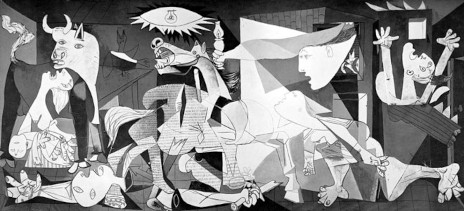
  • Guernica

    Guernica

    Picasso’s passion for peace
    Symbol of war’s horrors
    Screams of death and agony
    Fallen man, fallen horse

    Nazi Luftwaffe bombs falling
    On small Basque village
    It was market day, market day
    The streets were jammed

    Nazis bombed and strafed
    Planes diving, machine guns firing
    The young Luftwaffe pilots
    Found the marketplace

    Screaming villagers and peasants
    Running for their lives
    As death blurted from the sky that day
    Seventeen hundred murdered and maimed

    Picasso shared his human outrage
    In his unforgettable Guernica
    The Guernica of screams and death
    Of fallen man, fallen horse

    Cowardly diplomats and generals
    Try to hide Guernica but they cannot;
    Cover Guernica and it emerges
    Starker, stronger, truer

    Guernica was painted for you
    Watch the ones who avert their eyes
    As they slink by in shame
    Planning new wars, new sorrow
    Guernica

    Guernica is a small Basque village that was brutally attacked by the Nazi Luftwaffe on April 27, 1937, during the Spanish Civil War. The attack on the unarmed inhabitants of Guernica left 1,700 villagers and peasants dead or maimed. It was still unusual at that time for an air force to deliberately bomb a civilian population.

    The tragedy and brutality that occurred at Guernica was immortalized by Pablo Picasso in his impassioned mural expressing his outrage at the murderous attack. It is one of Picasso’s masterpieces that is known throughout the world. It depicts the horrors of war, the silent screams of men and beasts.

    Of late, Picasso’s Guernica has been in the news. The tapestry reproduction of the famous mural that hangs outside the entrance to the United Nations Security Council was covered with a blue curtain on the occasion of US Secretary of State Colin Powell presenting his evidence to the Council for war against Saddam Hussein. UN officials said that the blue curtain was to provide a better background for the television cameras. Certainly it is a more comfortable background, far easier on the eyes and minds of those who plead for war than the twisted, tormented figures portrayed in Picasso’s Guernica.

    No leader should be protected from Picasso’s Guernica. The tapestry of Guernica hanging outside the Security Council is a reminder to leaders of the brutality of war. To cover such art is to hide from the truth, and is made all the worse when it is done to protect the sensibilities of leaders who would wage war.

    Those leaders who would promote war for any reason should at a minimum have the courage to look straight at Picasso’s Guernica. War should never be sanitized or made to appear heroic. There is nothing heroic about middle aged war hawks sending young men and women off to kill and die. It was not heroic at Guernica, and it is no more so today.

  • The Art of Living: Santa Paula’s Xavier Montes Walks (and Teaches) the Talk

    Santa Paula native Xavier Montes remembers his ascent into social advocacy. A self-proclaimed “reborn Chicano,” he learned Spanish while visiting a relative in Mexico who challenged his limited vocabulary. While there, he extended his knowledge of culture and history by studying the meaning of traditional Mexican songs. His first attendance at a folklorico dance event in 1971 evoked feelings of awe—the sombreros looked like trophies, he said.

    A month later, he saw Teatro Campesino, with Chicano actors performing skits on controversial issues. From there, his transformation into a socially aware artist and musician was under way.

    And now, if you hear a harp at a community event, Montes is probably behind the strumming. If you see a mural in Santa Paula, chances are he had some input into the design. If you dine at Vince’s Café on Main and 8th streets, you’ll be surrounded by his acrylics.

    “My cultural heritage is filled with color and passion,” he tells the Santa Paula Society of the Arts. “It is in my veins and my heart. And so, like many other artists, I am compelled to creatively express what I feel, what I see and what I wish I could see.”

    And his commitment to his culture’s youth, in fact, stands as a work of art itself. In April, Santa Paula’s California Oil Museum will host Montes’ annual De Colores art exhibit for the ninth consecutive year. Montes views the show as a bridge between the community and the schools, two worlds he says need stronger ties: “How can you have cultural events,” he asks, “without students?”

    Montes, 50, views students as the lifeblood of community artwork. Students, he explains, are the ones who should care about their community, and the community should give them ample opportunities to become involved.

    On Montes’ wish list is a De Colores nonprofit organization to support year-round activities for students and community members. His greatest hope, though, is that Santa Paula will have a community art space for young people to develop their skills and talents.

    He has scoped a few windowfronts on Santa Paula’s Main Street, and he knows what the places would need: tables, chairs, art supplies, easels and personnel with the technical expertise to renovate and prepare the space. He adds that such a venture is especially important in the face of arts underfunding in high schools.

    “There are no painting classes in small high schools,” he lamented. “Those are for bigger schools.” Without this investment in creativity, he added, students develop their own means of expression that can result in the destruction of property.

    There’s a sadness and an irony involved, Montes said, when Mexican storeowners’ buildings are routinely defaced by young people of the same race and heritage (“How can they deface their own people’s property?”). He adds that he wants Santa Paula’s teenagers to take pride in the businesses their people have maintained through hard work and dedication.

    Montes, known to close friends as X, walks his talk. He takes his concern to the streets, working on murals with students and guiding them through the process of creating a public work of art. “I teach them techniques,” he said, “like how to blow up smaller images into larger ones using the grid method, planning it all out. The transformation starts with words on paper, ideas like love, pain, pride, future [and] family, and we narrow it down to a few ideas. Then we find symbols for those words, transferring the idea to a visual symbol. Next, we lay out the symbols, considering the viewership—what do we want people to notice first, how will they interpret the mural. This is a process, not a goal with an end point.”

    Montes has a degree in studio art and a teaching credential from UCSB. He serves as a mentor for the CalArts Visual Arts Program, helping to select young Latino and Latina artists who would benefit from summer classes.

    Montes sighed with concern over the fact that many young Latinos are ashamed of their heritage and culture, recalling once having felt similarly. He continues to work patiently with his students, facilitating their growth process as artists and as human beings. Students from Renaissance High School give him high marks; they have even taken on their own independent muraling projects using knowledge and skills learned in his classes.

    His students’ murals often deal with the themes of Mexican musical history and the Mexican revolution, events their grandparents and great-grandparents experienced. And while the students are painting, they hear Montes’ voice.

    “The scenes involve positive thinking,” he said. “I talk about pride, brown skin and the rich history of the Mexican people. And I tell them that the only way to get ahead is through education. Ignorance is the reason for the ‘isms,’ like racism and hatred.”
    *Leah C. Wells, a Santa Paula teacher, serves as peace education coordinator for the Nuclear Age Peace Foundation in Santa Barbara.