Category: Nuclear Threat

  • The Joint Statement of Obama and Medvedev: Pursuing a World Free of Nuclear Weapons

    The Joint Statement of Obama and Medvedev: Pursuing a World Free of Nuclear Weapons

    On April 1, 2009, the presidents of the United States and Russia, Barack Obama and Dmitriy Medvedev, issued a Joint Statement, promising “a new tone” and a far more constructive working relationship between the two countries. Relations had dramatically deteriorated under the leadership of George W. Bush and Vladimir Putin. The Joint Statement announced to the world that Obama and Medvedev are “ready to move beyond Cold War mentalities and chart a fresh start in relations between [the] two countries.”

    The Joint Statement covered a wide range of issues, but gave greatest attention to issues related to nuclear weapons. The two leaders pledged to fulfill their obligations under Article VI of the Nuclear Non-Proliferation Treaty (NPT), which calls for good faith negotiations to achieve nuclear disarmament. This will be welcome news to the non-nuclear weapon states that are parties to the NPT and have committed to not acquiring nuclear weapons.

    Presidents Obama and Medvedev committed their two countries “to achieving a nuclear free world.” This is an important promise, and these leaders must be supported by their citizens and people throughout the world in seeking its fulfillment. The promise is tempered, however, by the recognition of the two leaders that it is a “long-term goal” that will require “a new emphasis on arms control and conflict resolution measures, and their full implementation by all concerned nations.” The two leaders set no timeframe for achieving the goal.

    They further agreed “to pursue new and verifiable reductions in…strategic offensive arsenals in a step-by-step process.” They pledged to have their negotiators begin talks immediately on replacing the START I agreement, set to expire in December 2009, “with a new, legally-binding treaty.” This is an important step in preserving the verification provisions of the START I agreement and reducing the size of existing nuclear arsenals.

    The statement calls for reductions in strategic offensive weapons, but gives no numbers indicating the thinking of the two leaders regarding the next step down. Some reports have suggested that the next reductions are likely to be relatively modest, to the level of 1,500 deployed strategic weapons, continuing the past practice of allowing no controls on additional nuclear weapons held in reserve.

    The two leaders acknowledged differences related to the deployment of missile defense systems in Europe, while recognizing that there were possibilities to work together on assessing “missile challenges and threats.” They also promised to work together to secure loose nuclear materials, promote the Global Initiative to Combat Nuclear Terrorism, and bring the Comprehensive Test Ban Treaty into force (Russia has ratified, while the US has signed but not ratified).

    They also agreed to promote “international cooperation in the peaceful use of nuclear energy.” While many nations of the world may favor this, the promotion of nuclear energy has serious drawbacks. It will reduce emphasis on societal investment in truly sustainable forms of energy, and it will make it more difficult to achieve nuclear disarmament. The more that nuclear power is promoted and developed throughout the world, the more difficult it will be to assure that nuclear weapons do not proliferate to other countries or to terrorist organizations.

    Achieving a world free of nuclear weapons will require both a commitment and a detailed plan to provide a roadmap. The commitment has now been made. The plan will reveal the realism of the commitment. Reductions in nuclear arsenals demonstrate progress, but it is important that reductions be tied to the goal of eliminating all nuclear weapons from all arsenals within a reasonable timeframe.

    The intentions of the two leaders expressed in their Joint Statement are far ahead of the limited vision of their recent predecessors. It is real progress. The world is too dangerous, however, to think that it will be possible to muddle through to zero. The stakes are far too high. As President Obama pointed out recently in Strasbourg, “Even with the Cold War now over, the spread of nuclear weapons or the theft of nuclear material could lead to the extermination of any city on the planet.”

    Achieving a world of zero nuclear weapons will require the creation and implementation of a well-conceived plan. To assure our common future, Presidents Obama and Medvedev must assure a workable plan with a reasonable timeframe. They must now spend time at their drawing boards developing this plan.

    David Krieger is President of the Nuclear Age Peace Foundation (www.wagingpeace.org) and a Councilor of the World Future Council.

  • Nuclear Free and Independent Pacific Day

    March 1st is Nuclear Free and Independent Pacific Day (‘Bikini’ Day) which marks the anniversary of the US ‘Bravo’ nuclear bomb detonation at Bikini Atoll [*] in 1954.  The explosion gouged out a crater more than 200 feet deep and a mile across, melting huge quantities of coral which were sucked up into the atmosphere together with vast volumes of seawater. The resulting fallout caused widespread contamination in the Pacific.

    Powdery particles of radioactive fallout landed on the island of Rongelap (100 miles away) to a depth of one and a half inches in places, and radioactive mist appeared on Utirik (300 miles away). Radiation levels in the inhabited atolls of Rongerik, Ujelang and Likiep also rose dramatically. The US navy did not send ships to evacuate the people of Rongelap and Utirik until three days after the explosion. The people in the Marshall Islands, and elsewhere in the Pacific, were used as human guinea pigs in an obscene racist experiment to ‘progress’ the insane pursuit of nuclear weapons supremacy.

    Nuclear Free and Independent Pacific Day is a day to remember that the arrogant colonialist mindset which allowed, indeed encouraged, the horror mentioned above continues today – the Pacific remains neither nuclear free nor independent.

    It is a day to think about the many faces of colonisation – physical, cultural, spiritual, economic, political, nuclear, military – past and present; the issues of independence, self-determination and sovereignty here in Aotearoa New Zealand and the other colonised countries of the Pacific; and the ability of Pacific peoples to stop further nuclearisation, militarisation and economic globalisation of our region.

    It is a day to acknowledge and remember those who have suffered and died in the struggle for independence around the Pacific; those who have opposed colonisation in its many forms and paid for their opposition with their health and life; and those who have suffered and died as a result of the nuclear weapons states’ use of the Pacific for nuclear experimentation, uranium mining, nuclear weapons testing and nuclear waste dumping.

    It is a day to celebrate the strength and endurance of indigenous Pacific peoples who have maintained and taken back control of their lives, languages and lands to ensure the ways of living and being which were handed down from their ancestors are passed on to future generations.

    It is the day to pledge your support to continue the struggle for a nuclear free and independent Pacific, as the theme of the 8th Nuclear Free and Independent Pacific Conference said: No te parau tia, no te parau mau, no te tiamaraa, e tu, e tu – For justice, for truth and for independence, wake up, stand up !

    – Peace Movement Aotearoa

    [*] In 1946, a military officer representing the US government asked the people of Bikini if they would be willing to leave their atoll temporarily so that the United States could begin testing atomic bombs for “the good of mankind and to end all world wars”. They have been prevented from returning to their home ever since because of the level of radioactive contamination remaining there.

    In April 2006, together with the people of Enewetak, they filed a lawsuit against the US government in the US Court of Federal Claims. The lawsuit sought compensation for the taking of their property, and damage claims resulting from the US government’s failure and refusal to adequately fund the orders of the Nuclear Claims Tribunal. In 2000 and 2001 the Tribunal awarded compensation totaling around $948 million for loss of the islands, clean-up and resettlement costs, and personal injury and hardship. So far the Tribunal has only paid out about $3.8 million.

    On 29 January 2009, the US Court of Appeals for the Federal Circuit ruled against the people of Bikini and Enewetak, saying an agreement between the governments of the United States and Marshall Islands in 1986 is a settlement that is beyond judicial review – affirming the US Court of Federal Claims ruling on 2 August 2007. The decision of the Court of Appeals is available at http://www.cafc.uscourts.gov/opinions/07-5175.pdf with the people of Bikini’s response to the 2007 Court of Federal Claims ruling at http://www.bikiniatoll.com/Appellate%20brief%20reply%20final%204-25-08.pdf A history of Bikini Atoll and the people’s struggle for justice is at http://www.bikiniatoll.com/history.html

  • Inspired by the Hibakusha

    This article was published by the Hiroshima Peace Media Center

    In 1975, I was a 22-year-old high school music teacher in New Zealand. The school syllabus included a Threnody (‘song of lament’) for the Victims of Hiroshima by Penderecki. Until then I had never heard of hibakusha. My life changed forever when I read their stories, and showed photos and their paintings to my young students. The hibakusha inspired me to dedicate my life to help them abolish nuclear weapons.
    At that time there were over 52,000 nuclear weapons. Hundreds more were being tested by the US, UK and France in the Pacific: in Australia, Tahiti, the Marshall Islands and Kiribati. Radioactive fallout from these was even detected in mothers’ milk in New Zealand. Regional protest groups emerged, enraged that the “superpowers” would use our “Ocean of Peace” to test weapons causing severe health and environmental effects, and capable of annihilating most life on the planet. They lobbied their governments and, in 1973, New Zealand, Australia and other Pacific Islands took France to the International Court of Justice (World Court) and effectively forced future tests underground. When US warships, probably carrying nuclear weapons, visited our ports under the Australia New Zealand US (ANZUS) military alliance in 1976, peace groups organised “peace squadrons” of hundreds of small boats to oppose them. Thousands of people demonstrated on the streets throughout the country demanding that New Zealand should become a nuclear free zone.
    Ordinary citizens, including young mothers like myself, were angry that ANZUS membership made us a target for the enemies of the US and her allies, and we did not want nuclear weapons used against others in our defence. We worked hard over the next decade to establish 300 small neighbourhood peace groups throughout the country who educated the public about the dangers of both nuclear weapons and nuclear power. We showed films and exhibitions about hibakusha, and doorknocked nearly every home asking people to display nuclear free stickers on their homes and cars, and in their workplaces.
    By 1984, 66% of municipal councils were nuclear free and the new government pledged to ban visits by nuclear armed and powered vessels. Prime Minister David Lange believed that by rejecting the nuclear umbrella, New Zealand was strengthening its national security. He said: “We were, simply, safer without nuclear weapons in our defence than with them…”
    Although the government came under heavy US, British and Australian pressure, they were bolstered by a massive mobilisation of public support by the peace movement in both New Zealand and the US. The French government’s terrorist bombing of Greenpeace’s anti-nuclear flagship, Rainbow Warrior, in Auckland coincided in 1985 with the creation of a South Pacific Nuclear Weapon Free Zone. When the Chernobyl nuclear power plant exploded in 1986, the combination of these events ensured the passage into law of the Nuclear Free Act. In 1986, retired magistrate Harold Evans, from our local Christchurch peace group, initiated the World Court Project. This grew into a worldwide campaign to persuade the UN General Assembly to request an advisory opinion from the Court on the legal status of nuclear weapons. It took nearly a decade to build support and momentum nationally and internationally, helped by the improved political climate after the end of the Cold War.
    In 1994, for the first time the World Court accepted evidence from citizens which included 11,000 signatures from international judges and lawyers; a sample of the 100 million signature Hiroshima and Nagasaki Appeal, and material surveying 50 years of citizens’ opposition to nuclear weapons. In addition, over 700 citizen groups worldwide endorsed the Project. Forty-four states and the World Health Organisation participated in the biggest World Court case ever, with two-thirds arguing for illegality.
    Just before the oral hearings in 1995, the Court accepted 4 million individually signed Declarations of Public Conscience, including over 3 million from Japan. After strong domestic pressure, the Japanese government allowed the Mayors of Hiroshima and Nagasaki to testify. They confronted the 14 judges with huge photographs depicting the devastation and suffering. Over 50 hibakusha were present to witness this historic legal challenge. A woman from the Marshall Islands powerfully described how many islanders are still dying of cancers and women give birth to deformed babies including some which look like “jellyfish.”
    In July 1996, the Court delivered its historic Advisory Opinion that “a threat or use of nuclear weapons would generally be contrary to the rules of international law applicable in armed conflict, and in particular the principles and rules of humanitarian law.” The judges also unanimously agreed that “There exists an obligation to pursue in good faith and bring to a conclusion negotiations leading to nuclear disarmament in all its aspects under strict and effective international control.”
    The World Court Opinion helped spark new initiatives to achieve a nuclear weapon free world. As a former member of the World Court Project Steering Committee, I was invited in 1998 to join the Middle Powers Initiative. This campaign by a network of international citizen organisations worked closely with seven countries, including New Zealand, which had played important roles in the World Court Project. Called the New Agenda Coalition, they lobbied effectively within the UN and, at the 2000 Non Proliferation Treaty (NPT) Review Conference, secured an unequivocal commitment from the nuclear weapon states to eliminate their nuclear weapons.
    The Middle Powers Initiative also established the Parliamentary Network for Nuclear Disarmament (coordinated by New Zealander Alyn Ware, another leader of the World Court Project). It now has over 500 members in 70 countries with regular newsletters, and a website translated into 11 languages including Japanese. Recently, politicians from different parties in Belgium, Germany, Holland, Italy, Turkey and the UK called for the removal of US nuclear weapons from their soil after a US Air Force investigation concluded that “most sites” used for deploying nuclear weapons in Europe do not meet US Department of Defense minimum security requirements. In June 2008, 110 US tactical nuclear weapons were withdrawn from Britain, which means that there are now no US nuclear weapons there for the first time since 1950.
    Following the presentations by the Mayors of Nagasaki and Hiroshima to the World Court in 1995, they were inspired by the 1996 Opinion to renew their call for nuclear abolition and launch an international membership drive for Mayors for Peace. To mark the 10th anniversary of the Court’s Opinion in 2006, Mayors for Peace launched the Good Faith Challenge and the “Cities Are Not Targets” project. Today there are 2,708 member cities in 134 countries. Of these, 89 are capital cities, almost half the world’s capitals, including Moscow, Beijing, London and Paris.
    Other states supportive of the World Court Project, led by Malaysia and Costa Rica, sponsored UN resolutions calling for a Nuclear Weapons Convention–an enforceable global treaty to ban nuclear weapons. A consortium of lawyers, scientists and disarmament experts drafted a Model Nuclear Weapons Convention which was distributed by the UN Secretary-General in 1997 for states to consider. In 2007, the Model Nuclear Weapons Convention was updated, and translated into Japanese. The proposed treaty, and the more general call for nuclear abolition, have received growing support from across the political spectrum and from a wide array of constituencies including former Prime Ministers and Foreign Ministers, mayors, military leaders, academics, parliamentarians, scientists, governments, Nobel Laureates, NGOs and the general public.
    On United Nations Day last year, UN Secretary General Ban Ki-moon launched a five-point plan for nuclear disarmament. He called for the nuclear weapon states to fulfil their obligation under the NPT by pursuing “a framework of separate, mutually reinforcing instruments. Or they could consider negotiating a nuclear-weapons convention, backed by a strong system of verification, as has long been proposed at the United Nations.”
    With the world’s total of nuclear weapons now half what it was in 1975, and US President Obama himself calling for nuclear abolition, the time is ripe for all states to work together to take weapons off high alert; make immediate and drastic cuts to their nuclear arsenals; cancel missile defence systems; sign and ratify a Comprehensive Nuclear Test Ban Treaty; and negotiate a Fissile Material Cut-off Treaty and an Outer Space Treaty. There has never been a more hopeful moment for us all to press our leaders to start negotiating a Nuclear Weapons Convention. Then the pain and anguish suffered by hibakusha everywhere will not have been in vain, and our dreams and aspirations for a nuclear free world can be realised.


    Dr. Kate Dewes coordinates the Disarmament and Security Centre and taught Peace Studies at Canterbury University for 20 years.
  • The Way is Open for a Nuclear Weapon-Free Northern Europe

    This article was originally published on Active Nonviolence

    At the 50th Pugwash Conference in 2000, John Holdren said: “In a rapidly-changing world, which we are certainly living in, the establishment consensus on the necessity of nuclear weapons could crumble quickly.” Today John’s prediction seems to be coming true. There are indeed indications that the establishment is moving towards the point of view that the peace movement has always held: – that nuclear weapons are essentially genocidal, illegal and unworthy of civilization; and that they must be completely abolished as quickly as possible. There is a rapidly-growing global consensus that a nuclear-weapon-free world can and must be achieved in the very near future.

    One of the first indications of the change was the famous Wall Street Journal article by Schultz, Perry, Kissinger and Nunn advocating complete abolition of nuclear arms [1]. This was followed quickly by Mikhail Gorbachev’s supporting article, published in the same journal [2], and a statement by distinguished Italian statesmen [3]. Meanwhile, in October 2007, the Hoover Institution had arranged a symposium entitled “Reykjavik Revisited; Steps Towards a World Free of Nuclear Weapons” [4].

    In Britain, Sir Malcolm Rifkind, Lord Hurd and Lord Owen (all former Foreign Secretaries) joined the former NATO Secretary General Lord Robertson as authors of an article in The Times advocating complete abolition of nuclear weapons [5]. The UK’s Secretary of State for Defense, Des Brown, speaking at a disarmament conference in Geneva, proposed that the UK “host a technical conference of P5 nuclear laboratories on the verification of nuclear disarmament before the next NPT Review Conference in 2010″ to enable the nuclear weapon states to work together on technical issues.

    In February, 2008, the Government of Norway hosted an international conference on “Achieving the Vision of a World Free of Nuclear Weapons” [7]. A week later, Norway’s Foreign Minister, Jonas Gahr Stoere, reported the results of the conference to a disarmament meeting in Geneva [8].

    On July 11, 2008, speaking at a Pugwash Conference in Canada, Norway’s Defence Minister, Anne-Grete Stroem-Erichsen, reiterated her country’s strong support for the complete abolition of nuclear weapons [9].

    Other highly-placed statesmen added their voices to the growing consensus: Australia’s Prime Minister, Kevin Rudd, visited the Peace Museum at Hiroshima, where he made a strong speech advocating nuclear abolition. He later set up an International Commission on Nuclear Non-Proliferation and Disarmament co-chaired by Australia and Japan [10].On January 9, 2009, four distinguished German statesmen ( Helmut Schmidt, Richard von Weizäcker, Egon Bahr and Hans-Dietrich Genscher) published an article entitled “Towards a Nuclear-Free World: a German View” in the International Herald Tribune [11]. Among the immediate steps recommended in the article are the following:

    • “The vision of a nuclear-weapon-free world… must be rekindled.”
    • “Negotiations aimed at drastically reducing the number of nuclear weapons must begin…”
    • “The Nuclear Non-Proliferation Treaty (NPT) must be greatly reinforced.”
    • ” America should ratify the Comprehensive Nuclear Test-Ban Treaty.”
    • “All short-range nuclear weapons must be destroyed.”
    • “The Anti-Ballistic Missile (ABM) Treaty must be restored. Outer space may only be used for peaceful purposes.”

    From the standpoint of an NWFZ in Northern Europe, the recommendation that all short-range nuclear weapons be destroyed is particularly interesting. The US nuclear weapons currently stationed in Holland, Belgium and Germany prevent these countries from being (at present) part of a de-facto Northern European NWFZ; but with an Obama Administration in the United States, and with John Holdren advising President Obama, this situation might be quickly altered. Both public opinion and official declarations support the removal of US tactical nuclear weapons from Europe [12]. Indeed the only argument for their retention comes from NATO, which stubbornly maintains that although the weapons have no plausible function, they nevertheless serve as a “nuclear glue”, cementing the alliance.

    The strongest argument for the removal of US tactical nuclear weapons from Europe is the threatened collapse of the NPT. The 2005 NPT Review Conference was a disaster, and there is a danger that at the 2010 Review Conference, the NPT will collapse entirely because of the discriminatory position of the nuclear weapon states (NWS) and their failure to honor their committments under Article VI. NATO’s present nuclear weapon policy also violates the NPT, and correcting this violation would help to save the 2010 Review Conference from failure.

    At present, the air forces of the European countries in which the US nuclear weapons are stationed perform regular training exercises in which they learn how to deliver the weapons. This violates the spirit, and probably also the letter, of Article IV, which prohibits the transfer of nuclear weapons from an NWS to a non-NWS. The “nuclear sharing” proponents maintain that such transfers would only happen in an emergency; but there is nothing in the NPT saying that the treaty would not hold under all circumstances. Furthermore, NATO would be improved, rather than damaged, by giving up “nuclear sharing”.

    If President Obama wishes to fulfill his campaign promises [13] – if he wishes to save the NPT – a logical first step would be to remove US tactical nuclear weapons from Europe. The way would then be open for a nuclear Weapon-Free Zone in Northern Europe, comprising the Netherlands, Belgium, Luxembourg, Denmark, Norway, Sweden, Finland, Germany, Poland, Lithuania, Latvia and Estonia. Our final goal is, and must remain, the complete abolition of nuclear weapons. But NWFZs are steps along the road.

    References and links

    [1] George P. Schultz, William J. Perry, Henry A. Kissinger and Sam Nunn, “A World Free of Nuclear Weapons”, The Wall Street Journal, January 4, 2007, page A15 and January 15, 2008, page A15. www.nuclearsecurityproject.org http://online.wsj.com/article/SB116787515251566636.html?mod=Commentary-US

    [2] Mikhalil Gorbachev, “The Nuclear Threat”, The Wall Street Journal, January 30, 2007, page A15. http://online.wsj.com/article/SB117021711101593402.htm

    [3] Massimo D’Alema, Gianfranco Fini, Giorgio La Malfa, Arturo Parisi and Francesco Calogero, “For a World Free of Nuclear Weapons”, Corriere Della Sera, July 24, 2008. http://www.gsinstitute.org/pnnd/updates/20.html

    [4] Hoover Institution, “Reykjavik Revisited; Steps Towards a World Free of Nuclear Weapons”, October, 2007. http://www.hoover.org/publications/books/online/15766737.html

    [5] Douglas Hurd, Malcolm Rifkind, David Owen and George Robertson, “Start Worrying and Learn to Ditch the Bomb”, The Times, June 30, 2008. http://www.timesonline.co.uk/tol/comment/columnists/guest_contributors/article4237387.ece?openComment=true

    [6] Des Brown, Secretary of State for Defense, UK, “Laying the Foundations for Multilateral Disarmament”, Geneva Conference on Disarmament, February 5, 2008. http://www.mod.uk/defenceinternet/aboutdefence/people/speeches/sofs/20080205layingthefoundationsformultilateraldisarmament.htm

    [7] Government of Norway, International Conference on “Achieving the Vision of a World Free of Nuclear Weapons”, Oslo, Norway, February 26-27, 2008. http://disarmament.nrpa.no/

    [8] Jonas Gahr Stoere, Foreign Minister, Norway, “Statement at the Conference on Disarmament”, Geneva, March 4, 2008. http://www.regjeringen.no/nb/dep/ud/dep/utenriksminister_jonas_gahr_store/taler_artikler/2008/cd_statement.html?id=502420

    [9] Anne-Grete Stroem-Erichsen, Defense Minister, Norway, “Emerging Opportunities for Nuclear Disarmament”, Pugwash Conference, Canada, July 11, 2008. http://www.regjeringen.no/en/dep/fd/The-Ministry/defence-minister-anne-grete-strom-erichs/Speeches-and-articles/2008/emerging-opportunities-for-nuclear-disar.html?id=521830

    [10] Kevin Rudd, Prime Minister, Australia, “International Commission on Nuclear Non-Proliferation and Disarmament”, Media Release, July 9, 2008. http://www.pm.gov.au/media/release/2008/media_release_0352.cfm

    [11] Helmut Schmidt, Richard von Weizäcker, Egon Bahr and Hans-Dietrich Genscher, “Towards a Nuclear-Free World: a German View”, International Herald Tribune, January 9, 2009. http://www.iht.com/articles/2009/01/09/opinion/edschmidt.php

    [12] Hans M. Kristensen and Elliot Negin, “Support Growing for Removal of U.S. Nuclear Weapons from Europe”, Common Dreams Newscenter, first posted May 6, 2005. http://www.commondreams.org/news2005/0506-09.htm

    [13] David Krieger, “President-elect Obama and a World Free of Nuclear Weapons”, Nuclear Age Peace Foundation Website, 2008. https://wagingpeace.davidmolinaojeda.com/articles/2008/11/05_krieger_obama_elect.php

    John Avery is a leader in the Pugwash movement in Denmark.
  • New Deal on South Asian Nukes

    This article was originally published on www.truthout.org

    Pakistan’s President Asif Ali Zardari came out last Saturday with yet another series of statements to cause more than mere ripples in South Asia. He did so especially with pronouncements on the nuclear weapons issues between India and Pakistan that have made many sections in the subcontinent sit up and take notice.

    Do these statements, however, add up to a real promise of a new deal for the region, which has continued to be a dangerous place ever since the two rival nations became nuclear-armed neighbors in May 1998?

    Addressing India from Islamabad, at a video-conference in New Delhi at “Summit 2008,” organized by the leading daily The Hindustan Times, Zardari offered nothing less than Pakistan’s cooperation in turning South Asia into a nuclear-weapon-free zone, an objective to be achieved through a “non-nuclear treaty.” As he put it challengingly, “I can get around my parliament to this view, but can you get around the Indian parliament to this view?”

    He made an even greater impact by his answer to a question about the no-first-strike nuclear policy of India and the possibility of Pakistan adopting the same stand. His response was prompt and positive. He did not stop with saying that Pakistan would not use its nuclear weapons first. He went on to declare that he was opposed to these weapons anyway and to assert: “We do not hope to get into any position where nuclear weapons have any use.”

    The official Indian reaction was that Zardari’s statements were not quite official. Voices from India’s establishment, echoed in various media reports, wondered: Whom was the Pakistani president speaking for, anyway? Tauntingly, they asked whether he had the tacit support of Pakistan’s army on this subject.

    They had a point. By all accounts, Pakistan’s nuclear arsenal has remained mainly under the control of the army, which is possessively proud of them. Officially, up to now, Pakistan has not altered its policy by which it has retained the right of first nuclear strike. While India has made much play about its renunciation of this option, Pakistan has maintained from the outset that it could not do so because it lacked parity with its bigger neighbor in conventional weapons.

    Pakistan’s new democratic dispensation has apparently kept its distance from the army but not demonstrated its dominance over the generals. Quite the reverse is the message sent out by the government’s attempt sometime ago to acquire control of the Inter Services Intelligence (ISI), the army’s infamous and important arm, and Islamabad’s hasty retreat from the reform under obvious pressure.

    Rather surprisingly, there has been no other serious Indian response, not even from the opposition Bharatiya Janata Party (BJP), whose leadership may have to do business with Zardari with the party’s return to power in the general elections due early next year. The statements, however, elicited more reactions within Pakistan.

    Zardari has drawn much flak in his country before for statements considered overly friendly to India. He and the government of his Pakistan People’s Party (PPP) also had to beat a retreat after his statement in a media interview suggesting that the Kashmir issue could be kept on the back burner. In the video conference, he did not say the same thing about Kashmir but repeated his other controversial remark about seeing no “threat” from India. He may come in for criticisms again on these counts. His stand on the nuclear issue, however, has attracted no opposition offensive for the moment.

    Former Prime Minister Nawaz Sharif of the Pakistan Muslim League(N), the main opposition, in fact, was quick to claim that he had made the proposals for nuclear peace first. Sharif, who had presided over Pakistan’s nuclear weapons tests a decade ago, let his party clarify: “This was Nawaz Sharif’s proposal as prime minister. On the Pakistan side, the position has always been consistent. But because India refuses to abandon its nuclear weapons, this proposal has been in the doldrums.”

    The PML(N) also claimed that the proposal was contained in the Lahore Declaration signed between Sharif and former Indian Prime Minister Atal Bihari Vajpayee on February 1, 1999. While the claims are open to question, observers in Pakistan actually expect the opposition to unleash an offensive against the government on the presidential pronouncements. Front-ranking newspaper The Daily Times, for example, forecasts that a “chorus of criticism will now most probably overwhelm Mr. Zardari’s overtures to India and make them look like ‘concessions.’ “

    As for the reactions from uncommitted quarters, they are asking the same questions as India’s establishment. Lieutenant-General (retired) Talat Masood, a political commentator and head of the Pakistani chapter of Pugwash says:”The big question is, can President Zardari take along Pakistan’s ruling establishment, especially the military?” He adds, “Even if (Zardari) was not fully familiar with the nuclear vocabulary, what he possibly meant was that there has to be a strategic restraint regime between the two countries.”

    The fact is, the ruling establishments of the two countries have never been ready to consider any “strategic restraint regime” that envisages any reduction of their nuclear arsenals or any reversal of their nuclear weapons programs. They have been ready, in other words, to cooperate only in order to present a picture of “responsible” nuclear armed neighbors to the rest of the world.

    This, actually, was the larger purpose also of the Lahore Declaration, signed just nine months after nuclear weapons tests in both countries. The declaration recognizes “that the nuclear dimension of the security environment of the two countries adds to their responsibility for avoidance of conflict between the two countries.” The document voices commitment, not to regional peace as such, but to the “objective of universal nuclear disarmament and non-proliferation.”

    The declaration calls upon the two countries only to “take immediate steps for reducing the risk of accidental or unauthorized use of nuclear weapons and discuss concepts and doctrines with a view to elaborating measures for confidence-building in the nuclear and conventional fields, aimed at prevention of conflict.”

    India and Pakistan are said to have made much progress in their “peace process” initiated in 2004. New Delhi and Islamabad, however, have made sure that the nuclear part of the process made no advance beyond what the declaration mandated. The confidence-building measures (CBMs) – which have never gone beyond steps like notification of each other before tests of nuclear-capable missiles – were somehow supposed to create confidence that the people of the two countries were safe even when such missiles stayed in military deployment.

    Setting up a hotline between designated officials of the two armies, in order to avert chances of nuclear accidents among other things, has not exactly made the people of the subcontinent safer than before. It has not done so because the nuclear hawks of the two countries have not desisted from threatening use of the weapons by design. Terrifying nuclear threats have been traded, as we have recalled more than once in these columns, between the two countries during the Kargil conflict of 1999 (following on the heels of the Lahore Declaration) and the fearsome confrontation of 2002.

    The peace process has not prevented the nuclear militarists in both countries from pursuing their projects. The period since the declaration has seen both participating in a missile race, displaying no coyness about its nuclear dimension at all. In 2004, former Pakistani President Pervez Musharraf boasted: “My government has spent more money in the last three years on enhancing Pakistan’s nuclear capability than (spent for this purpose) in the previous 30 years.” We do not know whether the country’s current economic crisis has made any difference in this regard. Successive Indian governments may not have been forthcoming with similar figures. There is little doubt, however, that under the shroud of secrecy, they have swelled with the same pride over their misuse of taxpayers’ money to build weapons of mass-murder.

    At one point In the course of talks on CBMs, the rulers of India and Pakistan even agreed to seek “parity” with nuclear powers (P5), “consultations” with them “on matters of common concern,” and development of a “common nuclear doctrine.” The idea has not been pursued seriously, but has not been abandoned officially.

    This strange partnership of sworn nuclear rivals does not make the proposal from Pakistan’s president sound like a reliable promise for the peace-loving people of the region.

    J. Sri Raman is a freelance author and peace activist in India. He is the author of ” Flashpoint.”

  • Soaring, Cryptography and Nuclear Weapons

    Section 1: 99.9% Safe Maneuvers

    Let’s face it, nuclear weapons are the elephant in the room that no one likes to talk about. So let’s approach the issue from the less threatening perspective of the awesome picture below.
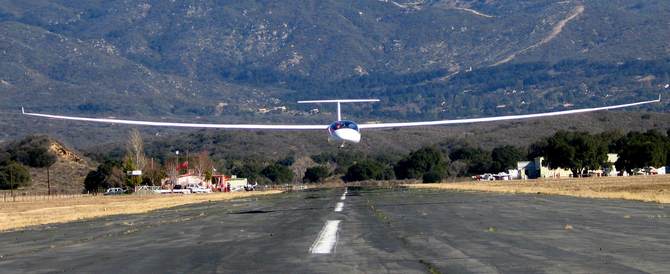
    Figure 1

    Figure 1: A glider executing a high speed low pass.

    The glider looks like it’s suspended above the runway, but in reality it’s screaming toward the photographer at 150 mph in a maneuver known as a high speed low pass. The pilot starts about 2000 feet high and a mile from the runway. He then dives to convert altitude into speed and skims the runway. Next, he does a steep climb to reconvert some of that speed into altitude so he can turn and land.

    Given that the glider has no engine, you might wonder how the pilot can be sure he’ll gain enough altitude in the climb to safely turn and land. The laws of physics tell us exactly how altitude is traded for speed and vice versa. While there is a loss due to the air resistance of the glider, that is a known quantity which the pilot takes it into account by starting from a higher altitude than needed for the landing phase.

    But it’s important to read the fine print in that guarantee provided by the laws of physics. It only applies if the air is stationary. If there’s a slight wind the difference is negligible, but if the air movement is unusually strong all bets are off – which is what happened to a friend of mine who had safely executed the maneuver many times before. But this time he hit an unusually strong, continuous downdraft. The laws of physics still applied, but the model of stationary air was no longer applicable and he had no way of knowing his predicament until he approached the runway with much less speed than needed for a safe landing. He managed to land without damage to himself or his glider, but was so shaken that he no longer does that maneuver.

    While most experienced glider pilots sometimes do low passes (and some race finishes require them), I’ve opted not to because I regard them as a 99.9% safe maneuver – which is not as safe as it sounds. A 99.9% safe maneuver is one you can execute safely 999 times out of a thousand, but one time in a thousand it can kill you.

    Even though they are clearly equivalent, one chance in a thousand of dying sounds a lot riskier than 99.9% safe. The perspective gets worse when it’s recognized that the fatality rate is one in a thousand per execution of the maneuver. If a pilot does a 99.9% safe maneuver 100 times, he stands roughly a 10% chance of being killed. Worse, the fear that he feels the first few times dissipates as he gains confidence in his skill. But that confidence is really complacency, which pilots know is our worst enemy.

    A similar situation exists with nuclear weapons. Many people point to the absence of global war since the dawn of the nuclear era as proof that these weapons ensure peace. The MX missile was even christened the Peacekeeper. Just as the laws of physics are used to ensure that a pilot executing a low pass will gain enough altitude to make a safe landing, a law of nuclear deterrence is invoked to quiet any concern over possibly killing billions of innocent people: Since World War III would mean the end of civilization, no one would dare start it. Each side is deterred from attacking the other by the prospect of certain destruction. That’s why our current strategy is called nuclear deterrence or mutually assured destruction (MAD).

    But again, it’s important to read the fine print. It is true that no one in his right mind would start a nuclear war, but when people are highly stressed they often behave irrationally and even seemingly rational decisions can lead to places that no one wants to visit. Neither Kennedy nor Khrushchev wanted to teeter on the edge of the nuclear abyss during the 1962 Cuban Missile Crisis, but that is exactly what they did. Less well known nuclear near misses occurred during the Berlin crisis of 1961, the Yom Kippur War of 1973 and NATO’s Able Archer exercise of 1983. In each of those episodes, the law of unintended consequences combined with the danger of irrational decision making under stress created an extremely hazardous situation.

    Because the last date for a nuclear near miss listed above was 1983, it might be hoped that the end of the Cold War removed the nuclear sword hanging over humanity’s head. Aside from the fact that other potential crises such as Taiwan were unaffected, a closer look shows that the Cold War, rather than ending, merely went into hibernation. In the West, the reawakening of this specter is usually attributed to resurgent Russian nationalism, but as in most disagreements the other side sees things very differently.

    The Russian perspective sees the United States behaving irresponsibly in recognizing Kosovo, in putting missiles (albeit defensive ones) in Eastern Europe, and in expanding NATO right up to the Russian border. For our current purposes, the last of these concerns is the most relevant because it involves reading the fine print – in this case, Article 5 of the NATO charter which states that an attack on any NATO member shall be regarded as an attack on them all. It is partly for that reason that a number of former Soviet republics and client states have been brought into NATO and that President Bush is pressing for Georgia and the Ukraine to be admitted. Once these nations are in NATO, the thinking goes, Russia would not dare try to subjugate them again since that would invite nuclear devastation by the United States, which would be treaty bound to come to the victim’s aid.

    But, just as the laws of physics depended on a model that was not always applicable during a glider’s low pass, the law of deterrence which seems to guarantee peace and stability is model-dependent. In the simplified model, an attack by Russia would be unprovoked. But what if Russia should feel provoked into an attack and a different perspective caused the West to see the attack as unprovoked?

    Just such a situation sparked the First World War. The assassination of Austria’s Archduke Ferdinand by a Serbian nationalist led Austria to demand that it be allowed to enter Serbian territory to deal with terrorist organizations. This demand was not unreasonable since interrogation of the captured assassins had shown complicity by the Serbian military and it was later determined that the head of Serbian military intelligence was a leader of the secret Black Hand terrorist society. Serbia saw things differently and rejected the demand. War between Austria and Serbia resulted, and alliance obligations similar to NATO’s Article 5 then produced a global conflict.

    When this article was first written in May 2008, little noticed coverage of a dispute between Russia and Georgia [Champion 2008] reported that “Both sides warned they were coming close to war.” As it is being revised, in August 2008, the conflict has escalated to front page news of a low-intensity, undeclared war. If President Bush is successful in his efforts to bring Georgia into NATO, and especially if the conflict should escalate further, we would face the unpleasant choice of reneging on our treaty obligations or threatening actions which risk the destruction of civilization. A similar risk exists between Russia and Estonia, which is already a NATO member.

    Returning temporarily to soaring, although I will not do low passes, I do not judge my fellow glider pilots who choose to do them. Rather, I encourage them to be keenly aware of the risk. The pilot in the photo has over 16,000 flight hours, has been doing low passes at air shows for over 30 years, will not do them in turbulent conditions, ensures that he has radio contact with a trusted spotter on the ground who is watching for traffic, and usually does them downwind so that he only has to do a “tear drop” turn to land. The fact that such an experienced pilot exercises that much caution says something about the risk of the maneuver. The danger isn’t so much in doing low passes as in becoming complacent if we’ve done them 100 times without incident.

    In the same way, I am not arguing against admitting Georgia to NATO or suggesting that Estonia should be kicked out. Rather, I encourage us to be keenly aware of the risk. If we do that, there is a much greater chance that we will find ways to lessen the true sources of the risk, including patching the rapidly fraying fabric of Russian-American relations. The danger isn’t so much in admitting former Soviet republics into NATO as in becoming complacent with our ability to militarily deter Russia from taking actions we do not favor.

    Section 2: Substates

    Part of society’s difficulty in envisioning the threat of nuclear war can be understood by considering Figure 2 below:
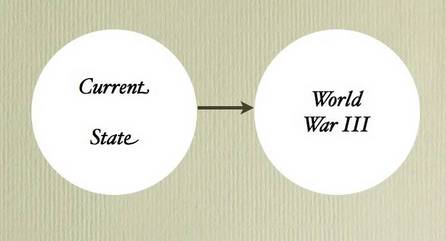
    Figure 2
    Figure 2. An overly simplified model

    The circle on the left represents the current state of the world, while the one on the right represents the world after a full-scale nuclear war. Because World War III is a state of no return, there is no path back to our current state. Even though an arrow is shown to indicate the possibility of a transition from our current state to one of global war, that path seems impossible to most people. How could we possibly transit from the current, relatively peaceful state of the world to World War III? The answer lies in recognizing that what is depicted as a single, current state of the world is much more complex. Because that single state encompasses all conditions short of World War III, as depicted below, it is really composed of a number of substates – world situations short of World War III, with varying degrees of risk:
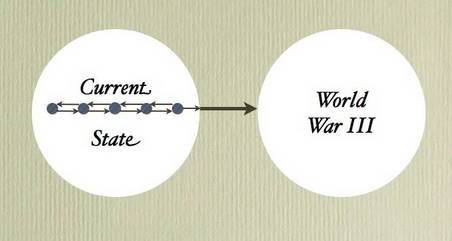
    Figure 3
    Figure 3. A more accurate model

    Society is partly correct in thinking that a transition from our current state to full-scale war is impossible because, most of the time, we occupy one of the substates far removed from World War III and which has little or no chance of transiting to that state of no return. But it is possible to move from our current substate to one slightly closer to the brink, and then to another closer yet. As described below, just such a sequence of steps led to the Cuban Missile Crisis and could lead to a modern day crisis of similar magnitude involving Estonia, Georgia, or other some other hot spot where we are ignoring the warning signs.

    The Cuban Missile Crisis surprised President Kennedy, his advisors, and most Americans because we viewed events from an American perspective and thereby missed warning signs visible from the Russian perspective. Fortunately, that view has been recorded by Fyodr Burlatsky, one of Khrushchev’s speechwriters and close advisors, as well as a man who was in the forefront of the Soviet reform movement. While all perspectives are limited, Burlatsky’s deserves our attention as a valuable window into a world we need to better understand:

    In my view the Berlin crisis [of 1961] was an overture to the Cuban Missile Crisis and in a way prompted Khrushchev to deploy Soviet missiles in Cuba. … In his eyes [America insisting on getting its way on certain issues] was not only an example of Americans’ traditional strongarm policy, but also an underestimation of Soviet might. … Khrushchev was infuriated by the Americans’ … continuing to behave as if the Soviet Union was still trailing far behind. … They failed to realize that the Soviet Union had accumulated huge stocks [of nuclear weapons] for a devastating retaliatory strike and that the whole concept of American superiority had largely lost its meaning. … Khrushchev thought that some powerful demonstration of Soviet might was needed. … Berlin was the first trial of strength, but it failed to produce the desired result, [showing America that the Soviet Union was its equal] . [Burlatsky 1991, page 164]

    [In 1959 Fidel Castro came to power and the U.S.] was hostile towards the Cuban revolutionaries’ victory from the very start. … At that time Castro was neither a Communist nor a Marxist. It was the Americans themselves who pushed him in the direction of the Soviet Union. He needed economic and political support and help with weapons, and he found all three in Moscow. [Burlatsky 1991, page 169]

    In April 1961 the Americans supported a raid by Cuban emigrees … The Bay of Pigs defeat strained anti-Cuban feelings in America to the limit. Calls were made in Congress and in the press for a direct invasion of Cuba. … In August 1962 an agreement was signed [with Moscow] on arms deliveries to Cuba. Cuba was preparing for self-defense in the event of a new invasion. [Burlatsky 1991, page 170]

    The idea of deploying the missiles came from Khrushchev himself. … Khrushchev and [Soviet Defense Minister] R. Malinovsky … were strolling along the Black Sea coast. Malinovsky pointed out to sea and said that on the other shore in Turkey there was an American nuclear missile base [which had been recently deployed]. In a matter of six or seven minutes missiles launched from that base could devastate major centres in the Ukraine and southern Russia. … Khrushchev asked Malinovsky why the Soviet Union should not have the right to do the same as America. Why, for example, should it not deploy missiles in Cuba? [Burlatsky 1991, page 171]

    In spite of the similarity between the Cuban and Turkish missiles, Khrushchev realized that America would find this deployment unacceptable and therefore did so secretly, disguising the missiles and expecting to confront the U.S. with a fait accompli. Once the missiles were operational, America could not attack them or Cuba without inviting a horrific nuclear retaliation. (The Turkish missiles had a similar purpose from an American point of view.) However, Khrushchev did not adequately envision what might happen if, as did occur, he was caught in the act.

    With respect to the Cuban Missile Crisis, the substates of Figure 3 which brought us to the brink of nuclear war can now be identified as:

    • conflict between America and Castro’s Cuba;
    • Russia demanding to be treated as a military equal and being denied this status;
    • the Berlin Crisis;
    • the Bay of Pigs invasion;
    • the American deployment of IRBM’s in Turkey; and
    • Khrushchev’s deployment of IRBM’s in Cuba

    The actors involved in each step did not perceive their behavior as overly risky. But compounded and viewed from their opponent’s perspective, those steps brought the world to the brink of disaster. During the crisis, there were additional, fortunately unvisited substates that would have made World War III even more likely. As just one example, the strong pressure noted by Burlatsky to correct the Bay of Pigs fiasco and remove Castro with a powerful American invasion force intensified after the Cuban missiles were discovered. But those arguing in favor of invasion were ignorant of the fact – not learned in the West until many years later – that the Russians had battlefield nuclear weapons on Cuba and came close to authorizing their commander on the island to use them without further approval from Moscow in the event of an American invasion.

    Section 3: Risk Analysis

    I have been concerned with averting nuclear war for over twenty-five years, but an extraordinary new approach only occurred to me last year: using quantitative risk analysis to estimate the probability of nuclear deterrence failing. This approach is a bit like Superman disguised as mild-mannered Clark Kent but, before I can explain why it is extraordinary, we need to explore what it is and overcome a key mental block that helps explain why no one previously had thought of applying this valuable technique.

    To understand this mental block, imagine someone gives us a trick coin, weighted so heads and tails are not equally likely, and we need to estimate the chance of its showing heads when tossed. What do we learn if we toss the coin fifty times and it comes up tails every time? Statistical analysis says we can be moderately confident (95% to be precise) that the chance of heads is somewhere between zero and 6% per toss, but that leaves way too much uncertainty.

    Thinking of the fifty years that deterrence has worked without a failure as the fifty tosses of the the coin, we are moderately confident that the chance of nuclear war is somewhere between zero and 6% per year. But there is a big difference between one chance in a billion per year and 6% per year, both of which are in that range. At one chance in a billion per year, a few more years of business as usual would be an acceptable risk. But 6% corresponds to roughly one in 16 odds, in which case our current nuclear strategy would be the equivalent of playing nuclear roulette – a global version of Russian roulette – once each year with a 16 chambered revolver.

    Just as the overly simplified two-state model of Figure 2 hides the danger of a nuclear war, the coin analogy hides the possibility of teasing much more information from the historical record – the two-sided coin corresponding to Figure 2’s two states. Breaking down one large state of Figure 2 into Figure 3’s smaller substates illuminated the danger hidden in the two state model. In the same way, risk analysis breaks down a catastrophic failure of nuclear deterrence into a sequence of smaller failures, many of which have occurred and whose probabilities can therefore be estimated.

    Modern risk analysis techniques first came to prominence with concerns about the safety of nuclear reactors, and in particular with the 1975 Rasmussen Report produced for the Nuclear Regulatory Commission. In Risk-Benefit Analysis, Wilson and Crouch note “[The Rasmussen report] used event tree analysis … This new approach originally had detractors, and indeed the failure … to use it may have contributed to the occurrence of the Three Mile Island Accident. If the event tree procedure … had been applied to [the reactor design used at Three Mile Island] … probably the Three Mile Island incident could have been averted.” [Wilson and Crouch 2001, pp. 172-173]

    An event tree starts with an initiating event that stresses the system. For a nuclear reactor, an initiating event could be the failure of a cooling pump. Unlike the catastrophic failure which has never occurred (assuming we are analyzing a design different from Chernobyl’s), such initiating events occur frequently enough that their rate of occurrence can be estimated directly. The event tree then has several branches at which the initiating event can be contained with less than catastrophic consequences, for example by activating a backup cooling system. But if a failure occurs at every one of the branches (e.g., all backup cooling systems fail), then the reactor fails catastrophically. Probabilities are estimated for each branch in the event tree and the probability of a catastrophic failure is obtained as the product of the individual failure probabilities.

    Applying risk analysis to the catastrophic failure of nuclear deterrence, a perceived threat by either side is an example of an initiating event. If either side exercises adequate caution in its responses, such an initiating event can be contained and the crisis dies out. But the event tree consisting of move and counter-move can fail catastrophically and result in World War III if neither side is willing to back down from the nuclear abyss, as almost happened with the 1962 Cuban crisis. Each branch or partial failure corresponds to moving one or more substates toward disaster in Figure 3.

    Because nuclear deterrence has never completely failed, the probability assigned to the last branch in the event tree (the final transition in Figure 3) will involve subjectivity and have more uncertainty. Confidence in the final result can be increased by incorporating a number of expert opinions and using a range instead of a single number for that probability, as well as providing justifications for the different opinions.

    The Cuban Missile Crisis provides a good example of how to estimate that final probability. President Kennedy estimated the odds of the crisis going nuclear as “somewhere between one-in-three and even.” His Secretary of Defense, Robert McNamara, wrote that he didn’t expect to live out the week, supporting an estimate similar to Kennedy’s. At the other extreme McGeorge Bundy, who was one of Kennedy’s advisors during the crisis, estimated those odds at 1%.

    In a recently published preliminary risk analysis of nuclear deterrence [Hellman 2008] I used a range of 10% to 50%. I discounted Bundy’s 1% estimate because invading Cuba was a frequently considered option, yet no Americans were aware of the Russian battlefield nuclear weapons which would have been used with high probability in that event. As an example of faulty reasoning due to this lack of information, Douglas Dillon, another member of Kennedy’s advisory group, wrote, “military operations looked like they were becoming increasingly necessary. … The pressure was getting too great. … Personally, I disliked the idea of an invasion [of Cuba] … Nevertheless, the stakes were so high that we thought we might just have to go ahead. Not all of us had detailed information about what would have followed, but we didn’t think there was any real risk of a nuclear exchange.” [Blight & Welch 1989, page 72]

    The sequence of steps previously listed as leading up to the Cuban Missile Crisis is an example of an event tree that nearly led to a catastrophic failure, and reexamining those steps in the light of similar current events will show that, contrary to public opinion which sees the threat of nuclear war as a ghost of the past, the danger is lurking in the shadows, waiting until once again it can surprise us by suddenly leaping into clear view as it did in 1962:

    Step #1: conflict between America and Castro’s Cuba:

    The current conflicts between Russia and a number of former Soviet client states are similar. For example, as noted earlier, President Bush is pushing for Georgia to become a NATO member even though Russia and Georgia just fought an undeclared war over still unresolved issues

    Step #2: Russia demanding to be treated as a military equal and being denied this status:

    The same is true today. Even though Russia has 15,000 nuclear weapons, America sees itself as the sole remaining superpower, leading even Mikhail Gorbachev to say recently, “there is just one thing that Russia will not accept … the position of a kid brother, the position of a person who does what someone tells it to do.” [Tatsis 2008] Repeated American statements that we defeated Russia in the Cold War add fuel to that fire since the Russians feel they were equal participants in ending that conflict.

    Steps #3 and #4: The Berlin Crisis and the Bay of Pigs invasion:

    Several potential crises are brewing (e.g., Chechnya, Georgia, Estonia, and Venezuela) which have similar potential.

    Step #5: The American deployment of IRBM’s in Turkey:

    A missile defense system we are planning for Eastern Europe bears an ominous similarity to those Turkish missiles. While these new missiles are seen as defensive and a non-issue in America, the Russians see them as offensive and part of an American military encirclement. In October 2007, Putin warned, “Similar actions by the Soviet Union, when it put rockets in Cuba, precipitated the Cuban Missile Crisis.” [Putin 2007] Two months later Gorbachev questioned America’s stated goal of countering a possible Iranian missile threat, “What kind of Iran threat do you see? This is a system that is being created against Russia.” [Gorbachev 2007]

    Step #6: Khrushchev’s deployment of the Cuban missiles:

    While there is not yet a modern day analog of this step, serious warning tremors have occurred. In July 2008 Izvestia, a Russian newspaper often used for strategic governmental leaks, reported that if we proceed with our Eastern European missile defense deployment then nuclear-armed Russian bombers could be based on Cuba [Finn 2008]. During Senate confirmation hearings as Air Force Chief of Staff, General Norton Schwartz countered that “we should stand strong and indicate that is something that crosses a threshold, crosses a red line.” [Morgan 2008] While the Russian Foreign Ministry later dismissed Izvestia’s reports as false [Rodriguez 2008], there is a dangerous resemblance to events which led to the Cuban Missile Crisis.

    The fact that we are not yet staring at the nuclear abyss is little cause for comfort. In terms of the sequence of events that turn a 99.9% safe maneuver into a fatal accident, we are already at a dangerous point in the process and, as in soaring, need to recognize complacency as our true enemy.

    Section 4: How Risky Are Nuclear Weapons?

    Even minor changes in our nuclear weapons posture have been rejected as too risky even though the baseline risk of our current strategy had never been estimated. Soon after recognizing this gaping hole in our knowledge, I did a preliminary risk analysis [Hellman 2008] which indicates that relying on nuclear weapons for our security is thousands of times more dangerous than having a nuclear power plant built next to your home.

    Equivalently, imagine two nuclear power plants being built on each side of your home. That’s all we can fit next to you, so now imagine a ring of four plants built around the first two, then another larger ring around that, and another and another until there are thousands of nuclear reactors surrounding you. That is the level of risk that my preliminary analysis indicates each of us faces from a failure of nuclear deterrence.

    While the analysis that led to that conclusion involves more math than is appropriate here, an intuitive approach conveys the main idea. In science and engineering, when trying to estimate quantities which are not well known, we often use “order of magnitude” estimates. We only estimate the quantity to the nearest power of ten, for example 100 or 1,000, without worrying about more precise values such as 200, which would be rounded to 100.

    In this intuitive approach I first ask people whether they think the world could survive 1,000 years that were similar to 20 repetitions of the last 50 years. Do they think we could survive 20 Cuban Missile Crises plus all the other nuclear near misses we have experienced? When asked that question, most people do not believe we could survive 1,000 such years. I then ask if they think we can survive another 10 years of business as usual, and most say we probably can. There’s no guarantee, but we’ve made it through 50 years, so the odds are good that we can make it through 10 more. In the order of magnitude approach, we have now bounded the time horizon for a failure of nuclear deterrence as being greater than 10 years and less than 1,000. That leaves 100 years as the only power of ten in between. Most people thus estimate that we can survive on the order of 100 years, which implies a failure rate of roughly 1% per year.

    On an annual basis, that makes relying on nuclear weapons a 99% safe maneuver. As with 99.9% safe maneuvers in soaring, that is not as safe as it sounds and is no cause for complacency. If we continue to rely on a strategy with a one percent failure rate per year, that adds up to about 10% in a decade and almost certain destruction within my grandchildren’s lifetimes. Because the estimate was only accurate to an order of magnitude, the actual risk could be as much as three times greater or smaller. But even ⅓% per year adds up to roughly a 25% fatality rate for a child born today, and 3% per year would, with high probability, consign that child to an early, nuclear death.

    Given the catastrophic consequences of a failure of nuclear deterrence, the usual standards for industrial safety would require the time horizon for a failure to be well over a million years before the risk might be acceptable. Even a 100,000 year time horizon would entail as much risk as a skydiving jump every year, but with the whole world in the parachute harness. And a 100 year time horizon is equivalent to making three parachute jumps a day, every day, with the whole world at risk.

    While my preliminary analysis and the above described intuitive approach provide significant evidence that business as usual entails far too much risk, in-depth risk analyses are needed to correct or confirm those indications. A statement endorsed by the following notable individuals:

    • Prof. Kenneth Arrow, Stanford University, 1972 Nobel Laureate in Economics
    • Mr. D. James Bidzos, Chairman of the Board and Interim CEO, VeriSign Inc.
    • Dr. Richard Garwin, IBM Fellow Emeritus, former member President’s Science Advisory Committee and Defense Science Board
    • Adm. Bobby R. Inman, USN (Ret.), University of Texas at Austin, former Director National Security Agency and Deputy Director CIA
    • Prof. William Kays, former Dean of Engineering, Stanford University
    • Prof. Donald Kennedy, President Emeritus of Stanford University, former head of FDA
    • Prof. Martin Perl, Stanford University, 1995 Nobel Laureate in Physics

    therefore “urgently petitions the international scientific community to undertake in-depth risk analyses of nuclear deterrence and, if the results so indicate, to raise an alarm alerting society to the unacceptable risk it faces as well as initiating a second phase effort to identify potential solutions.” [Hellman 2008]

    This second phase effort will be aided by the initial studies because, in addition to estimating the risk of a failure of nuclear deterrence, they will identify the most likely trigger mechanisms, thereby allowing attention to be directed where it is most needed. For example, if as seems likely, a nuclear terrorist incident is found to be a likely trigger mechanism for a full-scale nuclear war, then much needed attention would be directed to averting that smaller, but still catastrophic event.

    While definitive statements about the risk we face must await the results of the proposed in-depth studies, for ease of exposition the remainder of this article assumes the conclusion reached by my preliminary study – that the risk is far too great and urgently needs to be reduced.

    Section 5: The Positive Possibility

    In the mid 1970’s Whit Diffie, Ralph Merkle and I invented public key cryptography, a technology that now secures the Internet and has won the three of us many honors. Yet, when we first conceived the idea many experts told us that we could not succeed. Their skepticism was understandable because a public key flew in the face of the accumulated wisdom of hundreds of years of cryptographic knowledge: How could the key be public if its secrecy was all that kept an opponent from reading my mail? What was missed is that “the key” might become “two keys,” a public key for enciphering and a secret key for deciphering. Everyone could encipher messages using my public key, but only I could understand them by deciphering with my secret key.

    Just as many cryptographic experts thought we couldn’t split the key and used arguments based on years of accumulated wisdom that were not applicable to the new possibility, most people have difficulty envisioning a world in which the nuclear threat is a relic of the past. While there is no guarantee that a similar breakthrough exists for ending the threat posed by nuclear weapons, this section provides evidence that our chances for survival are greater than we think.

    First Figure 3 must be modified by adding a third state in which the risk of nuclear catastrophe has been reduced thousands of times from its present level, so that it is at an acceptable level.
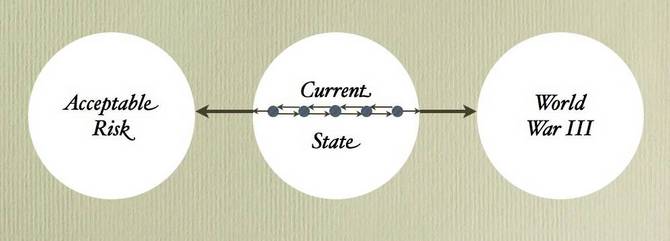
    Figure 4
    Figure 4. Adding hope to the model

    For the risk to truly be acceptable, this new state also must be a state of no return – its risk would not be acceptable if the world could transition back to our current state with its unacceptable risk. In this new figure, our current substate is near the middle of the current state of the world. We are not close to World War III, but neither are we close to an acceptable level of risk.

    Much as people had difficulty envisioning public key cryptography before we developed a workable system, they also have difficulty envisioning a world that is far better than what they have experienced in the past. The evolution of the movement to abolish slavery in the United States provides a good illustration of that difficulty. In 1787 slavery was written into our Constitution. In 1835 a Boston mob attacked the abolitionist William Lloyd Garrison and dragged him half naked through the streets. In Illinois in 1837 a mob killed another abolitionist, Elijah Lovejoy. The next year, a Philadelphia mob burned the building where an antislavery convention was held [Goldsmith 1998, pages 11, 29]. In that environment or substate, few people could envision the end of slavery within thirty years, much less that citizens of Massachusetts, Illinois and Pennsylvania would give their lives to help bring about that noble goal.
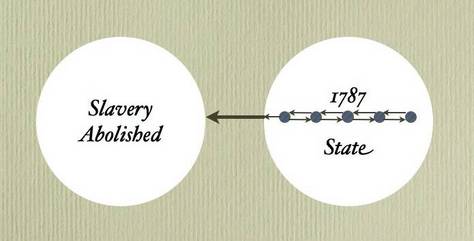
    Figure 5
    Figure 5. Substates leading to a positive end state

    While it was almost impossible to envision in 1787 – or even in the 1830’s – we now know that, as depicted in Figure 5 above, there was a sequence of substates that led to a new state in which slavery not only was abolished, but had no possibility of returning. The anti-abolitionist riots of the 1830’s – probably seen by most at that time as evidence of the insurmountable barriers to ending slavery – were actually a sign that a new substate had been reached and change was beginning to occur. There were no such riots in 1787 because the abolitionist movement was almost non-existent. By the 1830’s abolition was beginning to be seen as a serious threat to the supporters of slavery, resulting in the riots.

    History shows that people have tremendous difficulty envisioning both negative and positive possibilities that are vastly different from their current experience. Therefore, even if I had a crystal ball and could predict the sequence of substates (steps) that will take us to the state of acceptable risk depicted in Figure 4, very few would believe me. As an example of the difficulty imagine the reaction if someone, prior to Gorbachev’s coming to power, had predicted that a leader of the Soviet Union would lift censorship, encourage free debate, and not use military force to prevent republics from seceding from the union. At best, such a seer would have been seen as extremely naive.

    I had a milder version of that problem in September 1984 when I started a project designed to foster a meaningful dialog between the American and Soviet scientific communities in an attempt to defuse the threat of nuclear war, which was then in sharp focus. I was aware of the limitations that Soviet censorship imposed, but believed there still was some opportunity for information flow, primarily unidirectional. It had been eight years since my last trip to the Soviet Union and this visit was an eye-opening experience. While I did not know it at the time, I was meeting with people who were in the forefront of the nascent reform movement which would bring Gorbachev to power six months later, with some of them directly advising him.

    Censorship was still the law of the land, so the scientists with whom I met could not agree with those of my views that contradicted the party line. But neither did they argue. I sensed something very different was brewing, but on returning to the U.S. I was often seen as extremely naive for believing that meaningful conversations were possible with persons of any standing within the Soviet system.

    The steps leading to a truly safe world in Figure 4 would sound similarly naive to most people today. It is therefore counterproductive to lay out too explicit a road map to that goal. But how can one garner support without an explicit plan for reaching the goal? Until I realized the applicability of risk analysis, I didn’t see how that could be accomplished, but risk analysis provides an implicit, rather than an explicit map. No single step can reduce the risk a thousand-fold, so if the risk analysis approach can be embedded in society’s consciousness, then one step after another will have to be taken until a state with acceptable risk is reached. Later steps, which today would be rejected as impossible (which they probably currently are) need not be spelled out, but are latent, waiting to be discovered as part of that process.

    The first critical step therefore is for society to recognize the risk inherent in nuclear deterrence. If you agree, please share this article – or whatever approach you favor – with others. Email is particularly effective since friends who agree can then relay your message to others. This article, a sample email, and other tools can be found on the resource page at NuclearRisk.org. “Just talking” might not seem to accomplish much, but as graphically depicted in Figure 4 and as noted by the ancient Chinese sage Lao Tzu, “The journey of a thousand miles starts with a single step.” If you have not already done so, I hope you will take the first step.

    References

    This article was originally published at NuclearRisk.org

    Martin Hellman is a co-inventor of public key cryptography, the technology that secures communication of credit card and other sensitive information over the Internet. He has worked for over twenty-five years to reduce the threat posed by nuclear weapons and his current project is described at NuclearRisk.org. He is a glider pilot with over 2,600 hours in the air.

  • Ambassadors of the Nuclear Age

    Ambassadors of the Nuclear Age

    At the Nuclear Age Peace Foundation, we have recently been host to two hibakusha, survivors of the atomic bombings. Both of these hibakusha are women, and both are survivors of the US atomic bombing of Hiroshima in 1945. Junko Kayashige, the younger of the two women, was 6 years old when the bomb fell on her city. Miyako Yano was 14 years old when the bomb fell.

    The two hibakusha who visited us, and all atomic bomb survivors, are ambassadors of the Nuclear Age. Their goals are to rid the world of nuclear weapons and help humanity to move past its age-old penchant for solving conflicts by resorting to war, understanding from personal experience that war in the Nuclear Age is a catalyst for nuclear annihilation.

    The women traveled from Hiroshima to the United States to tell their stories. They did so in the hope that their past will not become our future. They wish that no one else will suffer the fate of the victims at Hiroshima and Nagasaki. Junko Kayashige stated, “There is not much time left for us hibakusha. We must find ways to not create even one more hibakusha.” Thus, they speak out and share their sad and painful recollections.

    The two women spoke to students at a local college and to assemblies at two high schools. The students paid rapt attention to the personal stories of these witnesses to history. Throughout their lives both women carried the fear that they would be stricken with cancer, leukemia or other radiation related diseases, the fate of so many victims of the atomic bombings. They also worried that radiation disease would effect their children or grandchildren.

    Miyako Yano, the older of the two women, was a second year student in a girl’s high school when the bomb was dropped. Her class had been assigned the task of helping to clean up the rubble in the city, near to what would become the epicenter of the bombing. On the day of the bombing she was ill and stayed home. By this chance occurrence, her life was saved. If the bombing had occurred the day before, she would have met certain death while working just 500 meters from the epicenter, as was the fate of her classmates the next day. Living four kilometers from the epicenter of the detonation, her family helped take care of the injured, many of whom died of radiation poisoning. As a 14-year-old girl, Miyako was given the task of incinerating the dead.

    Junko Kayashige shared a photograph of her family taken just before the bombing. It was a somber picture of a family gathered in wartime. Her older brother was about to go off to war, and the family thought it was the last photograph that would be taken of them all together. It was, in fact, the last photograph of them all together, but for a different reason. Hiroshima suffered the atomic bombings and two of her sisters were victims. Her father was able to find one of his daughters whose back was badly burned, with maggots crawling in the raw wounds. The family tried to help her, but she died ten days later, most likely from radiation poisoning. The other sister, who had gone out on an errand, was not found. The family never knew how she perished.

    Most Americans have an uncomplicated but at best incomplete understanding of the atomic bombings, based on a perspective of the bombings from above; that is, from the perspective of the bombers, rather than from the perspective of the victims. The absence of the victims in the perspective of the victors leaves a large hole that can be filled by the accounts of the survivors of bombed cities. This is important not only for a fuller understanding of the past, but for creating a more secure future.

    If the world continues upon the path it is on, with a small number of countries relying upon nuclear weapons for their “security,” eventually these weapons will be used again, by accident or design. Yesterday’s victors may become tomorrow’s victims. The United States, the country with the greatest military power the world has ever witnessed, could be brought to its knees by a terrorist group in possession of nuclear weapons.

    There is only one way to end this threat, and that is to abolish these weapons. The hibakusha are clear that nuclear weapons and human beings cannot coexist. The world is not large enough for both. Either nuclear weapons must be eliminated or human beings face the threat of extinction by weapons of their own creation.

    The hibakusha continue to warn us of the perils nuclear weapons pose to the human future. They have long ago forgiven their attackers and speak only from hearts of kindness. Miyako Yano stated, “I believe the A-bombs were dropped not on Hiroshima and Nagasaki alone, but on the entire humanity. We have no choice but to abolish nuclear weapons.”

    The aging hibakusha challenge each of us to act upon their warnings. Their voices are soft but clear. They summon us to achieve the political will to rid the world of this overriding threat.

    David Krieger is President of the Nuclear Age Peace Foundation (www.wagingpeace.org) and a councilor of the World Future Council.

  • Congress Has the Last Chance to Say No to the US-India Nuclear Proliferation Deal

    Congress Has the Last Chance to Say No to the US-India Nuclear Proliferation Deal

    India never joined the nuclear Non-Proliferation Treaty. Instead, it developed and tested nuclear weapons. It is a known nuclear proliferator. India is now thought to have an arsenal of some 60 nuclear weapons, and India’s first nuclear test in 1974 led Pakistan to also develop and later test nuclear weapons. India’s 1974 nuclear test also led to the formation of a Nuclear Suppliers Group, a group of 45 countries that agreed to ban nuclear technology transfers that would make nuclear proliferation more likely, particularly to countries such as India and Pakistan that were outside the nuclear Non-Proliferation Treaty.

    Despite the obvious implications for nuclear proliferation, George W. Bush put forward a plan in 2005 to transfer nuclear technology and materials to India. For this plan, which is best characterized as the US-India Nuclear Proliferation Deal, a special waiver was needed from the Nuclear Suppliers Group, requiring the consent of all members. This deal ran into trouble when Austria, Ireland and New Zealand initially sought to uphold the obligations of the nuclear Non-Proliferation Treaty and held out for tighter proliferation controls, at a minimum a commitment by India that it would conduct no further nuclear tests. Although India would not make this commitment – only going so far as to say it would engage in a voluntary moratorium on testing – arm-twisting diplomatic pressure from the US caused these last hold-outs against proliferation to capitulate. The only barrier remaining to this Nuclear Proliferation Deal going through is the US Congress.

    The Bush administration has given three justifications for pursuing this deal with India. First, it will forge a strategic partnership with the world’s largest democracy. Second, it will help India meet its increasing energy demand in an “environmentally friendly” way. Third, it will open a market for the sale of billions of dollars of nuclear technology to India.

    Forging a strategic partnership with India is fine, but why do it on a foundation of nuclear weapons proliferation? Surely, other countries will be looking at this Nuclear Proliferation Deal as a model that will serve their own interests as well. If the US can do it with India, why not China with Pakistan? Or Russia with Iran? Or Pakistan with Syria? The possibilities for nuclear proliferation are endless, and this deal makes them more likely.

    It is also fine for the US to help India to meet its growing energy demand in an environmentally friendly way, but it is absolute hypocrisy to classify nuclear energy “environmentally friendly.” No one knows what to do with the long-lived radioactive wastes from nuclear power plants – not the US, not anyone. And these wastes are truly long-lived. In the case of the highly toxic and leukemia causing by-product of nuclear power production, plutonium 239, the wastes will gradually decline in danger over a period of 240,000 years. Not the best gift to bestow on future generations.

    There are other reasons as well to be skeptical of nuclear power plants. They are capital intensive, subject to accidents and tempting targets for terrorists. They also require large societal subsidies, such as the underwriting of liability insurance. The uranium used in these plants, if highly enriched, not a technologically difficult feat, provides the basic ingredients for nuclear weapons. The plutonium generated in these plants, if reprocessed, also not difficult technologically, provides another fissionable material for nuclear weapons. Why not support India to produce truly environmentally friendly energy sources, such as wind or solar energy?

    The third reason for the US-India Nuclear Proliferation Deal sounds to me like the real one – that it will open a market to sell billions of dollars of nuclear technology to India. There will be a small number of corporations and their chief executives that will profit big-time from this deal, but they will be doing so at a heavy cost to the people of the world. This Nuclear Proliferation Deal has “double standards” written all over it. Can you imagine the US pushing the same deal with Iran, Iraq or North Korea? Of course not! This deal puts a hole the size of a nuclear explosion through the heart of the Non-Proliferation Treaty.

    Very soon the US-India Nuclear Proliferation Deal will be back before the US Congress for a final vote. If the Congress approves the deal as it stands, it goes through. If Congress votes it down, it doesn’t go through. This deal, initiated and promoted heavily by the Bush administration, will undermine the security of the American people and people everywhere, if Congress allows it to go through.

    The Bush administration was able to pressure the members of the Nuclear Suppliers Group, but the American people should not allow Mr. Bush to proceed with this final cynical act to enrich the few at the expense of national and global security. If you care about the dangers of nuclear weapons proliferation, it’s time for action. Let your representative in Washington know that you expect a No vote on the US-India Nuclear Proliferation Deal.

    David Krieger is President of the Nuclear Age Peace Foundation (www.wagingpeace.org).

  • A Short Message to the UC Regents: Get Out of the Nuclear Weapons Business

    A Short Message to the UC Regents: Get Out of the Nuclear Weapons Business

    Designing and developing weapons of mass annihilation should not be business as usual, especially for a great university. And yet, for the UC, it is business as usual. Since the beginning of the Nuclear Age, the UC has been in the business of providing management and oversight to the nation’s principal nuclear weapons laboratories, Los Alamos National Laboratory and Lawrence Livermore National Laboratory. The UC is now in that business with corporate partners such as Bechtel.

    Your involvement with the weapons labs is arguably illegal under international law, is certainly immoral and, from a security perspective, perpetuates US reliance on nuclear weapons, which undermines US and global security. It also sends exactly the wrong message to the young people who are educated at the University of California. It suggests to them that it must be acceptable to create weapons capable of destroying civilization when a great university engages in doing so.

    The UC shares in the responsibility for creating all nuclear weapons in the US arsenal. Should these weapons ever be used, by accident or design, the responsibility and accountability for that use will rest not only upon decision makers in the US government, but upon the UC system – including upon those who remained indifferent or apathetic in the face of the UC oversight of the weapons labs.

    Some at the UC refer to its work on nuclear weapons as a “national service.” I would say it is a disservice, both to the nation and to the University.

    The most important thing that can be said about nuclear weapons is that they do not and cannot protect their possessors. By continuing to rely upon these weapons, a prospect furthered by the nuclear weapons laboratories, the US upholds nuclear double standards that encourage nuclear proliferation.

    I suggest to you that a day will come when the UC will deeply regret having sold its good name to provide respectability to the creation and maintenance of nuclear weapons. In the interests of the UC and the country, I would urge you to take the following three actions:

    First, support the Student Department of Energy Lab Oversight Committee, which has already demonstrated serious intent and done important research on the weapons laboratories and how their work negatively impacts national and global security.

    Second, follow the example of the Norwegian government pension fund and divest the UC investment portfolio of corporations involved in creating nuclear weapons and their component parts.

    Third, withdraw from the management and oversight of the weapons labs on the grounds of legality, morality and human security. By doing so, you would be setting an invaluable example for UC students and for institutions of higher education in our country and throughout the world.

    Such acts of conscience by the UC Regents would help spark a national discussion on the need for US leadership for a world free of nuclear weapons.

    David Krieger is president of the Nuclear Age Peace Foundation (www.wagingpeace.org). On July 17, 2008, members of the public were allotted one minute each to express their views in the public comment portion of the UC Regents’ meeting.
     

  • Simulated Attack Reveals Security Flaws at Livermore

    A recent mock terrorist infiltration conducted at the Lawrence Livermore National Laboratory (LLNL), located near San Francisco, showed that fissile material necessary for building nuclear weapons was not hard to obtain. In Building 332, the faux-invaders found access to approximately 2,000 pounds of weapons-grade uranium and deadly plutonium, a surplus bountiful enough to build at least 300 nuclear weapons. The simulated attack also revealed problems with the lab’s hydraulic system which controls the Gatling gun responsible for protecting the facility.

    Voices from Capitol Hill, across party lines, called the incident “an embarrassment to those responsible for securing the nation’s nuclear facilities,” and called for immediate steps to correct the lab’s major security weaknesses. Danielle Brian, Executive Director of the Project on Government Oversight, explained the danger of allowing terrorists access to the wealth of nuclear materials at Livermore. She argued that terrorists willing to sacrifice their lives would not need to escape the lab safely with apprehended fissile materials. “They could simply detonate it as part of an improvised nuclear device on the spot.” With nearly seven million residents within 50 miles of the lab, the possibility of such a detonation has led many experts to urge the lab to choose a more remote location for nuclear material.

    The laboratory undergoes staged attacks annually, and the faux foes are timed to see how much damage real invaders could inflict. Can the attackers evade the lab’s security system just in time to build a “dirty bomb” for immediate detonation? Can they hold off the lab’s armed guards long enough to quickly construct a rudimentary device with a destructive capability akin to the bombs dropped on Hiroshima and Nagasaki? Or, would it be best to simply rush past the out-of-order Gatling gun and leave the lab altogether, fissile materials in tow, to use a nuclear device in the heart of San Francisco?

    Located above an irrigation canal, less than two miles from elementary schools, a pre-school, a middle school, a senior center, and a major highway junction, Livermore’s security defects have invigorated opposition to the storage of nuclear weapons materials at the lab. Marylia Kelley, executive director of Tri-Valley CARES, a nuclear weapons watchdog group, argued that the fissile materials at Livermore “simply cannot be made safe and secure.” She explained that the Livermore community, consisting of 81,000 residents, strongly desires that the plutonium and highly enriched uranium be moved elsewhere.

    The stores of weapons-grade uranium and plutonium across the street are not the only thing inducing anxiety among Livermore’s residents. The lab’s security system, assuming that its components are in working order, also serves to stir unease in the suburban homes nearby. The laboratory’s Gatling guns, which were purchased by the National Nuclear Security Administration (NNSA) just after the Department of Energy approved doubling the lab’s plutonium storing capacity, each release the force of a dozen armed guards, firing 4,000 rounds per minute and taking down targets up to a mile away. Former Administrator of the NNSA, Linton Brooks, explained that the guns “leave no doubt about the outcome” in the event of a military-style air or ground attack on the lab.”

    Kelley, of Tri-Valley CARES, referred to “children on bicycles and skateboards … people walking their dogs,” along the western perimeter of the lab, and questioned the transformation of the science laboratory into a fortified arsenal, prepared for military style attacks. In a residential neighborhood, she argued, “you can’t just indiscriminately open fire.” The Gatling guns are supposed to be tested regularly, and no explanation has been given for their malfunction.

    While the security failures exposed at Livermore seem unacceptable to most, many experts believe that many more exist, and remain undiscovered due to inherent flaws in the “force-on-force” simulated attacks. The mock intrusions generally occur at night or on weekends when the lab’s employees are safe at home and not susceptible to hostage-taking, and when the defenders are given advance notice of the attack. The staff-free corridors of the laboratory during these simulations do not give the defenders accurate practice at securing the lab, as they do not have to distinguish their firing between innocent bystanders and intruders. The “force-on-force” exercises also do not assess the lab’s capability of withstanding an attack from a rogue aircraft passing along one of the flight paths to or from one of the nearby airports.

    In a press release on the newly exposed security flaws, the Department of Energy (DOE) explained that the “force-on-force” simulation revealed both positive aspects of the security system and others “requiring corrective action.” A spokesperson told Time that the DOE does not believe the nuclear materials at Livermore are at risk, but is “interested in examining any deficiencies.”

    As long as there are those who seek access to the US’ stores of plutonium and uranium at Livermore, and those who build their lives on the suburban streets around the lab, perhaps the DOE should examine the prospect of transplanting its fissile material fortress, rather than waiting for new deficiencies to emerge, or simulated failures to become real tragedies.

    Rachel Hitow is the Nuclear Age Peace Foundation’s Washington, DC Intern.