Category: Nuclear Disarmament

  • What I didn’t get to say at the UN

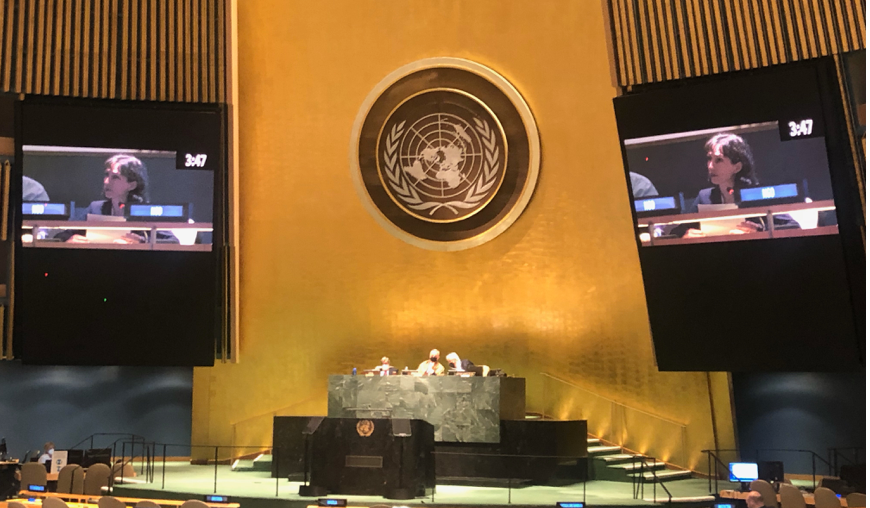
    Over the last weekend of September, in between a cross-country race for my high schooler, a soccer game for my 6th grader, and saying good bye to my daughter as she headed to Europe to study medicine, I was working on a statement to deliver during the United Nations General Assembly on September 26. My statement would take place at a commemorative meeting for the International Day for Total Elimination of Nuclear Weapons and I only had three minutes to deliver it. Three minutes is not a lot of time; about three hundred words to be exact. And I had so much to say.

    I wanted to tell the delegates about my amazing kids and husband and dog and why I feel that the biggest gift I can leave to my children would be a world free of nuclear weapons. I wanted to tell the delegates that my main motivation in pursuing the hard work of nuclear disarmament is love. Love for my family, for our beautiful planet, for all life on Earth, and for humanity itself. I wanted to tell them that nuclear weapons, in the words of David Krieger, threaten everything we love and everything we’ve ever known. They threaten humanity itself.

    We live in a challenging time. I wanted to tell the delegates about tears in my eyes while in the Times Square subway station just days earlier. I was on my way to the General Assembly while passing through the station. If you’ve ever been there, you’ll know that it’s not exactly the kind of location that is inspiring. But thinking about the weight of the world and seeing people singing, holding hands, rushing to wherever they were going, or selling fruit cups, brought tears to my eyes. If a nuclear weapon were to be used in New York City, that subway station would surely be vaporized. And so much more.

    Last year, an international treaty that bans nuclear weapons – the Treaty on the Prohibition of Nuclear Weapons (TPNW) – entered into force. A response of nuclear weapon states to this treaty has been to point out that they would love to get rid of nuclear weapons if it weren’t for the “bad” countries that possess them or aspire to possess them. But there is no such thing as bad or good nuclear weapons. They are all bad. A single nuclear weapon used today would be much more powerful than the bombs the United States used in attacks on Hiroshima and Nagasaki. More likely, multiple weapons would be delivered simultaneously on an intercontinental ballistic missile. And unlike in 1945, there would most certainly be a response consisting of more nuclear strikes.

    But I didn’t get to say all this. Instead, I focused on the lessons from the past, the current terrifying arsenals and modernization plans, and the future on a planet that currently supports a human civilization, however imperfect it may be, and that may not be able to do so in the future. Some necessary context: the use of nuclear weapons in attacks on Japan was not the only time that humanity suffered due to nuclear weapons. The suffering includes a long legacy of nuclear weapons testing on the atolls and islands of the Marshall Islands, Kiribati, French Polynesia, and Alaska, to the deserts of the American Southwest, Australia, Kazakhstan, and China, and in other locations around the world. This legacy consists of decades of physical health effects, such as increased rates of cancer and negative maternal health impacts, as well as mental and cultural demise.

    Some more context: today, nine countries possess around 13,000 weapons, about 1800 of which are on what is called a hair-trigger alert. This means that many hundreds of weapons can be launched within minutes in crisis situations. This also means that accidental use or use due to misunderstanding or miscalculation is much more likely. Finally, the use of even small fractions of the current arsenals would result in millions of direct deaths and even billions due to starvation within the first two years, depending on the exact circumstances of the weapons used and their total number. The latter is a consequence of something scientists called nuclear winter more than four decades ago. The results of a recent study of nuclear winter are simply terrifying.

    At the UN, I didn’t get to say everything I wanted to. But I had love in my heart and a clear message. Everything we know about nuclear weapons from thinking about the past, the present, and the future says that the only road ahead is that toward a world free of nuclear weapons.

    You can watch my statement HERE.

    – Ivana
  • President’s Letter: August 2022

    Dear NAPF Community,

    It is with a great sense of excitement that I greet you following my first month as NAPF’s President. Coincidentally, August 1 turned out to be three things: 1. My first official day in this position; 2. The first day of the 10th Nuclear Non-Proliferation Treaty (NPT) Conference at the United Nations (UN) in New York City; and 3. My daughter’s (oldest of three children) 21st birthday. And thus the day marked a new phase in my own personal and professional life, but also in the nuclear disarmament sphere more generally. Meeting both NGO colleagues and diplomats that first week, I kept saying in jest that my hope was that the failure or success of the conference would not be a reflection on my own path at NAPF.

    Attending the conference was truly an emotional rollercoaster. That first day, I was elated hearing from the UN Secretary General Antonio Guterres, whose brilliant statement will surely provide no shortage of quotes on the urgency, necessity, and imperative of nuclear disarmament. From saying that humanity is “one miscalculation away from nuclear annihilation,” to warning that, “luck is not a strategy,” Secretary General expressed deep commitment to nuclear abolition and the Treaty on the Prohibition of Nuclear Weapons (TPNW). In fact, Secretary General left the conference after his remarks to board a plane to Japan, where he was to visit Hiroshima on August 6, the 77thanniversary of the atomic bombing. His dedication to the cause was apparent from both his words and his actions.

    But the first day wasn’t all wonderful. I got to watch the United States (US) Secretary of State Anthony Blinken state that “The United States would only (emphasis mine) use nuclear weapons under extreme circumstances,” a position I find morally and ethically repugnant. In my opinion, no circumstances would justify incinerating and sickening civilians by the thousands or millions, while putting all of humanity at risk of starvation following use of even a fraction of today’s nuclear arsenals. The remainder of the week featured statements by individual states or groups of states, and I would single out the statements made by Austriathe Holy See, and South Africa, as models for how countries should be thinking about the NPT and its disarmament provisions. Also notable were the statements by the Marshall Islands and Kiribati, two countries that experienced the devastating short- and long-term consequences of nuclear weapons testing, conducted by the US and the United Kingdom (UK). Sadly, the Nuclear Weapon States (NWS: China, France, Russia, UK, and US) and many of their allies, especially the France/UK/US NATO allies, expressed far too little interest in nuclear disarmament and far more interest in maintaining the status quo. It’s as if they had not listened to the Secretary General’s remarks at all, as if the TPNW did not exist, as if there weren’t a war and other geopolitical tensions involving multiple NWS. They seemed to advocate for business as usual, with disarmament only a dream for the naïve.

    The end of the week featured the NGO session, where I was proud to deliver a statement on behalf of NAPF. If you have not watched the statement, I hope you’ll take time to do so. It is only six minutes long and you can find it here.

    Speaking in the UN General Assembly Hall

    It was exhilarating to not only have the opportunity to share with the conference my own and NAPF’s views on the urgency of nuclear disarmament, but also to hear from giants in the field, such as Sergio Duarte (former UN High Representative for Disarmament and President of the Pugwash Conferences) and Jackie Cabasso (from Western States Legal Foundation and Mayors for Peace), as well as rising stars of nuclear disarmament such as Yuta Takahashi of NO NUKES Tokyo and Benetick Kabua Maddison of the Marshallese Educational Initiative, who is also a part of our youth initiative, Reverse the Trend.

    I missed the second week of the conference in order to be in Santa Barbara for our 28th Annual Sadako Peace Day and to spend time in person with various members of our community. My time couldn’t have been more energizing and humbling. Sadako Peace Day saw us back at La Casa de Maria, with many in our community eager to reconnect and gratified to be back on the beautiful grounds of La Casa. In fact, we were their first public event since the site was closed following the devastating mudslides in 2018. I also had the opportunity to meet with our Board in person, following which our Senior Vice President Richard Falk wrote two essays inspired by our discussions. I hope you will read them.

    With Father Larry Gosselin at Sadako Peace Day

    During the third week of August, and back in New York and at the UN, I had the opportunity to participate in three separate conference side events. The first, co-organized by NAPF and IPPNW, took place on August 15. I was fortunate to Chair a fantastic panel of four fabulous experts and fierce advocates of a nuclear weapons-free world: Veronique Christory (ICRC Senior Advisor), Ambassador Tito of Kiribati, Tilman Ruff (Co-President of IPPNW), and Bonnie Docherty (Harvard Law Human Rights Clinic and Human Rights Watch). The focus of the panel was on humanitarian consequences of nuclear weapons and the discussion ranged from past to present to future, with important remarks and connections to the TPNW. I also participated at an August 17 side event, co-organized by Austria and Princeton, where I spoke about the environmental consequences of nuclear weapons testing in the Marshall Islands. And finally, on August 19, at another side-event co-organized by Abolition 2000 and World Future Council and others, I made the case for an absolutist position on nuclear abolition. All three events were amazing opportunities to advance NAPF’s mission and vision.

    The fourth week of the conference featured negotiations on drafts of the outcome document, which ultimately did not end up being adopted. I wrote an article for our website following the late Friday night closing session. If you haven’t read it, I hope you’ll consider doing so. In the article, I outline the issues that were at stake during the conference and make a case for why nuclear disarmament is more important than ever.

    Throughout the month I have felt warmly welcomed by everyone at NAPF – Carol Warner, Christian Ciobanu, Josie Parkhouse, Sandy Jones, and our Board of Directors. Each in their own way has supported, trusted, encouraged, and welcomed me into this family that is NAPF. I couldn’t be more grateful.

    Stay tuned for more updates from us this month on the continuation of our Nuclear Dangers in Ukraine Discussion Series (on Zoom), a new series of invited articles on nuclear abolition and other global challenges, and important work that we will be doing at the UN in regards to the TPNW. We also have an event coming up in November, a Women Waging Peace Luncheon, for which you can now purchase tickets and/or consider sponsorship opportunities. We are excited to honor two amazing women – Cynthia Lazaroff and Monique Limón – both of whom have made significant contributions to a nuclear weapons-free world and both of whom truly embody one of our guiding principles, “Peace is more than the absence of war.”

    This note also comes with an enormous thank you to all those who have supported NAPF over its four decades of existence, in a myriad of ways – from giving their time, energy and generosity to supporting nuclear disarmament efforts locally, nationally, and internationally. We wouldn’t be where we are today without you. We remain committed to a peaceful world, free of nuclear weapons, for as long as it takes to achieve.

    Warmly and with gratitude,

    Ivana

  • Discussions on the Treaty on the Prohibition of Nuclear Weapons at the 2019 UNGA First Committee

    Discussions on the Treaty on the Prohibition of Nuclear Weapons at the 2019 UNGA First Committee

    As we approach the 2020 Nuclear Non-Proliferation Treaty (NPT) Review Conference, it is important to reflect upon the current situation with nuclear weapons and the sliver of hope that humanity now has in the Treaty on the Prohibition of Nuclear Weapons.

    Brief History

    As part of the grand bargain between the Nuclear Weapon Sates (NWS) and the Non-Nuclear Weapon States (NNWS), the NWS agreed that they would “pursue negotiations in good faith on effective measures relating to cessation of the nuclear arms race at an early date and to nuclear disarmament.” In exchange, the NNWS would not acquire nuclear weapons.

    For decades, the NWS have not lived up to their part of their bargain to completely eliminate their nuclear weapons. Because of their opposition, 14,000 nuclear weapons still exist today. Additionally, the NWS have continuously modernized their nuclear weapons arsenals. In the case of the United States (U.S.), it plans to spend $494 billion over the next decade, which is an average of around $50 billion per year. Furthermore, according to the Center for Arms Control and Nonproliferation, U.S. modernization plans could cost as much as $1 trillion over the next three decades. Consequently, the NWS have continued to dangle Damocles’ Sword over the heads of all states and humanity.

    At countless NPT Review meetings, the NWS claimed that the “conditions were not yet ripe” for them to disarm their nuclear weapons. They also praised themselves for agreeing upon on a glossary of terms as a “step” towards a world free of nuclear weapons.

    Emergence of the TPNW

    As it became increasingly clear that the NWS would not ban their nuclear weapons, the NNWS and Non-governmental Organizations (NGOs) said enough is enough and took matters into their own hands. These states recognized the missing legal gap in Article VI of the NPT in the form of a legal prohibition for the complete and total elimination of nuclear weapons as articulated in the Humanitarian Pledge.

    With this in mind, the vast majority of states, in partnership with the International Campaign to Abolish Nuclear Weapons (ICAN), successfully negotiated a Treaty on the Prohibition of Nuclear Weapons in July of 2017 and one hundred and twenty two states voted in favor of the adoption of the treaty. The treaty unequivocally bans nuclear weapons once and for all. It is compatible with the NPT and is a necessary element for its implementation.

    To date, eighty states have signed and thirty-four states have ratified it. Fifty states are required to ratify it before it enters into humanitarian law. Once it becomes part of international customary humanitarian law, it will create a legal norm against nuclear weapons and completely prohibit them.

    2019 First Committee: Civil Society Statements

    To highlight the importance of the TPNW, the ICAN and international youth underscored the necessity for states to support the TPNW. ICAN underscored that:

    14,000 nuclear weapons that exist in the world today pose an acute existential threat to all of us. No nation is immune to the radioactive fallout that would transcend national borders if these weapons were ever used again. No nation is immune to the climate disruption, agricultural and economic collapse, mass human displacement and famine that would inevitably follow even a limited nuclear war.

    Additionally, young people reiterated that nuclear weapons remain an immediate threat facing humanity; and therefore, they must be banned.

    2019 First Committee’s resolution

    Due to the fact that an overwhelming number of states have expressed their support for the TPNW and their opposition to the status quo, fifty states delivered statements in support of the treaty during First Committee.

    Austria introduced its resolution entitled “Treaty on the Prohibition of Nuclear Weapons” (L.12). Algeria, Angola, Antigua and Barbuda, Bangladesh, Bolivia (Plurinational State of), Botswana, Brazil, Cabo Verde, Chile, Costa Rica, Côte d’Ivoire, Cuba, Democratic Republic of the Congo, Dominican Republic, Ecuador, Gambia, Ghana, Guatemala, Guinea-Bissau, Guyana, Indonesia, Ireland, Jamaica, Kazakhstan, Lao People’s Democratic Republic, Lesotho, Libya, Liechtenstein, Malawi, Mexico, Namibia, Nepal, New Zealand, Nigeria, Paraguay, Peru, Philippines, Saint Kitts and Nevis, Saint Lucia, Saint Vincent and the Grenadines, Samoa, San Marino, South Africa, Thailand, Trinidad and Tobago, Uganda, Uruguay and Viet Nam co-sponsored the resolution.

    The resolution contains seven operative paragraphs, including:

    Op 5, which calls upon those States in a position to do so to promote adherence to the Treaty through bilateral, sub regional, regional and multilateral contacts, outreach and other means;

    Op. 6. Requests the Secretary-General, as depositary of the Treaty, to report to the General Assembly at its seventy-fifth session on the status of signature and ratification, acceptance, approval or accession of the Treaty;

    States requested votes on both operative paragraphs.

    On Op. 5, 128 states voted in favor, 40 states voted against it, and 13 abstained on it. Concerning Op. 6, 109 states voted in favor, 26 states voted against, and 23 states abstained. As a whole, 119 states voted in favor, 41 states voted against, and 15 states abstained.

    The Opposition

    The NWS and their allies opposed the resolution. In a joint statement, France, the United Kingdom (UK), and the U.S. explained that “nuclear deterrence is essential to international security.” They further contended that the TPNW “denies this reality.” This assertion that nuclear deterrence is essential to international security completely contravenes the spirit and intent of the NPT.

    In its national statement, the U.S. articulated that the TPNW “will not move us any closer to the eliminating nuclear weapons and has increased political divisions that make future disarmament efforts more difficult.” It further claimed that methodical approaches, such as creating the environment/conditions, including verification and compliance, will be more effective than the TPNW at achieving a world free of nuclear weapons.

    Even though the U.S. claims that it supports the creation of an environment or conditions for nuclear disarmament, President Trump’s actions suggest otherwise. As described in the 2018 US Nuclear Posture Review, the Trump administration is interested in developing low-yield nuclear weapons. Further, the posture explicitly mentions the U.S. could employ nuclear weapons in response to “significant non-nuclear strategic attacks.” This includes but is not limited to “attacks on U.S., allied, or partner civilian population or infrastructure.” Furthermore, the document asserts that the U.S. “could employ nuclear weapons in response to “attacks on U.S. or allied nuclear forces, their command and control, or warning and attack assessment capabilities.” This new policy suggests that the U.S. would use nuclear weapons to respond to a cyber attack and categorically rejects a sole purpose policy. Considering the policies set forth in U.S. Nuclear Posture Review, it is hard to fathom that the U.S. cares about creating the environment or conditions for a world free of nuclear weapons.

    The UK presented a similar argument, contending that the TPNW risks undermining the NPT and fails to address technical and procedural challenges that must be overcome to achieve nuclear disarmament.

    Hope

    Despite the opposition from the NWS and their allied states, the TPNW will enter into force extremely soon. In fact, as illustrated in the  Nuclear Weapons Ban Treaty Monitor, the rate of ratification and adherence to the TPNW amongst states after 24 months has been higher than the majority of other WMD treaties as is shown in the graph below.

    The entry into force of the TPNW will mark a new era for the international community. It will strengthen the rule of law and the NPT. It will also send a clear signal that the vast majority of states will not remain hostage to a small group of states.

    We cannot continue to live on the precipice of annihilation. Thus, states and civil society groups must continue to collaborate to ensure that the TPNW- a robust complementary instrument to the NPT- enters into force.


    Top image of UN General Assembly Hall by Patrick Gruban, cropped and downsampled by Pine – originally posted to Flickr as UN General Assembly, CC BY-SA 2.0, https://commons.wikimedia.org/w/index.php?curid=4806869

  • Nobel Laureates’ Statement on the Urgent Need to Prevent Nuclear War

    Nobel Laureates’ Statement on the Urgent Need to Prevent Nuclear War

    Since August 1945, when the US detonated the first atomic bombs over Hiroshima and Nagasaki, the Nobel Peace Prize has been awarded eight times to individuals and organizations for their work to prevent nuclear war and to rid the world of the scourge of nuclear weapons.

    Yet in 2019—almost 75 years after this dire warning that nuclear weapons threaten our very existence—nuclear-armed states are engaging in expensive and aggressive arms races unlike anything we’ve seen since the Cold War between the US and the former Soviet Union. For the past two years, the Doomsday Clock has been set at two minutes to midnight—the closest it has been during the entire nuclear age.

    Just within the past several months, the US has withdrawn from the multinational agreement that prevents an Iranian nuclear weapons program; both the US and Russia have walked away from the 1987 Intermediate Nuclear Forces Treaty (INF); five Russian scientists were killed and radiation was released in an explosion during a test of a new hypersonic cruise missile designed to evade US missile defenses; the US began development of a new low-yield warhead and a nuclear-armed, sea-launched cruise missile; and North Korea has conducted several missile tests which the government has called a direct response to “double-dealing” by South Korea and the US.

    Direct and indirect threats to use nuclear weapons have multiplied, even as the nuclear-armed states spend billions of dollars to make nuclear weapons that are more accurate and more usable.

    As Nobel Peace Laureates, we have repeatedly warned about the catastrophic consequences of nuclear war, and we are compelled to do so again.

    A large scale nuclear war between the United States and Russia, , in which thousands of warheads were detonated, would kill hundreds of millions and would produce a nuclear winter, which would kill the vast majority of the human population and which might lead to our extinction as a species.

    A war in South Asia would also be a catastrophe for the entire planet.  New studies, which will be published in coming weeks, show that a nuclear war between India and Pakistan could kill more than 75 million people directly and cause worldwide climate disruption dropping temperatures across the planet an average of 4o C.  The resulting declines in agricultural output would trigger a famine that could put more than two billion people at risk of starvation.

    We urgently call on the leaders of India and Pakistan to resolve their differences and forswear any use of nuclear weapons, and we call on the entire international community to lend its good offices to the efforts to avoid a nuclear disaster in South Asia.

    Looking beyond the immediate crisis, we call on world leaders to take decisive action to eliminate the danger of nuclear war. The entry into force of the Comprehensive Test Ban Treaty, negotiated more than 20 years ago, is urgently needed.  In July 2017, the United Nations adopted a landmark Treaty on the Prohibition of Nuclear Weapons by a vote of 122-1. The TPNW, in a long-overdue step, finally places the world’s worst weapons on the same legal footing as chemical and biological weapons, antipersonnel landmines and cluster munitions, declaring them illegal on the grounds of their unacceptable humanitarian consequences.

    The TPNW has passed the halfway point toward the 50 ratifications needed to bring it into force. The Treaty itself is only a first step. The States Parties to the treaty must make full use of its legal, political, and moral norms to bring the nuclear-armed states into compliance, despite their current reticence. We support efforts, such as the Back from the Brink campaign in the United States, to bring about fundamental policy change in the nuclear armed state. We commend the States that have already signed and ratified the TPNW, and we urge all other states—including the nuclear-armed states—to do so as soon as possible, and to get on with the urgent task of eliminating nuclear weapons once and for all.

  • Hiroshima Unlearned: Time to Tell the Truth About US-Russia Relations and Finally Ban the Bomb

    Hiroshima Unlearned: Time to Tell the Truth About US-Russia Relations and Finally Ban the Bomb

    This article was originally published by InDepth News.

    August 6 and 9 mark 74 years since the atomic bombing of Hiroshima and Nagasaki, where only one nuclear bomb dropped on each city caused the deaths of up to 146,000 people in Hiroshima and 80,000 people in Nagasaki. Today, with the U.S. decision to walk away from the 1987 Intermediate-Range Nuclear Force (INF) negotiated with the Soviet Union, we are once again staring into the abyss of one of the most perilous nuclear challenges since the height of the Cold War.

    With its careful verification and inspections, the INF Treaty eliminated a whole class of missiles that threatened peace and stability in Europe. Now the U.S. is leaving the Treaty on the grounds that Moscow is developing and deploying a missile with a range prohibited by the Treaty. Russia denies the charges and accuses the U.S. of violating the Treaty. The U.S. rejected repeated Russian requests to work out the differences in order to preserve the Treaty.

    The US withdrawal should be seen in the context of the historical provocations visited upon the Soviet Union and now Russia by the United States and the nations under the US nuclear “umbrella” in NATO and the Pacific. The US has been driving the nuclear arms race with Russia from the dawn of the nuclear age:

    — In 1946 Truman rejected Stalin’s offer to turn the bomb over to the newly formed UN under international supervision, after which the Russians made their own bomb;

    — Reagan rejected Gorbachev’s offer to give up Star Wars as a condition for both countries to eliminate all their nuclear weapons when the wall came down and Gorbachev released all of Eastern Europe from Soviet occupation, miraculously, without a shot;

    — The US pushed NATO right up to Russia’s borders, despite promises when the wall fell that NATO would not expand it one inch eastward of a unified Germany;

    — Clinton bombed Kosovo, bypassing Russia’s veto in the UN Security Council and violating the UN Treaty we signed never to commit a war of aggression against another nation unless under imminent threat of attack;

    — Clinton refused Putin’s offer of cutting massive nuclear arsenals to 1000 bombs each and call all the others to the table to negotiate for their elimination, provided we stopped developing missile sites in Romania;

    — Bush walked out of the 1972 Anti-Ballistic Missile Treaty and put the new missile base in Romania with another to open shortly under Trump in Poland, right in Russia’s backyard;

    — Bush and Obama blocked any discussion in 2008 and 2014 on Russian and Chinese proposals for a space weapons ban in the consensus-bound Committee for Disarmament in Geneva;

    — Obama’s rejected Putin’s offer to negotiate a Treaty to ban cyber war;

    — Trump now walked out of the INF Treaty;

    — From Clinton through Trump, the US never ratified the 1992 Comprehensive Test Ban Treaty (CTBT) as Russia has, and has performed more than 20 underground sub-critical tests on the Western Shoshone’s sanctified land at the Nevada test site. Since plutonium is blown up with chemicals that don’t cause a chain reaction, the US claims these tests don’t violate the Treaty;

    — Obama, and now Trump, pledged over one trillion dollars for the next 30 years for two new nuclear bomb factories in Oak Ridge and Kansas City, as well as new submarines, missiles, airplanes, and warheads!

    What has Russia had to say about these US affronts to international security and negotiated treaties? Putin at his State of the Nation address in March 2018 said:

    I will speak about the newest systems of Russian strategic weapons that we are creating in response to the unilateral withdrawal of the United States of America from the Anti-Ballistic Missile Treaty and the practical deployment of their missile defence systems both in the US and beyond their national borders.

    I would like to make a short journey into the recent past. Back in 2000, the US announced its withdrawal from the Anti-Ballistic Missile (ABM)Treaty. Russia was categorically against this. We saw the Soviet-US ABM Treaty signed in 1972 as the cornerstone of the international security system.

    Under this Treaty, the parties had the right to deploy ballistic missile defence systems only in one of its regions. Russia deployed these systems around Moscow, and the US around its Grand Forks land-based ICBM base.

    Together with the Strategic Arms Reduction Treaty, the ABM Treaty not only created an atmosphere of trust but also prevented either party from recklessly using nuclear weapons, which would have endangered humankind, because the limited number of ballistic missile defence systems made the potential aggressor vulnerable to a response strike.

    We did our best to dissuade the Americans from withdrawing from the Treaty.  

    All in vain. The US pulled out of the Treaty in 2002. Even after that we tried to develop constructive dialogue with the Americans. We proposed working together in this area to ease concerns and maintain the atmosphere of trust.

    At one point, I thought that a compromise was possible, but this was not to be. All our proposals, absolutely all of them, were rejected. And then we said that we would have to improve our modern strike systems to protect our security. 

    Despite promises made in the 1970 Non-Proliferation Treaty (NPT) that the five nuclear weapons states – US, UK, Russia, France, China – would eliminate their nuclear weapons while all the other nations of the world promised not to get them (except for India, Pakistan, and Israel, which also acquired nuclear weapons), there are still nearly 15,000 nuclear bombs on the planet. All but 1,000 of them are in the US and Russia, while the seven other countries, including North Korea, have about 1000 bombs between them.

    If the US and Russia can’t settle their differences and honor their promise in the NPT to eliminate their nuclear weapons, the whole world will continue to live under what President Kennedy described as a nuclear Sword of Damocles, threatened with unimaginable catastrophic humanitarian suffering and destruction.

    To prevent a nuclear catastrophe, in 2017, 122 nations adopted a new Treaty for the Prohibition of Nuclear Weapons (TPNW). It calls for a ban on nuclear weapons just as the world had banned chemical and biological weapons. The ban Treaty provides a pathway for nuclear weapons states to join and dismantle their arsenals under strict and effective verification.

    The International Campaign to Abolish Nuclear Weapons (ICAN), which received the Nobel Peace Prize for its efforts, is working for the Treaty to enter into force by enrolling 50 nations to ratify the Treaty. As of today, 70 nations have signed the Treaty and 24 have ratified it, although none of them are nuclear weapons states or the US alliance states under the nuclear umbrella.

    With this new opportunity to finally ban the bomb and end the nuclear terror, let us tell the truth about what happened between the US and Russia that brought us to this perilous moment and put the responsibility where it belongs to open up a path for true peace and reconciliation so that never again will anyone on our  planet ever be threatened with the terrible consequences of nuclear war.

    Here are some actions you can take to ban the bomb:

    Support the ICAN Cities Appeal to take a stand in favor of the ban Treaty

    – Ask your member of Congress to sign the ICAN Parliamentary Pledge

    – Ask the US Presidential Candidates to pledge support for the Ban Treaty and cut Pentagon spending

    – Support the Don’t Bank on the Bomb Campaign for nuclear divestment

    Support the Code Pink Divest From the War Machine Campaign 

    – Distribute Warheads To Windmills, How to Pay for the Green New Deal, a new study addressing the need to prevent the two greatest dangers facing our planet: nuclear annihilation and climate destruction.

    – Sign the World Beyond War pledge and add your name to this critical new campaign to make the end of war on our planet an idea whose time has come!

  • Santa Barbara City Council Passes Revised Legislative Platform Supporting the Prohibition of Nuclear Weapons

    Santa Barbara City Council Passes Revised Legislative Platform Supporting the Prohibition of Nuclear Weapons

    For Immediate Release

    Contact:   Sandy Jones  (805) 965-3443; sjones@napf.org


    Santa Barbara–On June 18, 2019, the Santa Barbara City Council voted 6 to 1 to include in the new, revised legislative platform for the city, language that supports the prohibition of nuclear weapons, subject to Congressional oversight.

    The city’s legislative platform serves to summarize the Council’s official position on a variety of state and federal policy issues and authorizes City representatives, most commonly the Mayor, to take action on pending legislation on behalf of the City. It also enables the City to act quickly when advocacy is needed.

    This particular revision to the legislative platform was introduced to the City Council by the Nuclear Age Peace Foundation (NAPF), a non-profit, non-partisan organization based in Santa Barbara whose mission is to educate, advocate and inspire action for a peaceful world, free of nuclear weapons.

    The platform language is based primarily on the Treaty on the Prohibition of Nuclear Weapons, which was adopted at the United Nations in 2017 and would outlaw the use, threat of use, production and possession of nuclear weapons. Including this language in the legislative platform puts Santa Barbara at the forefront of nuclear abolition, along with other cities that have adopted similar language including Ojai, Los Angeles, Washington, D.C and Baltimore.

    Rick Wayman, NAPF’s incoming CEO, spoke at the City Council meeting, stating, “This treaty is the direction in which the world is moving and it’s incumbent upon us as citizens–as human beings–to do everything within our power, both individually and collectively, to prevent nuclear weapons from being used.”

    He continued by explaining, “City and state governments do not set foreign policy. But this issue transcends foreign policy. As anyone who has experienced a nuclear explosion will tell you, the devastation is beyond imagination. And the ability of first responders to deal with this situation is non-existent. Cities are the targets of nuclear weapons.”

    “For far too long, the world has teetered on the brink of nuclear war and it continues to this very minute. It’s up to all of us to change that course. By adopting this language as part of its legislative platform, the city of Santa Barbara would be doing a great service to its citizens and to the world.”

    #             #             #

    If you would like to interview Rick Wayman, NAPF’s Deputy Director, please call the Foundation at (805) 965-3443 or (805) 696-5159; A photo of Wayman is below.

    The Nuclear Age Peace Foundation’s mission is to educate, advocate and inspire action for a peaceful world, free of nuclear weapons. Founded in 1982, the Foundation is comprised of individuals and organizations worldwide who realize the imperative for peace in the Nuclear Age. The Nuclear Age Peace Foundation is a non-partisan, non-profit organization with consultative status to the United Nations. For more information, visit wagingpeace.org.

  • How About a Peace Race Instead of an Arms Race?

    How About a Peace Race Instead of an Arms Race?

    In late April, the highly-respected Stockholm International Peace Research Institute reported that, in 2018, world military expenditures rose to a record $1.82 trillion.  The biggest military spender by far was the United States, which increased its military budget by nearly 5 percent to $649 billion (36 percent of the global total).  But most other nations also joined the race for bigger and better ways to destroy one another through war.

    This situation represents a double tragedy.  First, in a world bristling with weapons of vast destructive power, it threatens the annihilation of the human race.  Second, as vast resources are poured into war and preparations for it, a host of other problems―poverty, environmental catastrophe, access to education and healthcare, and more―fail to be adequately addressed.

    But these circumstances can be changed, as shown by past efforts to challenge runaway militarism.

    During the late 1950s, the spiraling nuclear arms race, poverty in economically underdeveloped nations, and underfunded public services in the United States inspired considerable thought among socially-conscious Americans.  Seymour Melman, a professor of industrial engineering at Columbia University and a peace activist, responded by writing The Peace Race, a mass market paperback published in 1961.  The book argued that military spending was undermining the U.S. economy and other key aspects of American life, and that it should be replaced by a combination of economic aid abroad and increased public spending at home.

    Melman’s popular book, and particularly its rhetoric about a “peace race,” quickly came to the attention of the new U.S. President, John F. Kennedy.  On September 25, 1961, dismayed by the Soviet Union’s recent revival of nuclear weapons testing, Kennedy used the occasion of his address to the United Nations to challenge the Russians “not to an arms race, but to a peace race.”  Warning that “mankind must put an end to war―or war will put an end to mankind,” he invited nations to “join in dismantling the national capacity to wage war.”

    Kennedy’s “peace race” speech praised obliquely, but powerfully, what was the most ambitious plan for disarmament of the Cold War era:  the McCloy-Zorin Accords.  This historic US-USSR agreement, presented to the UN only five days before, outlined a detailed plan for “general and complete disarmament.”  It provided for the abolition of national armed forces, the elimination of weapons stockpiles, and the discontinuance of military expenditures in a sequence of stages, each verified by an international disarmament organization before the next stage began.  During this process, disarmament progress would “be accompanied by measures to strengthen institutions for maintaining peace and the settlement of international disputes by peaceful means.”  In December 1961, the McCloy-Zorin Accords were adopted unanimously by the UN General Assembly.

    Although the accelerating nuclear arms race―symbolized by Soviet and American nuclear testing―slowed the momentum toward disarmament provided by the McCloy-Zorin Accords and Kennedy’s “peace race” address, disarmament continued as a very live issue.  The National Committee for a Sane Nuclear Policy (SANE), America’s largest peace organization, publicly lauded Kennedy’s “peace race” speech and called for “the launching of a Peace Race” in which the two Cold War blocs joined “to end the arms race, contain their power within constructive bounds, and encourage peaceful social change.”

    For its part, the U.S. Arms Control and Disarmament Agency, created by the Kennedy administration to address disarmament issues, drafted an official U.S. government proposal, Blueprint for the Peace Race, which Kennedy submitted to the United Nations on April 18, 1962.  Leading off with Kennedy’s challenge “not to an arms race, but to a peace race,” the proposal called for general and complete disarmament and proposed moving in verifiable steps toward that goal.

    Nothing as sweeping as this followed, at least in part because much of the subsequent public attention and government energy went into curbing the nuclear arms race.  A central concern along these lines was nuclear weapons testing, an issue dealt with in 1963 by the Partial Test Ban Treaty, signed that August by the U.S., Soviet, and British governments.  In setting the stage for this treaty, Kennedy drew upon Norman Cousins, the co-chair of SANE, to serve as his intermediary with Soviet Premier Nikita Khrushchev.  Progress in containing the nuclear arms race continued with subsequent great power agreements, particularly the signing of the nuclear Nonproliferation Treaty of 1968.

    As is often the case, modest reform measures undermine the drive for more thoroughgoing alternatives.  Certainly, this was true with respect to general and complete disarmament.  Peace activists, of course, continued to champion stronger measures.  Thus, Martin Luther King, Jr. used the occasion of his Nobel Peace Prize lecture in Oslo, on December 11, 1964, to declare:  “We must shift the arms race into a ‘peace race.’”  But, with important curbs on the nuclear arms race in place, much of the public and most government leaders turned to other issues.

    Today, of course, we face not only an increasingly militarized world, but even a resumption of the nuclear arms race, as nuclear powers brazenly scrap nuclear arms control and disarmament treaties and threaten one another, as well as non-nuclear nations, with nuclear war.

    Perhaps it’s time to revive the demand for more thoroughgoing global disarmament.  Why not wage a peace race instead of an arms race―one bringing an end to the immense dangers and vast waste of resources caused by massive preparations for war?  In the initial stage of this race, how about an immediate cut of 10 percent in every nation’s military budget, thus retaining the current military balance while freeing up $182 billion for the things that make life worth living?  As the past agreements of the U.S. and Soviet governments show us, it’s not at all hard to draw up a reasonable, acceptable plan providing for verification and enforcement.

    All that’s lacking, it seems, is the will to act.


    [Dr. Lawrence Wittner (https://www.lawrenceswittner.com/ ) is Professor of History Emeritus at SUNY/Albany and the author of Confronting the Bomb (Stanford University Press).]

  • California Embraces Nuclear Disarmament

    California Embraces Nuclear Disarmament

    NAPF Deputy Director Rick Wayman wrote this article for Gensuikyo Tsushin, the newsletter of the Japan Council Against A & H Bombs. To see a scanned image of the article in Japanese, click here.

    On August 28, 2018, California became the first state in the U.S. to declare its support for the Treaty on the Prohibition of Nuclear Weapons (TPNW). The treaty, negotiated in 2017 among the majority of the world’s nations and many NGOs, was adopted at the United Nations by a vote of 122-1. The efforts of the International Campaign to Abolish Nuclear Weapons (ICAN) to achieve this treaty were recognized with the 2017 Nobel Peace Prize.

    Under both the Obama and Trump administrations, the United States has been aggressively opposed to a treaty that would outlaw these cruel, indiscriminate weapons of mass destruction.

    That’s why it’s such a big deal that California has taken a stand. About 12% of the U.S. population lives in California. The state has a long and proud history of setting positive legislative trends and kick-starting the process of change nationwide.

    The Japanese government has also been opposed to the TPNW, ignoring pressure from hibakusha, activists, and scholars who believe that Japan’s reliance on the U.S. “nuclear umbrella” is improper.

    Hundreds of municipalities around Japan have already encouraged the Japanese government to sign the TPNW. It is my hope that by sharing my story of how and why California adopted its resolution, more people throughout Japan will be inspired to get their local governments to speak out as well.

    How It Began

    In October 2017, the Nuclear Age Peace Foundation held its annual Evening for Peace, which that year honored Dr. Ira Helfand and the International Physicians for the Prevention of Nuclear War for their decades of work for nuclear weapons abolition.

    One of the members in the audience that evening was our local representative to the California State Assembly, Monique Limón. She was always generally supportive of our work, but had never indicated any particular interest in taking action to further nuclear weapons abolition.

    Dr. Helfand’s talk that evening was very powerful. He discussed in great detail the catastrophic humanitarian consequences of nuclear weapons, and made it clear that the threat of nuclear weapons being used continues to be very real.

    This shook many attendees to the core, and Assembly Member Limón was among them. She contacted us after the event to ask what she could do to help. Together with a couple of other NGOs, we created an informal group to consult with her office on the wording for a resolution in the California State Legislature.

    What It Says

    The California resolution, officially called “Assembly Joint Resolution 33,” is written in the traditional style of laying out background information with multiple “WHEREAS” statements, followed by several action points.

    The action points in this resolution are strong, and are worth examining in closer detail.

    1. “Resolved… that the Legislature urges our federal leaders and our nation to embrace the Treaty on the Prohibition of Nuclear Weapons and make nuclear disarmament the centerpiece of our national security policy.”

    The TPNW has received some media attention in many countries around the world, but the U.S. mainstream media has been virtually silent about the treaty’s existence. Nuclear deterrence has been the centerpiece of U.S. national security policy for over seven decades. Making the first action point about both the TPNW and nuclear disarmament makes it clear that these are high priorities for the most populated state in the U.S.

    1. Resolved, That the Legislature calls upon our federal leaders and our nation to spearhead a global effort to prevent nuclear war by renouncing the option of using nuclear weapons first, ending the President’s sole, unchecked authority to launch a nuclear attack, taking U.S. nuclear weapons off hair-trigger alert, canceling the plan to replace its entire arsenal with enhanced weapons, and actively pursuing a verifiable agreement among nuclear-armed states to eliminate their nuclear arsenals.

    This language comes directly from the Back from the Brink campaign, which lays out five common-sense steps that the United States should take to reform its nuclear policy. While these steps in and of themselves will not lead to the elimination of nuclear weapons, it is also a top priority to make sure that nuclear weapons are never again used.

    1. Resolved, That the Chief Clerk of the Assembly transmit copies of this resolution to the President and Vice President of the United States, to the Speaker of the House of Representatives, to the Minority Leader of the House of Representatives, to the Majority Leader of the Senate, to the Minority Leader of the Senate, to each Senator and Representative from California in the Congress of the United States, and to the Governor.

    It is important that the resolution did not just get passed and filed away in an obscure record book. By sending the resolution to all of the national-level representatives, it ensured that they knew that the body representing nearly 40 million Americans has made a strong call for nuclear disarmament.

    Why It Matters

    For 50 years, the United States has been a part of the Nuclear Non-Proliferation Treaty. This treaty has been remarkably successful at preventing the spread of nuclear weapons to additional countries. But it has failed to compel the nuclear-armed nations to fulfill their obligation to negotiate in good faith for an end to the nuclear arms race and for nuclear disarmament.

    In February 2018, the U.S. released its Nuclear Posture Review (NPR), a document that publicly declares the United States’ positions and priorities around nuclear weapons. In the introduction to the NPR, and repeated later in the body of the document – and subsequently repeated in official statements the U.S. has made – the authors write, “We must look reality in the eye and see the world as it is, not as we wish it to be.”

    The glasses they are looking through are very, very dark. Because what they propose over and over in this document is a readiness and a willingness to use nuclear weapons, including to use nuclear weapons first. They unashamedly say that they are ready to resume nuclear testing in response to “geopolitical challenges.”

    I dedicated my life to achieving the abolition of nuclear weapons after hearing two survivors of the U.S. atomic bombing of Hiroshima speak when I was 23, just before my two countries of citizenship – the U.S. and U.K. – invaded Iraq under the false pretenses of weapons of mass destruction.

    To this day, some of the people I admire most in the world are hibakusha from Hiroshima and Nagasaki, who openly share the unimaginable suffering imposed upon them when nuclear weapons were used on their cities. One of my personal and professional role models was Mr. Tony de Brum, who passed away last year from cancer, a fate that has befallen so many of his fellow Marshall Islanders following 12 years of brutal atmospheric nuclear testing by the U.S. I’ve spoken with nuclear testing survivors from many countries around the world, and their stories are real.

    That is reality. To see the world as it is, we must look into their eyes.

    Conclusion

    To all of my friends in Japan, I understand the frustration of having a national government that refuses to take action for nuclear disarmament. In fact, as a dual national of the U.S. and UK, both of my national governments act in this shameful way. Even amidst this challenging circumstance, it is essential to persevere and not to be discouraged.

    While the national governments of the U.S., UK, Japan, and other nuclear-armed and nuclear-allied countries continue to resist the valiant global effort to achieve nuclear abolition, we can find creative ways to make progress so that change on the national level is inevitable. Towns, cities, states, provinces, prefectures, trade unions, religious groups, and so many others have a responsibility to speak out in support of the Treaty on the Prohibition of Nuclear Weapons. Never give up!

  • Why Green New Deal Advocates Must Address Militarism

    Why Green New Deal Advocates Must Address Militarism

    In the spirit of a new year and a new Congress, 2019 may well be our best and last opportunity to steer our ship of state away from the twin planetary perils of environmental chaos and militarism, charting a course towards an earth-affirming 21st century.   

    The environmental crisis was laid bare by the sobering December report of the UN Climate panel: If the world fails to mobilize within the next 12 years on the level of a moon shot, and gear up to change our energy usage from toxic fossil, nuclear and industrial biomass fuels to the already known solutions for employing solar, wind, hydro, geothermal energy and efficiency, we will destroy all life on earth as we know it. The existential question is whether our elected officials, with the reins of power, are going to sit by helplessly as our planet experiences more devastating fires, floods, droughts, and rising seas or will they seize this moment and take monumental action as we did when the United States abolished slavery, gave women the vote, ended the great depression, and eliminated legal segregation.

    Some members of Congress are already showing their historic mettle by supporting a Green New Deal. This would not only start to reverse the damage we have inflicted on our collective home, but it would create hundreds of thousands of good jobs that cannot be shipped overseas to low wage countries.

    Even those congresspeople who want to seriously address the climate crisis, however, fail to grapple with the simultaneous crisis of militarism. The war on terror unleashed in the wake of the 911 terrorist attack has led to almost two decades of unchecked militarism. We are spending more money on our military than at any time in history. Endless wars in Afghanistan, Iraq, Yemen, Syria and elsewhere are still raging, costing us trillions of dollars and creating humanitarian disasters. Old treaties to control nuclear arms are unraveling at the same time that conflicts with the major powers of Russia and China are heating up.

    Where is the call for the New Peace Deal that would free up hundreds of billions from the overblown military budget to invest in green infrastructure? Where is the call to close a majority of our nation’s over 800 military bases overseas, bases that are relics of World War II and are basically useless for military purposes? Where is the call for seriously addressing the existential threat posed by nuclear weapons?

    With the crumbling phenomenon of outdated nuclear arms control treaties, it is unconscionable not to support the recently negotiated UN treaty, signed by 122 nations, to prohibit and ban nuclear weapons just as the world has done for chemical and biological weapons. The US Congress should not be authorizing the expenditures of one trillion dollars for new nuclear weapons, bowing to corporate paymasters who seek a larger arms race with Russia and other nuclear-armed countries to the detriment of our own people and the rest of the world. Instead, Congress should take the lead in supporting this treaty and promoting it among the other nuclear weapons states.

    Environmentalists need to contest the Pentagon’s staggering global footprint. The US military is the world’s largest institutional consumer of fossil fuels and the largest source of greenhouse gasses, contributing about 5 percent of global warming emissions. Almost 900 of the EPA’s 1,300 Superfund sites are abandoned military bases, weapons-production facilities or weapons-testing sites. The former Hanford nuclear weapons facility in Washington state alone will cost over $100 billion to clean up.

    If climate change is not addressed rapidly by a Green New Deal, global militarism will ramp up in response to increases in climate refugees and civil destabilization, which will feed climate change and seal a vicious cycle fed by the twin evils militarism and climate disruption. That’s why a New Peace Deal and a Green New Deal should go hand in hand. We cannot afford to waste our time, resources and intellectual capital on weapons and war when climate change is barreling down on all of humankind.  If the nuclear weapons don’t destroy us than the pressing urgency of catastrophic climate will.

    Moving from an economic system that relies on fossil fuels and violence would enable us to make a just transition to a clean, green, life-supporting energy economy.  This would be the quickest and most positive way to deal a death knell to the military-industrial complex that President Eisenhower warned about so many years ago.

    This work is licensed under a Creative Commons Attribution-Share Alike 3.0 License

  • Reviving the Nuclear Disarmament Movement: A Practical Proposal

    Reviving the Nuclear Disarmament Movement: A Practical Proposal

    In late November 2018, Noam Chomsky, the world-renowned public intellectual, remarked that “humanity faces two imminent existential threats:  environmental catastrophe and nuclear war.” 

    Curiously, although a widespread environmental movement has developed to save the planet from accelerating climate change, no counterpart has emerged to take on the rising danger of nuclear disaster.  Indeed, this danger―exemplified by the collapse of arms control and disarmament agreements, vast nuclear “modernization” programs by the United States and other nuclear powers, and reckless threats of nuclear war―has stirred remarkably little public protest within the United States and even less public debate during the recent U.S. midterm elections.

    Of course, there are U.S. peace and disarmament organizations that challenge the nuclear menace.  But they are fairly small and pursue their own, separate antinuclear campaigns.  Such campaigns―ranging from cutting funding for a new nuclear weapon, to opposing the Trump administration’s destruction of yet another disarmament treaty, to condemning its threats of nuclear war―are certainly praiseworthy.  But they have not galvanized a massive public uprising within the United States against the overarching danger of nuclear annihilation. 

    In these circumstances, what is missing is a strategy that will rouse the general public from its torpor and shift the agenda of the nuclear powers from nuclear confrontation to a nuclear weapons-free world.

    The Nuclear Weapons Freeze Campaign, launched decades ago in another time of nuclear crisis, suggests one possible strategy.  Developed at the end of the 1970s by defense analyst Randy Forsberg, the Freeze (as it became known) focused on a simple, straightforward goal:  a Soviet-American agreement to stop the testing, production, and deployment of nuclear weapons.  As Forsberg predicted, this proposal to halt the nuclear arms race had great popular appeal (with polls showing U.S. public support at 72 percent) and sparked an enormous grassroots campaign.  The Reagan administration, horrified by this resistance to its plans for a nuclear buildup and victory in a nuclear war, fought ferociously against it.  But to no avail.  The Freeze triumphed in virtually every state and local referendum on the ballot, captured the official support of the Democratic Party, and sailed through the House of Representatives by an overwhelming majority.  Although the Reaganites managed to derail it in the Senate, the administration was on the defensive and, soon, on the run.  Joined by massive antinuclear campaigns in Europe, Asia, and other parts of the world, the Freeze campaign forced a reversal of administration priorities and policies, leading to previously unthinkable Soviet-American nuclear disarmament treaties and an end to the Cold War.

    How might a comparable strategy be implemented today?

    The campaign goal might be a halt to the nuclear arms race, exemplified by an agreement among the nuclear powers to scrap their ambitious nuclear “modernization” plans.  Although the Trump administration would undoubtedly rail against this policy, the vast majority of Americans would find it thoroughly acceptable.  An alternative, more ambitious goal―one that would probably also elicit widespread public approval―would be the ratification by the nuclear powers of the Treaty on the Prohibition of Nuclear Weapons.  This UN-brokered treaty, signed in July 2017 by the vast majority of the world’s nations and scorned by the governments of the United States and other nuclear-armed countries, prohibits nations from developing, testing, producing, acquiring, possessing, stockpiling, using, or threatening to use nuclear weapons.

    The second stage of a current campaign strategy, as it was in the strategy of the Freeze, is to get as many peace groups as possible to endorse the campaign and put their human and financial resources behind it.  Working together in a joint effort seems feasible today.  Some of the largest of the current organizations―such as the American Friends Service Committee, the Nuclear Age Peace Foundation, Peace Action, Physicians for Social Responsibility, and Veterans for Peace―are already thoroughly committed to building a nuclear weapons-free world.

    The third stage of an effective strategy is winning the battle for public opinion.  In the case of the Freeze, this entailed not only distributing crucial information to members of the general public, but introducing Freeze resolutions at local gatherings or national conventions of religious denominations, unions, professional associations, and the vast panoply of voluntary organizations, where they almost invariably passed. 

    A final stage involves turning the objective into government policy.  The Freeze campaign found that many politicians were quite willing to adopt its program.  Similarly, at present, some key Democrats, including the chair of the incoming House Armed Services Committee and likely Democratic presidential candidates, are already attacking the Trump administration’s nuclear “modernization” program, its withdrawal from disarmament treaties, and its eagerness to launch a nuclear war.  Consequently, if a major public campaign gets rolling, substantial changes in public policy are within reach.

    To be fully effective, such a campaign requires international solidarity—not only to bring domestic pressure to bear on diverse nations, but overseas pressure as well.  The Freeze movement worked closely with nuclear disarmament movements around the world, and this international alliance produced striking results in both East and West.  Today, a new international alliance, enhanced by the current strong dissatisfaction of non-nuclear nations with the escalation of the nuclear arms race and the related dangers of nuclear war, could help foster significant changes in public policy.

    Of course, this proposal suggests only one of numerous possible ways to develop a broad nuclear disarmament campaign.  But there should be little doubt about the necessity for organizing that public mobilization.  The alternative is allowing the world to continue its slide toward nuclear catastrophe.

    [This is a revised version of an article published by Foreign Policy in Focus on December 7, 2018.]


    Lawrence Wittner (http://www.lawrenceswittner.com) is Professor of History Emeritus at SUNY/Albany and the author of Confronting the Bomb (Stanford University Press).