Category: Nuclear Abolition

  • What I didn’t get to say at the UN

    Over the last weekend of September, in between a cross-country race for my high schooler, a soccer game for my 6th grader, and saying good bye to my daughter as she headed to Europe to study medicine, I was working on a statement to deliver during the United Nations General Assembly on September 26. My statement would take place at a commemorative meeting for the International Day for Total Elimination of Nuclear Weapons and I only had three minutes to deliver it. Three minutes is not a lot of time; about three hundred words to be exact. And I had so much to say.

    I wanted to tell the delegates about my amazing kids and husband and dog and why I feel that the biggest gift I can leave to my children would be a world free of nuclear weapons. I wanted to tell the delegates that my main motivation in pursuing the hard work of nuclear disarmament is love. Love for my family, for our beautiful planet, for all life on Earth, and for humanity itself. I wanted to tell them that nuclear weapons, in the words of David Krieger, threaten everything we love and everything we’ve ever known. They threaten humanity itself.

    We live in a challenging time. I wanted to tell the delegates about tears in my eyes while in the Times Square subway station just days earlier. I was on my way to the General Assembly while passing through the station. If you’ve ever been there, you’ll know that it’s not exactly the kind of location that is inspiring. But thinking about the weight of the world and seeing people singing, holding hands, rushing to wherever they were going, or selling fruit cups, brought tears to my eyes. If a nuclear weapon were to be used in New York City, that subway station would surely be vaporized. And so much more.

    Last year, an international treaty that bans nuclear weapons – the Treaty on the Prohibition of Nuclear Weapons (TPNW) – entered into force. A response of nuclear weapon states to this treaty has been to point out that they would love to get rid of nuclear weapons if it weren’t for the “bad” countries that possess them or aspire to possess them. But there is no such thing as bad or good nuclear weapons. They are all bad. A single nuclear weapon used today would be much more powerful than the bombs the United States used in attacks on Hiroshima and Nagasaki. More likely, multiple weapons would be delivered simultaneously on an intercontinental ballistic missile. And unlike in 1945, there would most certainly be a response consisting of more nuclear strikes.

    But I didn’t get to say all this. Instead, I focused on the lessons from the past, the current terrifying arsenals and modernization plans, and the future on a planet that currently supports a human civilization, however imperfect it may be, and that may not be able to do so in the future. Some necessary context: the use of nuclear weapons in attacks on Japan was not the only time that humanity suffered due to nuclear weapons. The suffering includes a long legacy of nuclear weapons testing on the atolls and islands of the Marshall Islands, Kiribati, French Polynesia, and Alaska, to the deserts of the American Southwest, Australia, Kazakhstan, and China, and in other locations around the world. This legacy consists of decades of physical health effects, such as increased rates of cancer and negative maternal health impacts, as well as mental and cultural demise.

    Some more context: today, nine countries possess around 13,000 weapons, about 1800 of which are on what is called a hair-trigger alert. This means that many hundreds of weapons can be launched within minutes in crisis situations. This also means that accidental use or use due to misunderstanding or miscalculation is much more likely. Finally, the use of even small fractions of the current arsenals would result in millions of direct deaths and even billions due to starvation within the first two years, depending on the exact circumstances of the weapons used and their total number. The latter is a consequence of something scientists called nuclear winter more than four decades ago. The results of a recent study of nuclear winter are simply terrifying.

    At the UN, I didn’t get to say everything I wanted to. But I had love in my heart and a clear message. Everything we know about nuclear weapons from thinking about the past, the present, and the future says that the only road ahead is that toward a world free of nuclear weapons.

    You can watch my statement HERE.

    – Ivana

  • President’s Letter: August 2022

    Dear NAPF Community,

    It is with a great sense of excitement that I greet you following my first month as NAPF’s President. Coincidentally, August 1 turned out to be three things: 1. My first official day in this position; 2. The first day of the 10th Nuclear Non-Proliferation Treaty (NPT) Conference at the United Nations (UN) in New York City; and 3. My daughter’s (oldest of three children) 21st birthday. And thus the day marked a new phase in my own personal and professional life, but also in the nuclear disarmament sphere more generally. Meeting both NGO colleagues and diplomats that first week, I kept saying in jest that my hope was that the failure or success of the conference would not be a reflection on my own path at NAPF.

    Attending the conference was truly an emotional rollercoaster. That first day, I was elated hearing from the UN Secretary General Antonio Guterres, whose brilliant statement will surely provide no shortage of quotes on the urgency, necessity, and imperative of nuclear disarmament. From saying that humanity is “one miscalculation away from nuclear annihilation,” to warning that, “luck is not a strategy,” Secretary General expressed deep commitment to nuclear abolition and the Treaty on the Prohibition of Nuclear Weapons (TPNW). In fact, Secretary General left the conference after his remarks to board a plane to Japan, where he was to visit Hiroshima on August 6, the 77thanniversary of the atomic bombing. His dedication to the cause was apparent from both his words and his actions.

    But the first day wasn’t all wonderful. I got to watch the United States (US) Secretary of State Anthony Blinken state that “The United States would only (emphasis mine) use nuclear weapons under extreme circumstances,” a position I find morally and ethically repugnant. In my opinion, no circumstances would justify incinerating and sickening civilians by the thousands or millions, while putting all of humanity at risk of starvation following use of even a fraction of today’s nuclear arsenals. The remainder of the week featured statements by individual states or groups of states, and I would single out the statements made by Austriathe Holy See, and South Africa, as models for how countries should be thinking about the NPT and its disarmament provisions. Also notable were the statements by the Marshall Islands and Kiribati, two countries that experienced the devastating short- and long-term consequences of nuclear weapons testing, conducted by the US and the United Kingdom (UK). Sadly, the Nuclear Weapon States (NWS: China, France, Russia, UK, and US) and many of their allies, especially the France/UK/US NATO allies, expressed far too little interest in nuclear disarmament and far more interest in maintaining the status quo. It’s as if they had not listened to the Secretary General’s remarks at all, as if the TPNW did not exist, as if there weren’t a war and other geopolitical tensions involving multiple NWS. They seemed to advocate for business as usual, with disarmament only a dream for the naïve.

    The end of the week featured the NGO session, where I was proud to deliver a statement on behalf of NAPF. If you have not watched the statement, I hope you’ll take time to do so. It is only six minutes long and you can find it here.

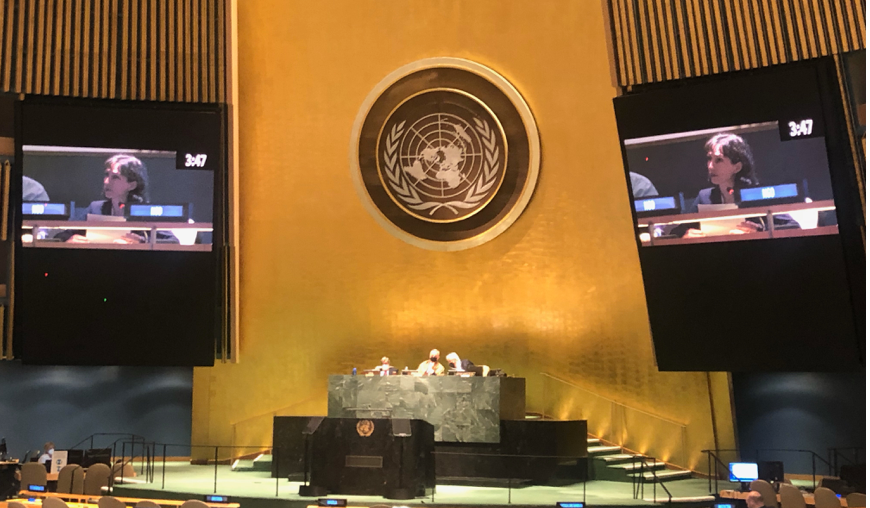
    Speaking in the UN General Assembly Hall

    It was exhilarating to not only have the opportunity to share with the conference my own and NAPF’s views on the urgency of nuclear disarmament, but also to hear from giants in the field, such as Sergio Duarte (former UN High Representative for Disarmament and President of the Pugwash Conferences) and Jackie Cabasso (from Western States Legal Foundation and Mayors for Peace), as well as rising stars of nuclear disarmament such as Yuta Takahashi of NO NUKES Tokyo and Benetick Kabua Maddison of the Marshallese Educational Initiative, who is also a part of our youth initiative, Reverse the Trend.

    I missed the second week of the conference in order to be in Santa Barbara for our 28th Annual Sadako Peace Day and to spend time in person with various members of our community. My time couldn’t have been more energizing and humbling. Sadako Peace Day saw us back at La Casa de Maria, with many in our community eager to reconnect and gratified to be back on the beautiful grounds of La Casa. In fact, we were their first public event since the site was closed following the devastating mudslides in 2018. I also had the opportunity to meet with our Board in person, following which our Senior Vice President Richard Falk wrote two essays inspired by our discussions. I hope you will read them.

    With Father Larry Gosselin at Sadako Peace Day

    During the third week of August, and back in New York and at the UN, I had the opportunity to participate in three separate conference side events. The first, co-organized by NAPF and IPPNW, took place on August 15. I was fortunate to Chair a fantastic panel of four fabulous experts and fierce advocates of a nuclear weapons-free world: Veronique Christory (ICRC Senior Advisor), Ambassador Tito of Kiribati, Tilman Ruff (Co-President of IPPNW), and Bonnie Docherty (Harvard Law Human Rights Clinic and Human Rights Watch). The focus of the panel was on humanitarian consequences of nuclear weapons and the discussion ranged from past to present to future, with important remarks and connections to the TPNW. I also participated at an August 17 side event, co-organized by Austria and Princeton, where I spoke about the environmental consequences of nuclear weapons testing in the Marshall Islands. And finally, on August 19, at another side-event co-organized by Abolition 2000 and World Future Council and others, I made the case for an absolutist position on nuclear abolition. All three events were amazing opportunities to advance NAPF’s mission and vision.

    The fourth week of the conference featured negotiations on drafts of the outcome document, which ultimately did not end up being adopted. I wrote an article for our website following the late Friday night closing session. If you haven’t read it, I hope you’ll consider doing so. In the article, I outline the issues that were at stake during the conference and make a case for why nuclear disarmament is more important than ever.

    Throughout the month I have felt warmly welcomed by everyone at NAPF – Carol Warner, Christian Ciobanu, Josie Parkhouse, Sandy Jones, and our Board of Directors. Each in their own way has supported, trusted, encouraged, and welcomed me into this family that is NAPF. I couldn’t be more grateful.

    Stay tuned for more updates from us this month on the continuation of our Nuclear Dangers in Ukraine Discussion Series (on Zoom), a new series of invited articles on nuclear abolition and other global challenges, and important work that we will be doing at the UN in regards to the TPNW. We also have an event coming up in November, a Women Waging Peace Luncheon, for which you can now purchase tickets and/or consider sponsorship opportunities. We are excited to honor two amazing women – Cynthia Lazaroff and Monique Limón – both of whom have made significant contributions to a nuclear weapons-free world and both of whom truly embody one of our guiding principles, “Peace is more than the absence of war.”

    This note also comes with an enormous thank you to all those who have supported NAPF over its four decades of existence, in a myriad of ways – from giving their time, energy and generosity to supporting nuclear disarmament efforts locally, nationally, and internationally. We wouldn’t be where we are today without you. We remain committed to a peaceful world, free of nuclear weapons, for as long as it takes to achieve.

    Warmly and with gratitude,

    Ivana

  • No Consensus at the 10th NPT Review Conference

    [fusion_builder_container type=”flex” hundred_percent=”no” equal_height_columns=”no” hide_on_mobile=”small-visibility,medium-visibility,large-visibility” background_position=”center center” background_repeat=”no-repeat” fade=”no” background_parallax=”none” parallax_speed=”0.3″ video_aspect_ratio=”16:9″ video_loop=”yes” video_mute=”yes” border_style=”solid”][fusion_builder_row][fusion_builder_column type=”1_1″ layout=”1_1″ background_position=”left top” background_color=”” border_color=”” border_style=”solid” border_position=”all” spacing=”yes” background_image=”” background_repeat=”no-repeat” padding_top=”” padding_right=”” padding_bottom=”” padding_left=”” margin_top=”0px” margin_bottom=”0px” class=”” id=”” animation_type=”” animation_speed=”0.3″ animation_direction=”left” hide_on_mobile=”small-visibility,medium-visibility,large-visibility” center_content=”no” last=”true” min_height=”” hover_type=”none” link=”” border_sizes_top=”” border_sizes_bottom=”” border_sizes_left=”” border_sizes_right=”” first=”true”][fusion_text columns=”” column_min_width=”” column_spacing=”” rule_style=”default” rule_size=”” rule_color=”” content_alignment_medium=”” content_alignment_small=”” content_alignment=”” hide_on_mobile=”small-visibility,medium-visibility,large-visibility” sticky_display=”normal,sticky” class=”” id=”” margin_top=”” margin_right=”” margin_bottom=”” margin_left=”” font_size=”” fusion_font_family_text_font=”” fusion_font_variant_text_font=”” line_height=”” letter_spacing=”” text_color=”” animation_type=”” animation_direction=”left” animation_speed=”0.3″ animation_offset=””]


    UN General Assembly Hall during the closing meeting of the 10th NPT Review Conference on August 26, 2022.

    Over the last four weeks, 191 countries met at the United Nations in New York for the Nuclear Non-Proliferation Treaty (NPT) Review Conference. The month-long meeting ended without an outcome document, as consensus couldn’t be reached, primarily on issues related to nuclear disarmament.* The Nuclear Age Peace Foundation (NAPF) participated in this important conference, delivering a statement that highlighted the urgency of nuclear disarmament in the current moment and organizing and participating in several side events focused on related issues. Given the failure of the NPT Review Conference to deliver meaningfully on nuclear disarmament, NAPF calls upon all NPT states to join the Treaty on the Prohibition of Nuclear Weapons or TPNW. This treaty came into force in January of 2021 and has been ratified by 66 countries and counting. All other NPT states parties should join their ranks.

    This August marked the 77th anniversary of the unconscionable atomic bombings on Hiroshima and Nagasaki, which as Einstein put it, “changed everything save our modes of thinking and we thus drift toward unparalleled catastrophe.” In the intervening decades, more countries joined the nuclear weapons club, with the United States and the Soviet Union proliferating in the extreme, reaching – near the end of the Cold War – arsenals of tens of thousands of nuclear weapons each. Over that time, we experienced numerous close calls, including the most famous one – the Cuban Missile Crisis – and many experts agree that good luck played a big role in averting a nuclear apocalypse. “But luck is not a strategy,” the United Nations Secretary General Antonio Guterres warned at the opening session of this review conference.  Given that a nuclear weapon state (Russia) has brutally attacked and invaded a non-nuclear weapon state (Ukraine), that the war has implicated other nuclear weapon states as well, and that there are additional rising geopolitical tensions, we need a far better strategy. In fact, the only reasonable answer to the present state of affairs is nuclear disarmament.

    In 1970, the NPT came into force, setting up a two-tier system of five countries – that had nuclear weapons by that point and were allowed to keep them – and the rest of the world. However, this arrangement was meant to be a temporary one and the five nuclear weapons states (China, France, Soviet Union – now Russia, United Kingdom, and United States) were – and remain – obligated to pursue nuclear disarmament, according to an article of the treaty, Article VI. Fifty-two years later, the nuclear weapon states have not only not fulfilled their NPT obligations, but they are doing precisely the opposite of pursuing disarmament. No wonder an agreement couldn’t be reached at the NPT conference.

    But there is good news on the horizon. In 2017, 122 countries negotiated the TPNW and the treaty went into force in January of 2021. What these states essentially said is that nuclear weapons have no place in this world and must be eliminated. This view has been shaped by deep knowledge and understanding of humanitarian harm of nuclear weapons from their use in Hiroshima and Nagasaki, to their testing around the world, from places like the Marshall Islands, Kiribati, and French Polynesia in the Pacific, to the deserts of the American southwest, Algeria, Australia, western China, and Kazakhstan. Moreover, the past use and testing – whose devastating consequences persist to today – is just a sliver of the harm that would be unleashed upon humanity should nuclear weapons be used in the future.

    First, the weapons in today’s nuclear arsenals are much more powerful than the Hiroshima and Nagasaki bombs and there are 13,000 of them rather than just a few. Second, at present, the nuclear weapon states have delivery systems that can deliver up to ten warheads to different locations – locations that are either far or close to one another. Finally, unlike with what happened in Japan, where there was no possible nuclear retaliation, there would almost certainly be a response to a nuclear attack anywhere in the world. And unlike with nuclear tests, where efforts were made not to cause widespread fires, nuclear weapon attacks on cities would cause such widespread fires so as to shut off food production and agriculture, leading to widespread famine and the death of billions of people.

    This is the second review conference in a row, following the 9th NPT Review Conference in 2015, that has failed to reach consensus. The urgency for disarmament couldn’t be higher and our commitment to it must be reinvigorated rather than allowed to falter. There is a way forward with the TPNW and we look forward to doing our part to strengthen and implement this treaty in full.

    * Technically, Russia blocked the outcome document over what their delegate referred to as “politicized” paragraphs regarding the Zaporizhzhia power plant. Subsequent statements from individual countries such as Costa Rica and South Africa, to joint statements by TPNW states, New Agenda Coalition, and the Non-Aligned Movement, reflected deep concern about the lack of progress and ambition on nuclear disarmament and the fulfillment of NPT’s Article VI obligations. I was particularly inspired by the South African statement, which quoted Nelson Mandela as saying, “Why do they need them, anyway?”

    For all NPT statements, go to Reaching Critical Will, NPT 2022 Statements 

    [/fusion_text][/fusion_builder_column][/fusion_builder_row][/fusion_builder_container]

  • Two new essays by Richard Falk, NAPF’s Senior Vice President

    NAPF’s most recent Board meeting on August 8, was both a joyous and somber occasion, simultaneously. Welcoming our new President to Santa Barbara and to her first official meeting as President was cause for celebration, while the timing of the meeting – sandwiched between the anniversaries of the attacks on Hiroshima and Nagasaki – presented an invitation for reflection on the attacks and the continuing threat that nuclear weapons pose to humanity. Our discussion was wide-ranging and it inspired Richard Falk, our Senior Vice President, to write two essays that touch on the topics we discussed. We are as ever grateful to Richard for sharing his wisdom, insight, and knowledge with us and invite you to read the essays. The first, entitled Two Perspectives on the 10th NPT Review Conference, can be found HERE. This essay discusses the context of the conference taking place amidst the anniversaries of the atomic bombings in Japan, as well as following the entry into force of the TPNW, and the current heightened geopolitical tensions. The second essay, entitled Connecting the Dots 77 Years Later: Hiroshima and Nuremberg, can be found HERE. This essay is a contemplation on the meaning of the term “victors’ justice” and the normalization of nuclear weapons that arose out of this view of what justice is or should be. We hope the writing will inspire you as it has inspired us to continue to fight for a peaceful world, one that is free of nuclear weapons.

  • NPT Review Conference Side Event on Nuclear Weapons and Climate Change

    [fusion_builder_container type=”flex” hundred_percent=”no” hundred_percent_height=”no” hundred_percent_height_scroll=”no” align_content=”stretch” flex_align_items=”flex-start” flex_justify_content=”flex-start” hundred_percent_height_center_content=”yes” equal_height_columns=”no” container_tag=”div” hide_on_mobile=”small-visibility,medium-visibility,large-visibility” status=”published” border_style=”solid” box_shadow=”no” box_shadow_blur=”0″ box_shadow_spread=”0″ gradient_start_position=”0″ gradient_end_position=”100″ gradient_type=”linear” radial_direction=”center center” linear_angle=”180″ background_position=”center center” background_repeat=”no-repeat” fade=”no” background_parallax=”none” enable_mobile=”no” parallax_speed=”0.3″ background_blend_mode=”none” video_aspect_ratio=”16:9″ video_loop=”yes” video_mute=”yes” absolute=”off” absolute_devices=”small,medium,large” sticky=”off” sticky_devices=”small-visibility,medium-visibility,large-visibility” sticky_transition_offset=”0″ scroll_offset=”0″ animation_direction=”left” animation_speed=”0.3″ filter_hue=”0″ filter_saturation=”100″ filter_brightness=”100″ filter_contrast=”100″ filter_invert=”0″ filter_sepia=”0″ filter_opacity=”100″ filter_blur=”0″ filter_hue_hover=”0″ filter_saturation_hover=”100″ filter_brightness_hover=”100″ filter_contrast_hover=”100″ filter_invert_hover=”0″ filter_sepia_hover=”0″ filter_opacity_hover=”100″ filter_blur_hover=”0″][fusion_builder_row][fusion_builder_column type=”1_1″ type=”1_1″ layout=”1_1″ background_position=”left top” background_color=”” border_color=”” border_style=”solid” border_position=”all” spacing=”yes” background_image=”” background_repeat=”no-repeat” padding_top=”” padding_right=”” padding_bottom=”” padding_left=”” margin_top=”0px” margin_bottom=”0px” class=”” id=”” animation_type=”” animation_speed=”0.3″ animation_direction=”left” hide_on_mobile=”small-visibility,medium-visibility,large-visibility” center_content=”no” last=”true” min_height=”” hover_type=”none” link=”” border_sizes_top=”” border_sizes_bottom=”” border_sizes_left=”” border_sizes_right=”” first=”true” content_layout=”block”][fusion_text columns=”” column_min_width=”” column_spacing=”” rule_style=”default” rule_size=”” rule_color=”” font_size=”” line_height=”” letter_spacing=”” text_color=”” content_alignment_medium=”” content_alignment_small=”” content_alignment=”” animation_type=”” animation_direction=”left” animation_speed=”0.3″ animation_offset=”” hide_on_mobile=”small-visibility,medium-visibility,large-visibility” sticky_display=”normal,sticky” class=”” id=””]

    On August 10, 2022, the Nuclear Age Peace Foundation, along with the Permament Missions to the UN of Kazakhstan and Kiribati, our youth initiative Reverse the Trend and our partners at the Marshallese Educational Initiative, and with financial support from the Prospect Hill Foundation, conducted a side event at the NPT Review Conference. The event focused on the twin existential crises of nuclear weapons and climate change and featured remarks by the Permament Representatives, Ambassador Teburoro Tito of Kiribati Ambassador Magzhan Ilyassov of Kazakhstan. Benetick Kabua Maddison from the Marshallese Educational Initiative and Alicia Sanders-Zakre from ICAN also participated in the panel, moderated by Christian N. Ciobanu, our Policy and Advocacy Coordinator. The event was well attended and generated excellent discussions and engagement from those in attendance. We are proud of all of the work that Christian and our interns did to make this event possible.

    [/fusion_text][/fusion_builder_column][fusion_builder_column type=”1_2″ type=”1_2″ layout=”1_1″ background_position=”left top” background_color=”” border_color=”” border_style=”solid” border_position=”all” spacing=”yes” background_image=”” background_repeat=”no-repeat” padding_top=”” padding_right=”” padding_bottom=”” padding_left=”” margin_top=”0px” margin_bottom=”0px” class=”” id=”” animation_type=”” animation_speed=”0.3″ animation_direction=”left” hide_on_mobile=”small-visibility,medium-visibility,large-visibility” center_content=”no” last=”true” min_height=”” hover_type=”none” link=”” border_sizes_top=”” border_sizes_bottom=”” border_sizes_left=”” border_sizes_right=”” first=”true”][fusion_text columns=”2″ column_min_width=”” column_spacing=”” rule_style=”default” rule_size=”” rule_color=”” content_alignment_medium=”” content_alignment_small=”” content_alignment=”” hide_on_mobile=”small-visibility,medium-visibility,large-visibility” sticky_display=”normal,sticky” class=”” id=”” margin_top=”” margin_right=”” margin_bottom=”” margin_left=”” font_size=”” fusion_font_family_text_font=”” fusion_font_variant_text_font=”” line_height=”” letter_spacing=”” text_color=”” animation_type=”” animation_direction=”left” animation_speed=”0.3″ animation_offset=””]

    [/fusion_text][/fusion_builder_column][/fusion_builder_row][/fusion_builder_container]

  • NAPF Statement at the UN

    [fusion_builder_container type=”flex” hundred_percent=”no” hundred_percent_height=”no” hundred_percent_height_scroll=”no” align_content=”stretch” flex_align_items=”flex-start” flex_justify_content=”flex-start” hundred_percent_height_center_content=”yes” equal_height_columns=”no” container_tag=”div” hide_on_mobile=”small-visibility,medium-visibility,large-visibility” status=”published” border_style=”solid” box_shadow=”no” box_shadow_blur=”0″ box_shadow_spread=”0″ gradient_start_position=”0″ gradient_end_position=”100″ gradient_type=”linear” radial_direction=”center center” linear_angle=”180″ background_position=”center center” background_repeat=”no-repeat” fade=”no” background_parallax=”none” enable_mobile=”no” parallax_speed=”0.3″ background_blend_mode=”none” video_aspect_ratio=”16:9″ video_loop=”yes” video_mute=”yes” absolute=”off” absolute_devices=”small,medium,large” sticky=”off” sticky_devices=”small-visibility,medium-visibility,large-visibility” sticky_transition_offset=”0″ scroll_offset=”0″ animation_direction=”left” animation_speed=”0.3″ filter_hue=”0″ filter_saturation=”100″ filter_brightness=”100″ filter_contrast=”100″ filter_invert=”0″ filter_sepia=”0″ filter_opacity=”100″ filter_blur=”0″ filter_hue_hover=”0″ filter_saturation_hover=”100″ filter_brightness_hover=”100″ filter_contrast_hover=”100″ filter_invert_hover=”0″ filter_sepia_hover=”0″ filter_opacity_hover=”100″ filter_blur_hover=”0″][fusion_builder_row][fusion_builder_column type=”1_1″ type=”1_1″ layout=”1_1″ background_position=”left top” background_color=”” border_color=”” border_style=”solid” border_position=”all” spacing=”yes” background_image=”” background_repeat=”no-repeat” padding_top=”” padding_right=”” padding_bottom=”” padding_left=”” margin_top=”0px” margin_bottom=”0px” class=”” id=”” animation_type=”” animation_speed=”0.3″ animation_direction=”left” hide_on_mobile=”small-visibility,medium-visibility,large-visibility” center_content=”no” last=”true” min_height=”” hover_type=”none” link=”” border_sizes_top=”” border_sizes_bottom=”” border_sizes_left=”” border_sizes_right=”” first=”true”][fusion_text columns=”1″ column_min_width=”” column_spacing=”” rule_style=”default” rule_size=”” rule_color=”” content_alignment_medium=”” content_alignment_small=”” content_alignment=”” hide_on_mobile=”small-visibility,medium-visibility,large-visibility” sticky_display=”normal,sticky” class=”” id=”” margin_top=”” margin_right=”” margin_bottom=”” margin_left=”” font_size=”” fusion_font_family_text_font=”” fusion_font_variant_text_font=”” line_height=”” letter_spacing=”” text_color=”” animation_type=”” animation_direction=”left” animation_speed=”0.3″ animation_offset=””]

    Our President, Dr. Ivana Nikolić Hughes, delivered a statement on behalf of NAPF at the NGO Session of the 10th NPT Review Conference. The session took place in General Assembly Hall at the United Nations in New York on August 5, 2022. Our statement focused on the urgency of nuclear disarmament in the current moment and the legal obligations and other reasons for nuclear weapons states to pursue disarmament. 

    [/fusion_text][fusion_youtube id=”https://www.youtube.com/watch?v=Ft3FLYh1Gwo” alignment=”center” width=”” height=”” autoplay=”false” api_params=”” title_attribute=”” hide_on_mobile=”small-visibility,medium-visibility,large-visibility” class=”” css_id=”” /][fusion_separator style_type=”default” hide_on_mobile=”small-visibility,medium-visibility,large-visibility” sticky_display=”normal,sticky” class=”” id=”” flex_grow=”2″ top_margin=”” bottom_margin=”” width=”” alignment=”center” border_size=”” sep_color=”” icon=”” icon_size=”” icon_color=”” icon_circle=”” icon_circle_color=”” /][fusion_text columns=”” column_min_width=”” column_spacing=”” rule_style=”default” rule_size=”” rule_color=”” content_alignment_medium=”” content_alignment_small=”” content_alignment=”” hide_on_mobile=”small-visibility,medium-visibility,large-visibility” sticky_display=”normal,sticky” class=”” id=”” margin_top=”” margin_right=”” margin_bottom=”” margin_left=”” font_size=”” fusion_font_family_text_font=”” fusion_font_variant_text_font=”” line_height=”” letter_spacing=”” text_color=”” animation_type=”” animation_direction=”left” animation_speed=”0.3″ animation_offset=””]

    Other Statements:

    We are inspired by remarks from the Secretary-General of the United Nations, Antonio Guterres, who delivered his statement to the NPT Review Conference on August 1, 2022. Secretary-General stated that “humanity is just one misunderstanding, one miscalculation away from nuclear annihilation. We need the Treaty on Non-Proliferation of Nuclear Weapons as much as ever.” Watch the entire statement:

    [/fusion_text][fusion_youtube id=”https://www.youtube.com/watch?v=I0My9xhgxVE” alignment=”center” width=”” height=”” autoplay=”false” api_params=”” title_attribute=”” hide_on_mobile=”small-visibility,medium-visibility,large-visibility” class=”” css_id=”” /][fusion_separator style_type=”none” hide_on_mobile=”small-visibility,medium-visibility,large-visibility” sticky_display=”normal,sticky” class=”” id=”” flex_grow=”2″ top_margin=”” bottom_margin=”” width=”” alignment=”center” border_size=”” sep_color=”” icon=”” icon_size=”” icon_color=”” icon_circle=”” icon_circle_color=”” /][fusion_text columns=”” column_min_width=”” column_spacing=”” rule_style=”default” rule_size=”” rule_color=”” content_alignment_medium=”” content_alignment_small=”” content_alignment=”” hide_on_mobile=”small-visibility,medium-visibility,large-visibility” sticky_display=”normal,sticky” class=”” id=”” margin_top=”” margin_right=”” margin_bottom=”” margin_left=”” font_size=”” fusion_font_family_text_font=”” fusion_font_variant_text_font=”” line_height=”” letter_spacing=”” text_color=”” animation_type=”” animation_direction=”left” animation_speed=”0.3″ animation_offset=””]

    President of Soka Gakkai International, Daisaku Ikeda, also issued a statement to the NPT Review Conference on July 26, 2022. The statement calls for No First Use of Nuclear Weapons and has NAPF’s full support. View statement HERE.

    You can read all of the NPT Review Conference statements from States Parties and NGOs HERE.

    [/fusion_text][/fusion_builder_column][/fusion_builder_row][/fusion_builder_container]

  • Nukes Are Illegal, Now What?

    Nukes Are Illegal, Now What?

    By Robert C. Koehler

    Let’s not forget: We are standing at the edge of global change. I believe what’s visible in this fleeting moment is our own evolution. http://commonwonders.com/nukes-are-illegal-now-what/

  • Don’t miss Studio 22.21: Entry into Force Day, ICAN’s online event

    Don’t miss Studio 22.21: Entry into Force Day, ICAN’s online event

    Don’t miss International Campaign to Abolish Nuclear Weapons (ICAN)‘s online event on January 22, the day the Treaty on the Prohibition of Nuclear Weapons enters into force.  https://www.icanw.org/studio2221

  • Celebrating the 50th Ratification of the Treaty on the Prohibition of Nuclear Weapons

    Celebrating the 50th Ratification of the Treaty on the Prohibition of Nuclear Weapons

    Setsuko Thurlow
    Setsuko Thurlow at the 2015 NAPF Evening for Peace.

    The Treaty on the Prohibition of Nuclear Weapons has entered into force! This truly marks the beginning of the end of nuclear weapons! When I learned that we reached our 50th ratification, I was not able to stand. I remained in my chair and put my head in my hands and I cried tears of joy. I have committed my life to the abolition of nuclear weapons. I have nothing but gratitude for all who have worked for the success of our treaty. I have a powerful feeling of solidarity with tens of thousands of people across the world. We have made it to this point.

    As I sat in my chair, I found myself speaking with the spirits of hundreds of thousands of people who lost their lives in Hiroshima and Nagasaki. I was immediately in conversation with these beloved souls — my sister, my nephew Eiji, other dear family members, my classmates, all the children and innocent people who perished. I was reporting to the dead, sharing this good news first with them, because they paid the ultimate price with their precious lives. Like many survivors, I made a vow that their deaths would not be in vain and to warn the world about the danger of nuclear weapons, to make sure that no one else suffers as we have suffered. I made a vow to work for nuclear disarmament until my last breath. And now we have reached a milestone in our decades’ long struggle — the Treaty on the Prohibition of Nuclear Weapons will become international law!

    I have a tremendous sense of accomplishment and fulfillment, a sense of satisfaction and gratitude. I know other survivors share these emotions — whether we are survivors from Hiroshima and Nagasaki; or test survivors from South Pacific island nations, Kazakhstan, Australia and Algeria; or survivors from uranium mining in Canada, the United States or the Congo. All those who have been victimized by the barbaric behavior of nine nations who continue to develop more horrendous weapons, prepared to repeat nuclear massacres far more devastating than the atomic bomb that leveled my hometown, Hiroshima. For the victims and survivors, this initial success with the Treaty on the Prohibition of Nuclear Weapons is tremendously uplifting. I celebrate this moment with my brothers and sisters across the world who have been victimized, and still raise their voices, and still survive.

    We also celebrate with those people across the world who recognize the ultimate evil of nuclear weapons, instruments of radioactive violence and omnicide that have kept the entire world hostage for all these 75 years. We celebrate with the global community of anti-nuclear activists who have come together and have worked for the success of this treaty. I am especially grateful to my dear colleagues in the International Campaign to Abolish Nuclear Weapons. ICAN laid the groundwork to collaborate across the divide of diplomacy and activism, to achieve something of profound and lasting importance.

    I also want to acknowledge how moved I am that in the preamble to the treaty, hibakusha are identified by name. This is the first time in international law that we have been so recognized. We share this recognition with other hibakusha across the world, those who have suffered radioactive harm from nuclear testing, from uranium mining, from secret experimentation. And furthermore, the treaty recognizes that indigenous people have been disproportionately affected by the production of nuclear weapons. We in hibakusha and indigenous communities uniquely understand that not only the use of nuclear weapons in war but also the testing and production of nuclear weapons causes death and unspeakable suffering through invisible radioactive contamination. And here the treaty recognizes that women and girls are more susceptible to the effects of radiation — that there are gendered implications to radioactive violence.

    I am moved to acknowledge the positive obligations of the treaty as well — such as victims assistance and environmental remediation which will be a hallmark for taking responsibility for the inter-generational effects of radiation. It is vitally important that we all understand that the nuclear age will continue far beyond the nuclear weapon age. We will need to contain and care for radioactive materials into the far future.

    But for now, in this joyous present moment, we can rejoice in making our first move. I cannot truly express with words my feelings of overwhelming gratitude. How we have struggled in spite of being confronted by indifference and ignorance! How we have struggled in spite of being ridiculed by nuclear armed and nuclear dependent states! In spite of that and more, we have made it to this point — nuclear weapons are now illegal under international law!

    Nuclear abolitionists everywhere can be incredibly encouraged and empowered by this new legal status. Now, with greater intensity and purpose, we will push forward. While this is a time to celebrate, it is not a time for us to relax. The world is ever more dangerous. Yes, we have made it to this point, but we have a long path to cover until we reach our goal of the total elimination of nuclear weapons.

    It is unlikely that I will see that day. It is unlikely that any atomic bomb survivor with their own lived memories will bear witness on that day but with the Treaty on the Prohibition of Nuclear Weapons, we can be certain that that beautiful day will dawn. And on that day, we hibakusha, test survivors, indigenous people and others, victim to the inter-generational cruelty of radioactive poison, will be remembered and someone alive at present will report to us. Because of our work, our solidarity, our love for this world, we will be a part of a much greater celebration in spirit, when nuclear disarmament will be achieved as part of a greater movement that encompasses peace, justice, equality and compassion for all.

    The Treaty on the Prohibition of Nuclear Weapons has opened a new door, wide. Passing through it we begin a new chapter in our struggle — with a mighty embrace of gratitude from those we have lost, and a heartfelt welcome from those who are yet to come. The beginning of the end of nuclear weapons has arrived! Let us step through the doorway now!


    Setsuko Thurlow is a survivor of the US atomic bombing of Hiroshima, and a member of the NAPF Advisory Council.

  • Open Letter in Support of the 2017 Treaty on the Prohibition of Nuclear Weapons

    Open Letter in Support of the 2017 Treaty on the Prohibition of Nuclear Weapons

    This open letter was coordinated by the International Campaign to Abolish Nuclear Weapons, of which NAPF is a Partner Organization. Numerous articles were written about the open letter, including in The New York Times.


    The coronavirus pandemic has starkly demonstrated the urgent need for greater international cooperation to address all major threats to the health and welfare of humankind. Paramount among them is the threat of nuclear war. The risk of a nuclear weapon detonation today — whether by accident, miscalculation or design — appears to be increasing, with the recent deployment of new types of nuclear weapons, the abandonment of longstanding arms control agreements, and the very real danger of cyber-attacks on nuclear infrastructure. Let us heed the warnings of scientists, doctors and other experts. We must not sleepwalk into a crisis of even greater proportions than the one we have experienced this year.

    It is not difficult to foresee how the bellicose rhetoric and poor judgment of leaders in nuclear-armed nations might result in a calamity affecting all nations and peoples. As past leaders, foreign ministers and defence ministers of Albania, Belgium, Canada, Croatia, the Czech Republic, Denmark, Germany, Greece, Hungary, Iceland, Italy, Japan, Latvia, the Netherlands, Norway, Poland, Portugal, Slovakia, Slovenia, South Korea, Spain and Turkey — all countries that claim protection from an ally’s nuclear weapons — we appeal to current leaders to advance disarmament before it is too late. An obvious starting point for the leaders of our own countries would be to declare without qualification that nuclear weapons serve no legitimate military or strategic purpose in light of the catastrophic human and environmental consequences of their use. In other words, our countries should reject any role for nuclear weapons in our defence.

    By claiming protection from nuclear weapons, we are promoting the dangerous and misguided belief that nuclear weapons enhance security. Rather than enabling progress towards a world free of nuclear weapons, we are impeding it and perpetuating nuclear dangers — all for fear of upsetting our allies who cling to these weapons of mass destruction. But friends can and must speak up when friends engage in reckless behavior that puts their lives and ours in peril.

    Without doubt, a new nuclear arms race is under way, and a race for disarmament is urgently needed. It is time to bring the era of reliance on nuclear weapons to a permanent end. In 2017, 122 countries took a courageous but long-overdue step in that direction by adopting the Treaty on the Prohibition of Nuclear Weapons — a landmark global accord that places nuclear weapons on the same legal footing as chemical and biological weapons and establishes a framework to eliminate them verifiably and irreversibly. Soon it will become binding international law.

    To date, our countries have opted not to join the global majority in supporting this treaty. But our leaders should reconsider their positions. We cannot afford to dither in the face of this existential threat to humanity. We must show courage and boldness — and join the treaty. As states parties, we could remain in alliances with nuclear-armed states, as nothing in the treaty itself nor in our respective defence pacts precludes that. But we would be legally bound never under any circumstances to assist or encourage our allies to use, threaten to use or possess nuclear weapons. Given the very broad popular support in our countries for disarmament, this would be an uncontroversial and much-lauded move.

    The prohibition treaty is an important reinforcement to the half-century-old Non-Proliferation Treaty, which, though remarkably successful in curbing the spread of nuclear weapons to more countries, has failed to establish a universal taboo against the possession of nuclear weapons. The five nuclear-armed nations that had nuclear weapons at the time of the NPT’s negotiation — the United States, Russia, Britain, France and China — apparently view it as a licence to retain their nuclear forces in perpetuity. Instead of disarming, they are investing heavily in upgrades to their arsenals, with plans to retain them for many decades to come.

    This is patently unacceptable.

    The prohibition treaty adopted in 2017 can help end decades of paralysis in disarmament. It is a beacon of hope in a time of darkness. It enables countries to subscribe to the highest available multilateral norm against nuclear weapons and build international pressure for action. As its preamble recognizes, the effects of nuclear weapons “transcend national borders, pose grave implications for human survival, the environment, socioeconomic development, the global economy, food security and the health of current and future generations, and have a disproportionate impact on women and girls, including as a result of ionizing radiation”.

    With close to 14,000 nuclear weapons located at dozens of sites across the globe and on submarines patrolling the oceans at all times, the capacity for destruction is beyond our imagination. All responsible leaders must act now to ensure that the horrors of 1945 are never repeated. Sooner or later, our luck will run out — unless we act. The nuclear weapon ban treaty provides the foundation for a more secure world, free from this ultimate menace. We must embrace it now and work to bring others on board. There is no cure for a nuclear war. Prevention is our only option.

    Signed by:

    Lloyd AXWORTHY
    Former Minister of Foreign Affairs of Canada

    BAN Ki-moon
    Former Secretary-General of the United Nations and Minister of Foreign Affairs of South Korea

    Jean-Jacques BLAIS
    Former Minister of National Defence of Canada

    Kjell Magne BONDEVIK
    Former Prime Minister and Minister of Foreign Affairs of Norway

    Ylli BUFI
    Former Prime Minister of Albania

    Jean CHRÉTIEN
    Former Prime Minister of Canada

    Willy CLAES
    Former Minister of Foreign Affairs of Belgium and Secretary General of NATO

    Erik DERYCKE
    Former Minister of Foreign Affairs of Belgium

    Joschka FISCHER
    Former Federal Minister of Foreign Affairs of Germany

    Franco FRATTINI
    Former Minister of Foreign Affairs of Italy and Vice-President of the European Commission

    Ingibjörg Sólrún GÍSLADÓTTIR
    Former Minister for Foreign Affairs of Iceland

    Bjørn Tore GODAL
    Former Minister of Foreign Affairs and Minister of Defence of Norway

    Bill GRAHAM
    Former Minister of Foreign Affairs and Minister of National Defence of Canada

    HATOYAMA Yukio
    Former Prime Minister of Japan

    Thorbjørn JAGLAND
    Former Prime Minister and Minister of Foreign Affairs of Norway

    Ljubica JELUŠIČ
    Former Minister of Defence of Slovenia

    Tālavs JUNDZIS
    Former Minister of Defence of Latvia

    Jan KAVAN
    Former Minister of Foreign Affairs of the Czech Republic and President of the UN General Assembly

    Alojz KRAPEŽ
    Former Minister of Defence of Slovenia

    Ģirts Valdis KRISTOVSKIS
    Former Minister of Foreign Affairs, Minister of Defence, and Minister of the Interior of Latvia

    Aleksander KWAŚNIEWSKI
    Former President of Poland

    Yves LETERME
    Former Prime Minister and Minister of Foreign Affairs of Belgium

    Enrico LETTA
    Former Prime Minister of Italy

    Eldbjørg LØWER
    Former Minister of Defence of Norway

    Mogens LYKKETOFT
    Former Minister of Foreign Affairs of Denmark

    John McCALLUM
    Former Minister of National Defence of Canada

    John MANLEY
    Former Deputy Prime Minister and Minister of Foreign Affairs of Canada

    Rexhep MEIDANI
    Former President of Albania

    Zdravko MRŠIĆ
    Former Minister of Foreign Affairs of Croatia

    Linda MŪRNIECE
    Former Minister of Defence of Latvia

    Fatos NANO
    Former Prime Minister of Albania

    Holger K. NIELSEN
    Former Minister of Foreign Affairs of Denmark

    Andrzej OLECHOWSKI
    Former Minister of Foreign Affairs of Poland

    Kjeld OLESEN
    Former Minister of Foreign Affairs and Minister of Defence of Denmark

    Ana de PALACIO Y DEL VALLE-LERSUNDI
    Former Minister of Foreign Affairs of Spain
    Theodoros PANGALOS
    Former Deputy Prime Minister and Minister for Foreign Affairs of Greece

    Jan PRONK
    Former Minister of Defence (Ad Interim) and Minister for Development Cooperation of the Netherlands

    Vesna PUSIĆ
    Former Deputy Prime Minister and Minister of Foreign and European Affairs of Croatia

    Dariusz ROSATI
    Former Minister of Foreign Affairs of Poland

    Rudolf SCHARPING
    Former Federal Minister of Defence of Germany

    Juraj SCHENK
    Former Minister of Foreign Affairs of Slovakia

    Nuno SEVERIANO TEIXEIRA
    Former Minister of National Defense of Portugal

    Jóhanna SIGURÐARDÓTTIR
    Former Prime Minister of Iceland

    Össur SKARPHÉÐINSSON
    Former Minister for Foreign Affairs of Iceland

    Javier SOLANA
    Former Minister of Foreign Affairs of Spain and Secretary General of NATO

    Anne-Grete STRØM-ERICHSEN
    Former Minister of Defence of Norway

    Hanna SUCHOCKA
    Former Prime Minister of Poland

    SZEKERES Imre
    Former Minister of Defense of Hungary

    TANAKA Makiko
    Former Minister of Foreign Affairs of Japan

    TANAKA Naoki
    Former Minister of Defense of Japan

    Danilo TÜRK
    Former President of Slovenia

    Hikmet Sami TÜRK
    Former Minister of National Defense of Turkey

    John N. TURNER
    Former Prime Minister of Canada

    Guy VERHOFSTADT
    Former Prime Minister of Belgium

    Knut VOLLEBÆK
    Former Minister of Foreign Affairs of Norway

    Carlos WESTENDORP Y CABEZA
    Former Minister of Foreign Affairs of Spain