Blog

  • Courage, Foresight and Accountability

    Peace Palace
    Photograph: CIJ-ICJ/UN-ONU, Capital Photos/Frank van Beek – Courtesy of the ICJ. All rights reserved.

    On October 5, the International Court of Justice declared that it does not have jurisdiction in the nuclear disarmament cases brought by the Republic of the Marshall Islands (RMI) against India, Pakistan and the United Kingdom (UK).

    By an 8-8 vote, with President Ronny Abraham of France issuing the casting “no” vote, the Court declared that there was not sufficient evidence of a dispute between the RMI and the UK, and therefore the Court lacks jurisdiction. Similar judgments were issued in the cases against India and Pakistan, with those votes coming in at 9-7.

    By dismissing the cases on the preliminary issue of jurisdiction, the Court did not examine the merits of the cases. The cases aimed to hold the nine nuclear-armed states (U.S., Russia, UK, France, China, Israel, India, Pakistan and North Korea) accountable for violating international law by failing to respect their nuclear disarmament obligations under the 1968 Nuclear Non-Proliferation Treaty (NPT) and customary international law.

    In the 8-8 judgment in the UK case, the following judges voted against the Court having jurisdiction: Abraham (France); Owada (Japan); Greenwood (UK); Xue (China); Donoghue (U.S.); Gaja (Italy); Bhandari (India); and Gevorgian (Russia). According to the ICJ website, “A Member of the Court is a delegate neither of the government of his own country nor of that of any other State. Unlike most other organs of international organizations, the Court is not composed of representatives of governments.” It is striking to note, however, that six of the judges come from nuclear-armed states, while the other two (Japan and Italy) are deeply invested in the U.S. “nuclear umbrella.”

    The RMI showed remarkable courage and foresight in bringing these cases to the ICJ. When the cases were filed on April 24, 2014, Tony de Brum, Co-Agent of the Marshall Islands, said, “Our people have suffered the catastrophic and irreparable damage of these weapons, and we vow to fight so that no one else on earth will ever again experience these atrocities. The continued existence of nuclear weapons and the terrible risk they pose to the world threaten us all.”

    These cases brought by the Marshall Islands have inspired activists around the world and have demonstrated to other non-nuclear weapon states that it is possible to stand up to the nuclear-armed countries to demand justice.

  • International Court of Justice Dismisses Marshall Islands’ Nuclear Disarmament Cases Without Considering the Merits

    Contact:
    Rick Wayman
    +1 805 696 5159
    rwayman@napf.org

    Peace Palace
    Photograph: CIJ-ICJ/UN-ONU, Capital Photos/Frank van Beek – Courtesy of the ICJ. All rights reserved.

    October 5, 2016 – The International Court of Justice (ICJ), the world’s highest court, delivered its judgments on preliminary issues in the Marshall Islands’ nuclear disarmament cases against India, Pakistan and the United Kingdom (UK).

    By a vote of 8-8, by the casting vote of Ronny Abraham, President of the Court, the Court upheld the objection of the United Kingdom that there was not sufficient evidence of the existence of a dispute, and therefore the ICJ does not have jurisdiction to hear the case on the merits.

    By votes of 9-7, the Court upheld the objections of India and Pakistan that there was not sufficient evidence of the existence of a dispute, and therefore the ICJ does not have jurisdiction to hear the cases on the merits.

    The government of the Republic of the Marshall Islands released an official statement following the judgments, which can be found at the end of this press release.

    Phon van den Biesen, Co-Agent of the Republic of the Marshall Islands, said, “We are pleased that the Court recited its unanimous decision of 1996 that there exists an obligation to pursue in good faith negotiations leading to nuclear disarmament in all its aspects. Likewise we are pleased that half of the judges of the highest court in the world confirmed, as the Marshall Islands alleged, that jurisdiction exists here. Nonetheless it is difficult to understand how eight judges could have found that no disputes existed in these cases when they were filed. So that is very disappointing. It is particularly worrying that the World Court cannot be unanimous on what it takes to establish a dispute in the context of nuclear disarmament.”

    These unprecedented lawsuits were submitted by the Republic of the Marshall Islands (RMI) to the ICJ on April 24, 2014. They aimed to hold the nine nuclear-armed states (U.S., Russia, UK, France, China, Israel, India, Pakistan and North Korea) accountable for violating international law by failing to respect their nuclear disarmament obligations under the 1968 Nuclear Non-Proliferation Treaty (NPT) and customary international law.

    Only the UK, India and Pakistan appeared before the Court, since only they accept the compulsory jurisdiction of the ICJ. China, the U.S., Russia, France, Israel and North Korea chose to ignore the ICJ cases. The RMI also has a nuclear disarmament case pending against the United States in the U.S. Ninth Circuit Court of Appeals.

    David Krieger, President of the Nuclear Age Peace Foundation and a consultant to the RMI, said, “In bringing these lawsuits, Tony de Brum and the Marshall Islands have demonstrated the courage and determination to act and speak, based on conviction and bitter, tragic experience, for the benefit of all humankind. De Brum and the Marshall Islands made the choice to act in a constructive manner to find a path to end the existential threat posed by nuclear weapons. With the lawsuits, the Marshall Islands challenged the nuclear-armed states to show good faith in meeting the universal legal obligation to pursue and conclude negotiations on complete nuclear disarmament. The Marshall Islands itself has shown good faith fulfilment of that obligation in a dignified, respectful way, through court action.”

    Contact information for the International Legal Team:

    Phon van den Biesen, Co-Agent of the RMI
    Attorney at Law at Van den Biesen Kloostra Advocaten, Amsterdam http://vdbkadvocaten.eu/en/phon-van-den-biesen-en/
    +31.65.2061266
    phonvandenbiesen@vdbkadvocaten.eu

    A complete list of the International Legal Team as well as information on the lawsuits can be found at www.nuclearzero.org. The California-based Nuclear Age Peace Foundation is consultant to the Republic of the Marshall Islands.


    Official statement from the government of the Republic of the Marshall Islands:

    “While these proceedings were initiated by a previous government administration, and have been carried forward, the Marshall Islands has – for decades – repeatedly reminded the international community that our own burden and experiences with nuclear detonation must never again be repeated – this includes Marshallese who petitioned the United Nations in 1954 and 1956 to cease the nuclear testing program during its status as a UN Trust Territory. Recent nuclear tests in North Korea are a stunning example of clearly unacceptable risks which remain with us all.

    While it may be that there are several political pathways to sharply reducing – and eliminating – nuclear risk, further progress on nuclear disarmament appears stalled. Without further flexibility and political will by all sides of the table, and with all necessary actors – and without common agreement on a way forward, it is as though there is no visible path to a world free of nuclear weapons, and the peace and security which accompany it. Such a lack of progress is no way to honor or respond to the lesson that Marshallese people have offered the world.

    We look forward to studying closely the Court’s opinion before commenting further.”

  • The Fierce Urgency of Nuclear Zero

    The Nuclear Age began with the utter destruction of the Japanese cities of Hiroshima and Nagasaki.  Survivors of these bombings have borne witness to the death, devastation, pain and suffering that resulted from the use of nuclear weapons.  They have given ample testimony to the horrors they experienced.  Their most powerful and persistent insight is: “We must abolish nuclear weapons before they abolish us.”  The “we” in that statement is “humanity” and the “us” is “all of us.”

    The weapons used at Hiroshima and Nagasaki were small compared to the thermonuclear weapons subsequently developed, including those in today’s nuclear arsenals.

    Planet Earth from outer spaceThe use of only one or two percent of the more than 15,000 nuclear weapons in modern nuclear arsenals would likely destroy civilization and could destroy much of life on Earth.  Rather than engaging in serious nuclear disarmament efforts, however, all nine nuclear-armed countries are in the process of modernizing and upgrading their nuclear arsenals.

    It is clear, but not widely considered, that today’s nuclear arsenals threaten all we love and treasure, make humans an endangered species, and undermine our stewardship of the planet.

    A quarter century after the end of the Cold War, some 1,800 nuclear weapons in the arsenals of the United States and Russia remain on hair-trigger alert, ready to be fired within moments of an order to do so.  This is literally a disaster waiting to happen.

    Nuclear trouble spots are intensifying across the globe, but particularly in relations between former Cold War adversaries, U.S. and Russia, leading some analysts to describe the situation as a new cold war.

    Expanding NATO membership to Russia’s borders, in spite of promises not to do so, has been among the major factors causing deterioration in U.S.-Russian relations.

    The U.S. has deployed missile defense installations on military bases of NATO members close to the Russian border.  The Russians view missile defenses as dangerous dual-purpose technology (with offensive as well as defensive capabilities), and these installations are heightening tensions between Russia and the West.

    Similar tensions are developing in East Asia as a result of the deployment of U.S. missile defense installations in that region, viewed by China as undermining its minimum deterrent force and helping to drive the modernization of the Chinese nuclear arsenal.  Tensions also remain high in South Asia and the Middle East.

    Against this backdrop of danger and uncertainty, the nuclear disarmament obligations of the Nuclear Non-Proliferation Treaty (NPT) are not being fulfilled by the nuclear weapon states that are parties to the treaty, thus breaching the treaty and violating the bargain of the treaty.  In a bold action, the tiny Pacific Island state, the Republic of the Marshall Islands, brought lawsuits in 2014 against the nine nuclear-armed countries for breaching their obligations under the NPT and/or customary international law to negotiate in good faith for an end to the nuclear arms race and for nuclear disarmament.

    Among the nine nuclear-armed countries and those countries under the “nuclear umbrella” of the United States (the 28 NATO countries and Australia, Japan, Republic of Korea and Taiwan), there appears to be little political will for nuclear disarmament and the public in these countries seems to be largely complacent.

    The Doomsday Clock of the Bulletin of the Atomic Scientists stands at three minutes to midnight, close to doomsday.  And yet, humanity is experiencing the “frog’s malaise.”  It is as though the human species has been placed into a pot of tepid water and is content to calmly stay there treading water while the temperature rises to the fatal boiling point.

    As Noam Chomsky analyzes the situation, “Nuclear weapons pose a constant danger of instant destruction, but at least we know in principle how to alleviate the threat, even to eliminate it, an obligation undertaken (and disregarded) by the nuclear powers that have signed the Non-Proliferation Treaty.”

    Humanity stands at the edge of a nuclear precipice.  Our choices are to do nothing or to back away from the precipice and change course.  We can remain complacent, and thus unengaged, in the face of the threat, or we can become engaged and demand the elimination of nuclear weapons before they are used again by mistake, miscalculation or malice.  There is no meaningful middle ground.

    How is humanity to shoulder the moral burden for species survival that is our collective responsibility in the Nuclear Age?

    We must change the discourse on nuclear dangers and the actions that follow from it. 

    We must awaken, create and build a movement that is powerful enough to achieve the political will to end the nuclear era.

    The movement must have one simple demand that resonates across the globe – a world free of nuclear weapons.  This must be conveyed to political leaders as an urgent and essential goal for assuring the future of humanity.  Once the goal is widely accepted, steps along the way must be agreed upon.  Meaningful steps would include:

    • Reinstating the Anti-Ballistic Missile Treaty and the removal of U.S. missile defense installations from near the Russian border.
    • Convening negotiations for a Nuclear Ban Treaty to prohibit and eliminate nuclear weapons on Earth and in outer space.
    • De-alerting nuclear arsenals; declaring policies of No First Use and No Launch-on-Warning; removing all U.S. nuclear weapons from foreign soil; ratifying the Comprehensive Test Ban Treaty; and negotiating a treaty banning weapons in space.
    • Zeroing out funding for “modernizing” nuclear arsenals and directing these funds instead to meeting human needs and protecting the environment.

    The Nuclear Age is a time of great challenge.  We must raise the level of our moral and political engagement to assure that globally we are able to control the power of our destructive technologies.  Youth must lead the way in creating a new human epoch that is characterized by the seven C’s: compassion, commitment, courage, conscience, creativity, cooperation and celebration.

  • Sunflower Newsletter: October 2016

    Issue #231 – October 2016

    Donate Now!

    Your donation directly supports costs associated with the Marshall Islands’ Nuclear Zero Lawsuits. For every gift of $60 or more, we will send you the book We Need a Department of Peace: Everybody’s Business, Nobody’s Job.

    Facebook Twitter Addthis

    • Perspectives
      • The Simple Act of Pushing a Button by David Krieger
      • Banning Nuclear Weapons Is Crucial for Global Health by Ira Helfand, Tilman Ruff, Michael Marmot, Frances Hughes and Michael Moore
      • Statement from the Holy See on Nuclear Abolition Day by Archbishop Bernadito Auza
    • Nuclear Disarmament
      • Non-Nuclear States Push for Treaty Banning Nuclear Weapons
    • U.S. Nuclear Weapons Policy
      • UN Security Council Adopts U.S.-Drafted Resolution Against Nuclear Testing
      • Sen. Markey and Rep. Lieu Introduce Bills on No First Use
    • Nuclear Proliferation
      • North Korea Conducts Fifth Nuclear Test
      • New Poll Shows 58 Percent of South Koreans Favor Nuclear Armament
    • War and Peace
      • Women Encourage a Peace Treaty to End Korean War
    • Nuclear Insanity
      • U.S. Airmen Propose Names for New Nuclear-Armed Bomber
      • UK Nuclear Weapon Convoys Regularly Involved in Mishaps
    • Nuclear Modernization
      • U.S. Defense Secretary Goes On Whirlwind Nuclear Modernization Tour
    • Nuclear Zero Lawsuits
      • International Court of Justice to Deliver Judgments on October 5
    • Resources
      • October’s Featured Blog
      • This Month in Nuclear Threat History
    • Foundation Activities
      • Noam Chomsky to Receive NAPF Distinguished Peace Leadership Award
      • Fourth Graders and Peace Literacy
      • Poetry Contest Winners Announced
    • Quotes


    Perspectives

    The Simple Act of Pushing a Button

    “Since the appearance of visible life on Earth, 380 million years had to elapse in order for a butterfly to learn how to fly, 180 million years to create a rose with no other commitment than to be beautiful, and four geological eras in order for us human beings to be able to sing better than birds, and to be able to die from love. It is not honorable for the human talent, in the golden age of science, to have conceived the way for such an ancient and colossal process to return to the nothingness from which it came through the simple act of pushing a button.”

    I recently came across this quotation by the great Colombian novelist Gabriel Garcia Marquez, the author of One Hundred Years of Solitude and recipient of the 1982 Nobel Prize for Literature. The quotation is from a 1986 speech by Garcia Marquez entitled “The Cataclysm of Damocles.” In the short quotation, he captures what needs to be said about nuclear weapons succinctly, poetically and beautifully. With a few deft literary brushstrokes, he shows that the journey of life from nothingness to now could be ended with no more than “the simple act of pushing a button.”

    To read more, click here.

    Banning Nuclear Weapons Is Crucial for Global Health

    Before this year ends, the United Nations general assembly can take a decisive step toward ending one of the most urgent threats to public health and human survival in the world today. UN member states can and must mandate negotiations on a new treaty that prohibits nuclear weapons.

    Banning and eliminating nuclear weapons is a high global health priority. The general assembly has the opportunity to move us towards this critical goal. It must not fail to act.

    To read more, click here.

    Statement from the Holy See on Nuclear Abolition Day

    My delegation believes that nuclear arms offer a false sense of security, and that the uneasy peace promised by nuclear deterrence is a tragic illusion. Nuclear weapons cannot create for us a stable and secure world. Peace and international stability cannot be founded on mutually assured destruction or on the threat of total annihilation. The Holy See believes that peace cannot be solely the maintaining of a balance of power. On the contrary, as Pope Francis affirmed, “Peace must be built on justice, socio-economic development, freedom, respect for human rights, the participation of all in public affairs and the building of trust between peoples.”

    Lasting peace thus requires that all must strive for progressive and concerted nuclear disarmament. For our own good and that of future generations, we have no reasonable or moral option other than the abolition of nuclear weapons.

    To read more, click here.

    Nuclear Disarmament

    Non-Nuclear States Push for Treaty Banning Nuclear Weapons

    On September 28, six countries introduced a resolution to the United Nations General Assembly urging the commencement of negotiations in 2017 for a treaty banning nuclear weapons. The six countries – Austria, Brazil, Ireland, Mexico, Nigeria and South Africa – are urging countries “to negotiate a legally-binding instrument to prohibit nuclear weapons.”

    The draft resolution “calls upon States participating in the conference to make their best endeavours to conclude as soon as possible a legally-binding instrument to prohibit nuclear weapons, leading towards their total elimination.”

    Many nuclear-armed nations have expressed outright animosity toward this nuclear disarmament effort. Anita Friedt, a high-ranking official in the U.S. State Department’s Bureau of Arms Control, Verification and Compliance, said that the United States believes “pursuit of such a ban is unrealistic and simply impractical” and “could actually end up harming” broader, tangible efforts toward disarmament.

    A vote is expected around the end of October.

    Jamey Keaten, “Non-Nuclear States Advance Push for UN Treaty to Ban Nukes,” Associated Press, September 28, 2016.

    U.S. Nuclear Weapons Policy

    UN Security Council Adopts U.S.-Drafted Resolution Against Nuclear Testing

    On September 23, the United Nations Security Council passed a resolution introduced by the United States calling on all countries to end nuclear weapons testing. The resolution coincides with the 20th anniversary of the introduction of the Comprehensive Test Ban Treaty, which the U.S. and a few other nuclear-capable countries have not ratified.

    Republicans in the U.S. Senate expressed outrage over the move, saying that it aimed to sidestep the authority of the Senate to ratify international treaties. Many Republicans threatened to withhold the $32 million per year that the U.S. contributes to the Comprehensive Test Ban Treaty Organization if the vote went ahead.

    Kambiz Foroohar, “UN Adopts U.S.-Drafted Plea for Stalled Nuclear Test Treaty,” Bloomberg, September 23, 2016.

    Sen. Markey and Rep. Lieu Introduce Bills on No First Use

    Senator Ed Markey (D-MA) and Representative Ted Lieu (D-CA) have introduced bills into the Senate and House of Representatives that would eliminate the ability of the President to conduct a nuclear first strike without an explicit declaration of war from Congress.

    Rep. Lieu said, “Our Founding Fathers would be rolling over in their graves if they knew the President could launch a massive, potentially civilization-ending military strike without authorization from Congress. Our Constitution created a government based on checks and balances and gave the power to declare war solely to the people’s representatives. A nuclear first strike, which can kill hundreds of millions of people and invite a retaliatory strike that can destroy America, is war. The current nuclear launch approval process, which gives the decision to potentially end civilization as we know it to a single individual, is flatly unconstitutional. I am proud to introduce the Restricting First Use of Nuclear Weapons Act of 2016 with Sen. Markey to realign our nation’s nuclear weapons launch policy with the Constitution.”

    Congressman Lieu & Senator Markey Introduce the Restricting First Use of Nuclear Weapons Act,” Office of Rep. Ted Lieu, September 27, 2016.

    Nuclear Proliferation

    North Korea Conducts Fifth Nuclear Test

    On September 9, North Korea conducted its fifth nuclear weapon test, thought to be its most powerful yet. The blast registered a 5.0 on the Richter scale, leading experts to believe that the explosive yield was around 10 kilotons. For comparison, the atomic bomb that the U.S. dropped on Hiroshima on August 6, 1945, had an explosive yield of approximately 15 kilotons.

    Click here to read a statement from the Nuclear Age Peace Foundation about North Korea’s most recent test.

    Choe Sang-Hun and Jane Perlez, “North Korea Tests a Mightier Nuclear Bomb, Raising Tension,” The New York Times, September 8, 2016.

    New Poll Shows 58 Percent of South Koreans Favor Nuclear Armament

    A poll conducted by Gallup Korea of 1,010 South Koreans in September found that 58 percent support the idea of the country developing its own nuclear weapons in response to North Korea’s nuclear program. While only 39 percent of people in their 20s supported the idea, three quarters of those aged 60 and above were in support.

    Nearly 60 pct of S. Koreans Support Nuclear Armament: Poll,” Yonhap News Agency, September 23, 2016.

    War and Peace

    Women Encourage a Peace Treaty to End Korean War

    A group of 100 prominent women from 38 countries has sent a letter to UN Secretary-General Ban Ki-moon urging him to fulfill his promise to seek a permanent end to the Korean War. The letter urges Ban to “initiate a peace process, together with the UN Security Council president, to replace the 1953 armistice agreement with a binding peace treaty to end the Korean War.”

    The letter was organized by Women’s International League for Peace and Freedom, along with Women Cross DMZ.

    Leading Female Activists Petition UN Chief to Pursue Korea Peace Treaty,” The Japan Times, September 28, 2016.

    Nuclear Insanity

    U.S. Airmen Propose Names for New Nuclear-Armed Bomber

    The U.S. Air Force recently held a contest among airmen to find a name for its proposed new B21 nuclear-armed bomber aircraft. With cost estimates already reaching $100 billion, many of the anonymously-submitted entries addressed the outrageous cost. Entries included: Money Pit; Waste of Money; Bombastic Boondoggle; Fundsucker; Hole In the Sky to Throw Money Into; and You Won’t Believe How Much This Cost You in Taxes.

    Jacqueline Klimas, “From Trumpnator to Princess Sparklepony: Here Are the 4,600 Names Submitted for the Air Force Bomber Contest,” Washington Examiner, September 22, 2016.

    UK Nuclear Weapon Convoys Regularly Involved in Mishaps

    Military convoys that transport British nuclear weapons through UK cities and towns have been involved in 180 mishaps in 16 years, according to a new report by Rob Edwards.

    Matt Hawkins, spokesman for ICAN-UK, said the report “painted a grim picture of the great risks posed by nuclear convoys,” and that nuclear weapons “only add danger to our lives, exposing us all to the risk of radiation leaks or an attack by terrorists on one of these convoys.”

    Rob Evans, “UK Nuclear Weapons Convoys ‘Have Had 180 Mishaps in 16 Years,’” The Guardian, September 21, 2016.

    Nuclear Modernization

    U.S. Defense Secretary Goes On Whirlwind Nuclear Modernization Tour

    In September, U.S. Defense Secretary Ashton Carter visited numerous sites integral to the U.S. nuclear arsenal. On a visit to Minot Air Force Base in North Dakota, Secretary Carter said, “If we don’t replace these systems, quite simply they will age even more, and become unsafe, unreliable, and ineffective.” He continued, “So it’s not a choice between replacing these platforms or keeping them … it’s really a choice between replacing them or losing them.”

    Carter also visited Kirtland Air Force Base in New Mexico, where he spoke to members of the military as well as civilians involved in the design and production of nuclear weapons. Carter said, “The nuclear mission is the bedrock of American security….It is what everything else rests upon.”

    Aaron Mehta, “Carter: Nuclear Triad ‘Bedrock of Our Security,’” Defense News, September 26, 2016.

    Nuclear Zero Lawsuits

    International Court of Justice to Deliver Judgments on October 5

    The International Court of Justice (ICJ) will deliver its judgments on preliminary issues in the three Marshall Islands’ nuclear disarmament cases against India, Pakistan and the United Kingdom on October 5 at 10:00 a.m. local time in The Hague. The judgments will be read in open court.

    In all three cases the Court is to address and decide questions of jurisdiction and admissibility. If these questions are decided in favor of the Marshall Islands, the cases will go forward to the merits stage. If the Court decides against the Marshall Islands in any of the cases, the litigation in that case will be ended.

    The judgments will be livestreamed on the ICJ website starting at 10:00 a.m. (4:00 a.m. Eastern, 1:00 a.m. Pacific). Click here for a link to the livestream.

    International Court of Justice to Deliver Judgments on Preliminary Issues in Marshall Islands’ Nuclear Disarmament Cases on October 5 at 10:00 a.m.,” Nuclear Age Peace Foundation, September 28, 2016.

     Resources

    October’s Featured Blog

    This month’s featured blog is Groundswell, the new blog from Peace Action. The blog aims to inform, engage and mobilize readers concerned about a wide range of peace issues.

    Recent titles include “Saudi Arms Deal Under Fire,” “Whose Finger? On What Button?” and “Grassroots Campaign Has Made Cluster Bombs Unprofitable.”

    Click here to read the blog.

    This Month in Nuclear Threat History

    History chronicles many instances when humans have been threatened by nuclear weapons. In this article, Jeffrey Mason outlines some of the most serious threats that have taken place in the month of October, including the October 27, 1969 incident in which President Nixon ordered 18 B-52 bombers to fly with dozens of hydrogen bombs to the eastern border of the Soviet Union. Part of Nixon’s “Madman Strategy,” this was one of the most destabilizing instances of saber-rattling of the Cold War.

    To read Mason’s full article, click here.

    For more information on the history of the Nuclear Age, visit NAPF’s Nuclear Files website.

    Foundation Activities

    Noam Chomsky to Receive NAPF Distinguished Peace Leadership Award

    Noam Chomsky, one of the greatest minds of our time, will be honored with NAPF’s Distinguished Peace Leadership Award at this year’s Evening for Peace on Sunday, October 23, in Santa Barbara, California.

    We’re calling the evening NOTHING BUT THE TRUTH because that’s what Chomsky is about– truth. He believes humanity faces two major challenges: the continued threat of nuclear war and the crisis of ecological catastrophe. To hear him on these issues will be highly memorable. Importantly, he offers a way forward to a more hopeful and just world. We are pleased to honor him with our award.

    The annual Evening for Peace includes a festive reception, live entertainment, dinner and an award presentation. It is attended by many Santa Barbara leaders and includes a large contingent of sponsored students.

    For more information and tickets, click here.

    Fourth Graders and Peace Literacy

    During the 2016 International Day of Peace (September 21), NAPF Peace Leadership Director Paul K. Chappell shared Peace Literacy concepts with fourth graders at Punahou School in Honolulu, Hawaii.

    The goal for the new NAPF Peace Literacy initiative is to become part of the curriculum for elementary, secondary, and higher education. Chappell explains this urgent need: “As a child in school I spent many years learning to read and write, but I did not learn peace literacy skills. For example, I was never taught how to resolve conflict, calm myself down, calm others down, or deal with the root causes of problems.”

    To read more about Paul’s trip to Hawaii, click here. To learn more about Peace Literacy, click here.

    Poetry Contest Winners Announced

    The Nuclear Age Peace Foundation has announced the winners of its 2016 Barbara Mandigo Kelly Peace Poetry Awards. This annual contest invites poets to “explore and illuminate positive visions of peace and the human spirit.” Click here to read this year’s winning poems.

    To find out more about the poetry contest, including the winning poems from all years of the contest and information on the 2017 contest, click here.

    Quotes


    “If we have no peace, it is because we have forgotten that we belong to each other.”

    Mother Teresa. This quote appears in the book Speaking of Peace: Quotations to Inspire Action, which is available for purchase in the NAPF Peace Store.


    “Let us pledge to work for the total elimination of nuclear weapons with urgency and a sense of collective purpose. Our very survival depends upon it.”

    Ban Ki-moon, Secretary-General of the United Nations, speaking on the International Day for the Total Elimination of Nuclear Weapons (September 26).


    “Recent Gallup polls show US public opinion of Russia is at a post–Cold War low, with 65–70 percent of Americans having an unfavorable opinion of the Kremlin. While much of this is certainly informed by real-world actions (Russia’s annexation of Crimea, its bombing of Syrian rebels), the corollary media panic perfectly captured by this 60 Minutes segment—portraying everything Russia does in the worst light possible, and everything the United States does as noble and justified—goes a long way to compounding these fears. And in doing so, making any type of future nuclear de-escalation that much less politically viable.”

    Adam H. Johnson, in an article in The Nation criticizing 60 Minutes for its reporting on the threat of nuclear war.

    Editorial Team


    David Krieger
    Mitchell McMahon
    Kristian Rolland
    Carol Warner
    Rick Wayman


  • October: This Month in Nuclear Threat History

    October 2, 1981 – During his tenth month in office, President Ronald Reagan announced his strategic program and signaled the largest peacetime military buildup in U.S. history. His nuclear buildup plan stated that the U.S. would “strengthen and modernize the strategic nuclear triad with the highest priority of improving the command-and-control system.”  President Reagan proposed a new cruise missile program that included the deployment of long-range nuclear attack cruise missiles on submarines, two new strategic bombers, 100 long-range Peacekeeper MX missiles carrying a total of 1,000 nuclear warheads, and a new class of Trident strategic nuclear submarines.  Many analysts and observers at the time were alarmed that this program confirmed the administration’s commitment to a nuclear war-fighting doctrine that included MX missiles, anti-satellite (ASAT) weapons, and extensive ABM Treaty-violating ballistic missile defenses (which were announced later in President Reagan’s March 23, 1983 Strategic Defense Initiative “Star Wars” speech).  Although supporters of the plan justified the buildup as a means of addressing growing Soviet nuclear parity, many other nuclear experts expressed the grave concern that this buildup would increase the risks of global thermonuclear war.  Comments:  And indeed those concerns were realized as the world came dangerously close to nuclear war, several times during the Reagan presidency.   Contributing factors were the September 1, 1983 Soviet shoot down of Korean Airlines Flight 007 near Sakhalin Island, a September 26, 1983 Soviet false nuclear alert, the November 1983 Able Archer military exercise that Soviet leadership widely misinterpreted as a warmup for an eventual U.S. first strike nuclear attack, and the August 11, 1984 off-the-cuff sound check gaffe by President Reagan (“we begin bombing Russia in five minutes”).  After the Cold War ended in 1991, the promised Peace Dividend resulted in the cutting of nuclear arsenals by only a fraction.  Unfortunately, the recent return of Cold War tensions, particularly after the 2014-2015 Crimea-Ukraine Crisis, have substantially increased the risks of nuclear Armageddon.  (Source:  Raymond Garthoff.  “The Great Transition:  American-Soviet Relations and the End of the Cold War.”  Washington, DC:  The Brookings Institution Press, 2000, p. 36.)

    October 9, 2002 – At a Congressional hearing on Capitol Hill held on this date, the Subcommittee on Health of the House Committee on Veterans’ Affairs discussed the purposeful use of chemical, biological, and nuclear agents against U.S. military personnel, as part of a Defense Department program known as Project SHAD (Shipboard Hazard and Defense) from 1962-73.  The purpose of the SHAD tests was to identify U.S. warships’ vulnerabilities to attacks with biological, chemical, or radioactive warfare substances and to develop procedures to respond to such attacks while maintaining a warfighting capability.   During the hearing, approximately 5,000 U.S. sailors were identified by the VA as victims of these previously classified tests.  The Chairman of the Committee, Rep. Christopher H. Smith of New Jersey, testified that, “Back in the 1980s, I was contacted by a widow of a sailor who served onboard the U.S.S. McKinley when it was sprayed with a plutonium mist as part of ‘Operation Wig Wam.’”  A nonsmoker, the sailor nevertheless died several years later of a very rare form of lung cancer, most probably as a direct result of inhaling just a minuscule portion of the deadliest poison ever invented by mankind.  Comments:  In a 1995 interview with Rep. Edward J. Markey (D-Ma.), this member of Congress summed up the impact of decades of Pentagon testing on U.S. military and civilian subjects during the Cold War (1945-1991):  “A certain number of soldiers and civilians were used as human guinea pigs in order to determine what the effects of exposure to radiation, to plutonium, to other radioactive materials would be, and then those lessons would be applied to the planning for a nuclear war between the U.S. and Soviet Union…And unfortunately the government knew how dangerous radiation was before most of these people were ever put into those experimental situations.”  In conclusion, Rep. Markey said, “And so, to a certain extent, one of the unfortunate, ironic twists of the Cold War is that the U.S. did more damage to American citizens and soldiers in their use of nuclear material than they ever did to the Soviet Union.”  Comments:  One can’t help but wonder if the nuclear weapons states are still conducting such tests, perhaps in much more subtle, nontransparent ways, to set the stage for future nuclear war-fighting.  This represents yet another frightening reason why nuclear weapons must be reduced immediately and eliminated in the very near future.  (Sources:  America’s Defense Monitor.  Program No. 847, “The Legacy of Hiroshima.”  Center for Defense Information, aired August 6, 1995 and U.S. Congress. “Military Operations Aspects of SHAD and Project 112.”  Hearing before the Subcommittee on Health of the Committee on Veterans’ Affairs, U.S. House of Representatives, 107th Congress, 2nd Session, Oct. 9, 2002, pp. 1-8 [Serial No. 107-43].)

    October 11, 1957 – As a B-47 bomber departed Homestead Air Force Base, Florida, one of the aircraft’s outrigger tires exploded causing the plane to crash during takeoff into an uninhabited area just 3,800 feet from the end of the runway.  The aircraft was carrying one nuclear weapon in ferry configuration in the bomb bay and one nuclear capsule in a carrying case in the crew compartment.  The nuclear capsule was recovered mostly intact later but when the plane’s fuel ignited at the time of the crash, intense heat triggered two explosions of the conventional high explosive charges jacketing the full-fledged hydrogen bomb.  Radioactive materials contaminated a large area of the crash zone and an extensive cleanup had to be conducted.  Comments:  Many of the hundreds if not thousands of nuclear accidents involving all nine nuclear weapons states still remain partially or completely classified and hidden from public scrutiny.  These near-nuclear catastrophes provide an additional justification for reducing dramatically and eventually eliminating global nuclear weapons arsenals.  (Sources:  Bethan Owen.  “13 Times the U.S. Almost Destroyed Itself With Its Own Nuclear Weapons.”  Deseret News, Salt Lake City, Utah, July 13, 2014 at http://www.deseretnews.com/top/2605/10/October-11-1957-Homestead-Air-Force-Baser-Florida-13-times-the-U.S.-almost-destroyed-itself-with.html    and U.S. Department of Defense.  “Narrative Summaries of Accidents Involving Nuclear Weapons, 1950-1980.”  National Security Archives at George Washington University http://nsarchive.files.wordpress.com/2010/04/653.pdf both accessed on September 15, 2016.)

    October 20, 2015 – Two nuclear waste dump fires reported by journalists on this date at two different locations in the U.S., one near St. Louis and the other outside Beatty, Nevada, highlight a growing concern about the large number of nuclear waste dumps that originally were established during the Cold War to sequester away toxic contaminants from the nation’s nuclear weapons production complex.  Almost all of those waste sites have been transferred over the last couple decades from strong U.S. Department of Energy (DOE) stewardship to local, privately-managed companies with weaker DOE scrutiny.  In addition to the hundreds of toxic nuclear dumps generated by decades of nuclear weapons production (most notable is the Hanford Reservation in Washington state which contains several leaking million-plus gallon highly radioactive waste tanks), there are also growing amounts of spent fuel and a huge volume of other nuclear wastes produced daily by around 100 U.S. civilian nuclear power plants.   Comments:  In addition to the dangerous risk of nuclear power plant accidents like Three Mile Island, Chernobyl, Fukushima, and others too numerous to list here, the tremendously out-of-control civilian and military nuclear waste sequestration, remediation, and permanent storage conundrum as well as the terrorist targeting potential, the economic unsustainability of civilian nuclear power, and the potential for nuclear proliferation points logically to an accelerated phase-out of global nuclear power plants over the next decade.  Another priority is a new strategic government plan to have military weapons manufacturers like Lockheed Martin and many other firms significantly scale back their arms production and refocus on new technologies and strategies to address the nuclear waste transport, storage, and clean-up problem while at the same time addressing an accelerated nuclear weapons dismantlement imperative consistent with a global zero plan of action.  (Sources:  Keith Rogers.  “Fire That Shut Down US 95 Called Hot, Powerful.”  Las Vegas Review-Journal. October 20, 2015 at http://www.reviewjournal.com/news/nevada/fire-shut-down-us-95-called-hot-powerful and Matt Pearce.  “Officials Squabble as Underground Fire Burns Near Radioactive Waste Dump in St. Louis Area.”  Los Angeles Times. October 20, 2015 at http://www.latimes.com/nation/la-na-nuclear-fire-20151020-story.html both accessed on September 15, 2016.)

    October 27, 1969 – As part of President Richard Nixon’s and National Security Advisor Henry Kissinger’s detailed top secret “Madman Strategy” encompassing the period from October 13-30, 1969, on this date a squadron of 18 B-52 strategic bombers carrying dozens of multi-megaton hydrogen bombs departed from the western U.S., were refueled by KC-135 tanker aircraft near the Canadian Arctic, and proceeded to fly to the eastern borders of the Soviet Union in perhaps the biggest, most destabilizing, and horrendously dangerous case of nuclear saber-rattling in Cold War history.  A 2015 book by William Burr and Jeffrey P. Kimball titled, “Nixon’s Nuclear Specter:  The Secret Alert of 1969, Madman Diplomacy and the Vietnam War,” detailed President Nixon’s new Vietnam War strategy to threaten the Soviet Union with a massive nuclear strike and persuade its leaders, especially General Secretary Leonid Brezhnev, to believe that the President was actually crazy enough to go through with a first strike.  The ultimate purpose of this extensively planned series of global military moves (which included military operations in the U.S., Western Europe, the Mideast, and the Atlantic and Pacific regions) was to coerce the Soviets to pressure North Vietnamese leaders to make significant military concessions at the negotiating table to allow the U.S. breathing space it needed to withdraw its military forces from Indochina, Vietnamize the war, and prevent a quick victory by the communist North.  Comments:  At risk was the future of the human species because many Soviet leaders actually knew about previously leaked nuclear first strike plans by the Pentagon.  Ironically, a pre-emptive Soviet nuclear first strike became much more likely due to Nixon and Kissinger’s Strangelovian “logic.”  This situation represented another example of how extremely fortunate the human race has been to avoid a nuclear Armageddon.  But one’s luck eventually runs out!  The penultimate issue facing our world today is:  Will the growing risks of nuclear war finally be zeroed out?  Only a growing global citizens’ movement can coerce our leaders to do what is right and eliminate forever the nuclear threat.  The alternative is inevitable omnicide.

    October 30, 1961 – The Soviet Union’s “Tsar Bomba,” the most powerful nuclear weapon ever constructed was detonated after being dropped from a TU-95 bomber at approximately four kilometers altitude over Novaya Zemlya Island in the Russian Arctic Sea.  This hydrogen bomb formally designated RDS-220, which weighed about 27 tons and was eight meters long, had an estimated yield of 50 megatons or the equivalent of 3,800 Hiroshima bombs.  The tremendous blast triggered a seismic shock wave, equivalent to an earthquake registered at 5.0 on the Richter Scale, that travelled around the world.  The bomb’s zone of total destruction measured 35 kilometers in radius and the mushroom cloud generated rose to the altitude of 60 kilometers.  Third degree burns would have been possible at a distance of hundreds of kilometers.  Comments:  This blast was just one of 715 nuclear explosive tests conducted by the U.S.S.R./Russia from 1949-1990 and over 2,000 such tests conducted by all nine nuclear weapons states.  Although both the U.S. and Russia signed the Comprehensive Test Ban Treaty (CTBT), only Russia ratified the agreement.  A U.S. vote for ratification failed in the U.S. Senate on October 13, 1999 by a vote of 51-48.  Clearly, ratifying the CTBT ought to be a top priority of the incoming 45th President of the United States, along with other essential steps to address the global nuclear threat such as de-alerting U.S. nuclear weapons (and persuading Russia, China, and other powers to follow suit), reversing planned improvements in nuclear weapons development (which will cost our nation over $1 trillion over the next 30 years), beginning the phase-out of civilian nuclear energy (not just in our nation but worldwide), and many other critical unilateral and multilateral moves.  (Source:  “30 October 1961 – The Tsar Bomba.”  Comprehensive Test Ban Treaty Organization (CTBTO) Preparatory Commission website.  https://www.ctbto.org/specials/testing-times/30-october-1961-the-tsar-bomba accessed on September 15, 2016.)

  • International Court of Justice to Deliver Judgments on Preliminary Issues in Marshall Islands’ Nuclear Disarmament Cases on October 5 at 10:00 a.m.

    International Court of Justice to Deliver Judgments on Preliminary Issues in Marshall Islands’ Nuclear Disarmament Cases on October 5 at 10:00 a.m.

    Media Advisory


    INTERNATIONAL COURT OF JUSTICE TO DELIVER
    JUDGMENTS ON PRELIMINARY ISSUES
    IN MARSHALL ISLANDS’ NUCLEAR DISARMAMENT CASES
    ON OCTOBER 5 AT 10:00 A.M.

    Rick Wayman
    +1 805 696-5159
    rwayman@napf.org

    Sandy Jones
    +1 805 965-3443
    sjones@napf.org

    The International Court of Justice (ICJ) will deliver its judgments on preliminary issues in the three Marshall Islands’ nuclear disarmament cases against India, Pakistan and the United Kingdom on October 5 at 10:00 am local time in The Hague. The judgments will be read in open court.

    The nuclear disarmament lawsuits were filed on April 24, 2014 in the ICJ by the Republic of the Marshall Islands. The cases aim to hold the nuclear-armed nations accountable for their breaches of Article VI of the nuclear Non-Proliferation Treaty (NPT) and customary international law.

    In all three cases the Court is to address and decide questions of jurisdiction and admissibility. If these questions are decided in favor of the Marshall Islands, the cases will go forward to the merits stage. If the Court decides against the Marshall Islands in any of the cases, the litigation in that case will be ended.

    For those unable to travel to The Hague, the judgments will be webstreamed live (no delay) on two sites:

    For those who plan to be in The Hague, information regarding media admission and accreditation is in this ICJ press release.

    Contact information for the International Legal Team:

    Phon van den Biesen, Co-Agent of the Republic of the Marshall Islands
    Attorney at Law at Van den Biesen Kloostra Advocaten, Amsterdam
    http://vdbkadvocaten.eu/en/phon-van-den-biesen-en/
    +31.65.2061266
    phonvandenbiesen@vdbkadvocaten.eu

    Press releases about the March hearings on the preliminary issues and other information about the lawsuits can be found at http://www.nuclearzero.org/newsmedia. The California-based Nuclear Age Peace Foundation is consultant to the Republic of the Marshall Islands.

    For those attending the session, Mr. van den Biesen will be available for comment to the press 15 minutes after the conclusion of the session; venue to be announced at that point in time.

  • Where Is That Wasteful Government Spending?

    In early September 2016, Donald Trump announced his plan for a vast expansion of the U.S. military, including 90,000 new soldiers for the Army, nearly 75 new ships for the Navy, and dozens of new fighter aircraft for the Air Force.  Although the cost of this increase would be substantial―about $90 billion per year―it would be covered, the GOP presidential candidate said, by cutting wasteful government spending.

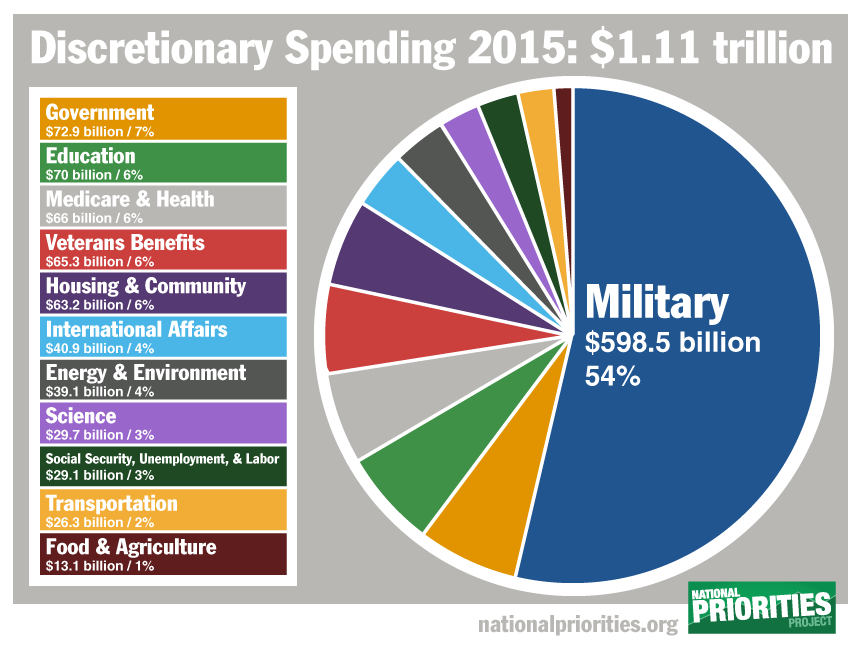
    capitol_moneyBut where, exactly, is the waste?  In fiscal 2015, the federal government engaged in $1.1 trillion of discretionary spending, but relatively small amounts went for things like education (6 percent), veterans’ benefits (6 percent), energy and the environment (4 percent), and transportation (2 percent).  The biggest item, by far, in the U.S. budget was military spending:  roughly $600 billion (54 percent).  If military spending were increased to $690 billion and other areas were cut to fund this increase, the military would receive roughly 63 percent of the U.S. government’s discretionary spending.

    Well, you might say, maybe it’s worth it.  After all, the armed forces defend the United States from enemy attack.  But, in fact, the U.S. government already has far more powerful military forces than any other country.  China, the world’s #2 military power, spends only about a third of what the United States does on the military.  Russia spends about a ninth.  There are, of course, occasional terrorist attacks within American borders.  But the vast and expensive U.S. military machine―in the form of missiles, fighter planes, battleships, and bombers―is simply not effective against this kind of danger.

    Furthermore, the U.S. Department of Defense certainly leads the way in wasteful behavior.  As William Hartung, the director of the Arms and Security Project of the Center for International Policy, points out, “the military waste machine is running full speed ahead.”  There are the helicopter gears worth $500 each purchased by the Army at $8,000 each, the $2.7 billion spent “on an air surveillance balloon that doesn’t work,” and “the accumulation of billions of dollars’ worth of weapons components that will never be used.”  Private companies like Halliburton profited handsomely from Pentagon contracts for their projects in Afghanistan, such as “a multimillion-dollar `highway to nowhere,’” a $43 million gas station in nowhere, a $25 million `state of the art’ headquarters for the U.S. military in Helmand Province . . . that no one ever used, and the payment of actual salaries to countless thousands of no ones aptly labeled `ghost soldiers.’”  Last year, Pro Publica created an interactive graphic revealing $17 billion in wasteful U.S. spending uncovered by the U.S. Special Inspector General for Afghan Reconstruction.

    Not surprisingly, as Hartung reports, the Pentagon functions without an auditing system.  Although, a quarter century ago, Congress mandated that the Pentagon audit itself, it has never managed to do so.  Thus, the Defense Department doesn’t know how much equipment it has purchased, how much it has been overcharged, or how many contractors it employs.  The Project on Government Oversight maintains that the Pentagon has spent about $6 billion thus far on “fixing” its audit problem.  But it has done so, Hartung notes, “with no solution in sight.”

    The story of the F-35 jet fighter shows how easily U.S. military spending gets out of hand.   Back in 2001, when the cost of this aircraft-building program was considered astronomical, the initial estimate was $233 billion.  Today, the price tag has more than quadrupled, with estimates ranging from $1.1 trillion to $1.4 trillion, making it the most expensive weapon in human history.  The planes reportedly cost $135 million each, and even the pilots’ helmets run $400,000 apiece.  Moreover, the planes remain unusable.  Although the U.S. Marine Corps and the U.S. Air Force recently declared their versions of the F-35 combat ready, the Pentagon’s top testing official blasted that assertion in a 16-page memo, deriding them as thoroughly unsuitable for combat.  The planes, he reported, had “outstanding performance deficiencies.”  His assessment was reinforced in mid-September 2016, when the Air Force grounded ten of its first F-35 fighters due to problems with their cooling lines.

    U.S. wars, of course, are particularly expensive, as they require the deployment of large military forces and hardware to far-flung places, chew up very costly military equipment, and necessitate veterans’ benefits for the survivors.  Taking these and other factors into account, a recent study at Brown University’s Watson Institute for International and Public Affairs put the cost to U.S. taxpayers of the U.S. wars in Iraq and Afghanistan at nearly $5 trillion thus far.  According to the report’s author, Neta Crawford, this figure is “so large as to be almost incomprehensible.”

    Even without war, another military expense is likely to create a U.S. budgetary crisis over the course of the next thirty years:  $1 trillion for the rebuilding of the U.S. nuclear weapons complex, plus the construction of new nuclear missiles, nuclear submarines, and nuclear-armed aircraft.  Aside from the vast cost, an obvious problem with this expenditure is that these weapons will either never be used or, if they are used, will destroy the world.

    Wasted money, wasted lives, or maybe both.  That’s the promise of increased military spending.


    [Dr. Lawrence Wittner (http://www.lawrenceswittner.com) is Professor of History emeritus at SUNY/Albany.  His latest book is a satirical novel about university corporatization and rebellion, What’s Going On at UAardvark?]

  • Statement from the Holy See on Nuclear Abolition Day

    This speech was delivered by H.E. Archbishop Bernadito Auza, Apostolic Nuncio, Permanent Observer of the Holy See to the United Nations at the High-level plenary meeting to commemorate and promote The International Day for the Total Elimination of Nuclear Weapons in New York.

    Mr. President,

    bernadito_auzaThe Holy See fervently hopes that this annual commemoration of the International Day for the Total Elimination of Nuclear Weapons will contribute to breaking the deadlock that has beset the United Nations’ disarmament machinery for far too long now.

    In February 1943, two years and a half before the Trinity test, Pope Piu XII had already voiced deep concern regarding the violent use of atomic energy. After Hiroshima and Nagasaki  and  given  the totally uncontrollable and indiscriminate consequences of nuclear weapons, Pope Pius XII demanded the effective proscription and banishment of atomic warfare, calling the arms race a costly relationship of mutual terror. The Holy See has maintained this position ever since the advent of nuclear weapons.

    My delegation believes that nuclear arms offer a false sense of security, and that the uneasy peace promised by nuclear deterrence is a tragic illusion. Nuclear weapons cannot create for us a stable and secure world. Peace and international stability cannot be founded on mutually assured destruction or  on the threat of total annihilation. The Holy See believes that peace cannot be solely the maintaining of a balance of power. On the contrary, as Pope Francis affirmed, “Peace must be built on justice, socio-economic development, freedom, respect for human rights, the participation of all in public affairs and the building of trust between peoples.”

    Lasting peace thus requires that all must strive for progressive and concerted nuclear disarmament.

    The Holy See has been a Party to the Nuclear Non-Proliferation Treaty (NPT) since the very beginning, in order to encourage nuclear possessing States to abolish their nuclear weapons, to dissuade non-nuclear possessing States from acquiring or developing nuclear capabilities, and to encourage international cooperation on the peaceful uses of nuclear material. While firmly believing that the NPT remains vital to international peace and security and regretting deeply our collective failure to move forward with a positive disarmament agenda, the Holy See will continue to argue against both the possession and the use of nuclear weapons, until the total elimination of nuclear weapons is achieved.

    Indeed, the Holy See considers it a moral and humanitarian imperative to advance the efforts towards the final objective of the total elimination of nuclear weapons. Disarmament treaties are not just legal obligations; they are also moral commitments based on trust between States, rooted in the trust that citizens place in their governments. If commitments to nuclear disarmament are not  made in good faith and consequently result in breaches of trust, the proliferation of such weapons would be the logical corollary.

    For our own good and that of future generations, we have no reasonable or moral option other than the abolition of nuclear weapons. Nuclear weapons are a global problem and they impact all  countries and all peoples, including future generations. Increasing interdependence and globalization demand that whatever response we make to the threat of nuclear weapons be collective and concerted, based on reciprocal trust, and within a framework of general and complete disarmament, as Art. VI of the NPT demands. Moreover, there is the real and present danger that nuclear weapons and other arms of mass destruction would fall into the hands of extremist terrorist groups and other violent non-state actors.

    The 2030 Agenda for Sustainable Development calls upon all of us to embark on the implementation of the daunting ambition to better every life, especially those who have been and are left behind. It would be naïve and myopic if we sought to assure world peace and security through nuclear weapons rather than through the eradication of extreme poverty, increased accessibility to healthcare and education, and the promotion of peaceful institutions and societies through dialogue and solidarity.

    Mr. President,

    No one could ever say that a world without nuclear weapons is easily achievable. It is not; it is extremely arduous; to some, it may even appear utopian. But there is no alternative than to work unceasingly towards its achievement.

    Let me conclude by reaffirming the conviction that Pope Francis expressed in his December 2014 message to  the  President  of  the  Vienna  Conference on the Humanitarian Impact of Nuclear Weapons: “I am convinced that the desire for peace and fraternity planted deep in the human heart will bear fruit in concrete ways to ensure that nuclear weapons are banned once and for all, to the benefit of our common home.”

  • Media Advisory: ICJ to Deliver Judgments in Marshall Islands Nuclear Disarmament Cases

    cropped-nuclear_zero_lawsuits.jpgThe International Court of Justice (ICJ) has announced that it will read its judgments in the Marshall Islands’ nuclear disarmament cases against India, Pakistan and the United Kingdom on October 5 at 10:00 am local time in The Hague.
    The judgments will address the questions of jurisdiction of the Court and admissibility of the Application in the cases against India and Pakistan. In the case against the UK, the judgment will address the preliminary objections raised by the United Kingdom.

    For those who are able to travel to The Hague, information regarding media admission and accreditation is in this ICJ press release.

    While we have not received confirmation that the judgments will be live-streamed online, they likely will be, just as the oral arguments were last March.

    If you would like to interview members of the Marshall Islands’ legal team, please contact Rick Wayman at either +1. 805.965.3443, +1. 805.696.5159 or rwayman@napf.org.

  • 2016’s Winning Poems

    2016 Poetry Contest

    The following poems were selected as the winners of the Nuclear Age Peace Foundation’s 2016 Barbara Mandigo Kelly Peace Poetry contest. For more information about this annual contest, visit www.peacecontests.org. Click here to read the winning poems from all years of the contest.

    Fishbone Hair
    by Kathy Jetnil-Kijiner
    Adult Category, First Place

    I.
    Inside my niece Bianca’s old room I found two ziplocks stuffed. With rolls and rolls of hair.
    Dead as a
    doornail black as a tunnel hair thin. As strands of tumbling seaweed. Maybe it was my sister.
    Who
    stashed away Bianca’s locks so no one would see trying to save that rootless hair. That hair
    without a
    home.    It all
    fell out.

    II.
    The marrow should have worked. They said she had six months to live.

    III.
    That’s what doctors told the fishermen over 50 years ago while they were out at sea. Just miles
    away from
    Bikini. The day the sun exploded.

    IV.
    There is an old Chamorro legend that Guahan was once attacked. By a giant monster fish. The
    women,
    guided by their dreams, hacked off their hair. Wove their locks into a massive magical net. They
    caught
    the fish. They saved their islands.

    V.
    Thin, rootless
    fishbone hair
    black night   sky               catch    ash
    catch      moon                  catch
    stars
    for you Bianca
    for you


    What a Time to Be Alive
    by Jocelyn Chambers
    Adult Category, Honorable Mention

    death taught me how to dress.
    it says “not that one, these shoes instead, a little less vibrant and a little more docile, more
    humility, less confidence.”
    death taught me not to wear hoodies, to keep my head uncovered, to wear light colors
    instead of dark because i am dark enough already
    to buy a belt for every pair of pants i own, better yet, to not wear pants,
    death taught me how to do my hair, it says “less coil, more common, straighter, longer,
    thinner,” it burns my scalp and hands me a comb and says “isn’t it nice to run your
    fingers through it now,”
    death taught me who to like, what music to listen to, how to keep people comfortable,
    how to walk; “don’t limp, straight shoulders, but stay smaller than them,”
    it taught me my vocabulary, all of the big words that earn me awards such as ‘articulate,’
    ‘not like the rest of them,’ ‘a good one,’
    death is always telling me to be less, less african, more american, a welcome addition, a
    token, to lay myself bare and strip myself of any weapons, any threats
    death is an x-ray machine, and says if i do anything wrong, it will come
    as if i’m not dying to myself already
    death says “what a time to be alive.”
    because in this country, white is invisible.


    An incident at the bridge of no return
    by John B. Lee
    Adult Category, Honorable Mention

    in an assignment
    involving a clear view
    the young lieutenant
    was trimming a particular poplar tree
    so the Americans
    might observe without obstruction
    the deployment and movement
    of enemy guns, and
    training his axe
    on the aspen with its shivering leaf
    looking north to the bridge of no return
    he fell from a fatal blow to the brain from behind
    the cold tool blunting his last thought
    like the dark wedge
    where the burnt Y of the barkless trunk
    remains with its blackened knot
    like a blind eye fastened at the fork
    of two branches
    it stands there
    a scorched post crowned in rot
    with us living on
    in such a ridiculous world
    in the sad significance of risible things
    where what matters most
    seems valued least
    and what matters least
    is conserved
    in the chiseled knowing of stone


    For Nyakier
    by Allison Huang
    Youth Category (13-18), First Place Tie

    “Even if you die in the water, it’s better to be killed by snakes or crocodiles than
    by soldiers”
                                                                   –  Nyakier Gatluak, South Sudan (from NYT)

    On our way home, we roll over a hill & a deer
    leaps in front of the car
    loses its balance
    gracefully, not unlike a man
    heaves into a woman.

    The corpse lists on the asphalt like
    a body in a dark current, her belly still pulsing with
    something warm & vaguely fawn-like.
    A life within
    a life.

    I know children who leap into
    crocodile-infested waters to keep
    from knowing men. I know a boy
    who was born against a field of red

    petals,
    himself opened up. Who could name
    every curve of the gun, slept with it
    under his neck, a clay reminder dissolving

    the way a scream dissolves
    into a current.

    Tell me how to bring a child into a world where
    the river claims the boy who would rather face
    the teeth of a beast than face his older self.

    The water swells over him
    as a mother’s round stomach swells with a seed.

    So many poppies
    in the field, seeping against the blank
    bits of sky,
    poppies that are as dark
    as mouths.


    An Open Letter to the Bullet That Shot My Brother
    by Matthan Sutton
    Youth Category (13-18), First Place Tie

    Dear Bullet,

    You are not to blame, and it took me time to see but the way that you
    Scream through the air is similar to the way that he
    Screamed as the man in green pulled the trigger:
    Involuntarily.

    And your life must not have been easy either, a raindrop of molten
    Metal pounded to proliferate Man’s purpose in the world through
    Tightly packed and popped pistols in dark alleys and
    War valleys and demonstration rallies in countries where people are silenced
    Through violence and, to be the toy Men use when they
    Don’t get their money or their oil or their way in the world they built themselves. It
    Must be hard to fly for them. To stream through the sky only to
    Fall with the body you killed for them.

    When my brother came home he was
    Zipped up in a bag built for bodies and I find it funny that the zipper sealing
    Him in was made from the same metal as the object that
    Sealed his fate. And I find it funny that you were blamed when the zipper did just
    As much to hold him in the grips of sleep.

    I think, Bullet, that we hate you because blaming ourselves is too
    Hard to do. Because bullets flying are the justification for more bullets and if we blame the
    Object we can ignore the push. If we blame the bullet. The Barrel. The powder. The hammer.
    The trigger. The soldier. The war. The government. The “Man”.
    If we blame the fire we can ignore the match: our hate.

    I forgive you, even though you have nothing to apologize for,
    And even though I never actually met my brother
    And even though I never knew his name
    And even though he was American and I am Iranian
    I forgive you Bullet, for screaming.


    Me and You
    by Kiran Treacy-Hind
    Youth Category (12 and Under), First Place

    The world talks to me in my head and birds chirping in the wind and the sun shining on my face.
    Dogs looking for their bones, while I see beauty in every face.
    The world brings us together,
    it moves as slow as a sloth.
    People live in different ways, treat them the same way.
    The world has so many mysteries
    that no one knows and may not find.
    We all have two shadows inside us, but it helps us, it finds who we are, in this place where
    people live and die, and will never find why they were born.
    The world brings us together, like a mother and her child.
    It moves us, helps us, and cares for us. So why are we killing the earth, if we help it,
    it will grow so we can grow.
    We may feel helpful to poor children,
    We may be helpful to people that
    have been bullied and all sadness all
    hate will wash away, as the sun shines
    on the water, as the birds fly in the
    wind and never stop seeing beauty.


    I Remember
    by Inica Kotasthane
    Youth Category (12 and Under), Honorable Mention

    I remember those days,
    When I was a young, innocent child.
    I never had understood what was going on,
    For those long, dark six years.

    It first started with the radio,
    My parents chatting nervously,
    While rushed reports were heard on
    That old ‘speaking box.’

    Then, the noises came.
    They would awake me in the middle of the night.
    The whooshing of airplanes flying overhead,
    And mother closing those dark curtains.

    Those days father refused for mother and I
    To go outside onto the streets.
    I used to be so happy because I wouldn’t go to school,
    But little did I know about the real reason.

    When dinner was scarce,
    And I ate every last crumb of bread.
    When I looked out the window to see
    Poor humans being beat to death.

    I remember those days not as clearly,
    As I did back then.
    And even after all these years,
    I still wonder why a person would do that to another.

    Why do we do this to one another,
    Are we animals: predators and prey?
    We must find a way to get together,
    And see where peace has gone.